

Houston Independent School District is moving deeper into the 2026–27 school year with another major change at the top of its leadership structure.
Deputy Superintendent Kristen Hole has announced her resignation, becoming the third high-level departure from Superintendent Mike Miles’ cabinet in roughly two months. Hole said she is leaving to reunite with her family after they relocated out of state in the spring. She had continued traveling between her new home and Houston while helping launch several of HISD’s major programs for the new school year.
The timing is significant because Hole was closely involved in several initiatives now being implemented across Houston schools. Her responsibilities included the district’s special education overhaul, new AI-focused Future 2 schools, early-literacy initiatives and the creation of a transitional “kinder bridge” grade.
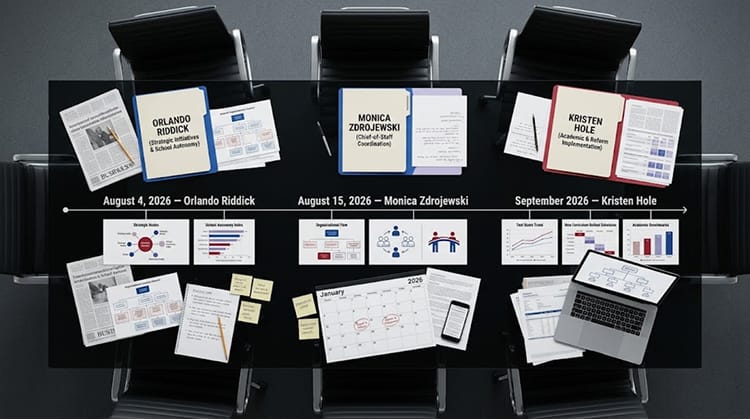
Her departure comes after the August exits of Orlando Riddick, the former chief of strategic initiatives, and Monica Zdrojewski, the former chief of staff. Together, the changes affect several senior positions responsible for carrying out the district’s broader transformation.
Kristen Hole Leaves After Helping Launch Major 2026-27 Programs
Hole joined HISD shortly after the state appointed Mike Miles to lead the district in 2023. She initially served as chief academic officer before Miles created the deputy superintendent position for her in February 2026.

Her background included work at the Texas Education Agency and consulting experience before she moved into HISD leadership. During her time in Houston, she became closely associated with some of the district’s most significant academic and instructional initiatives.
HISD said Hole’s family relocated out of state in the spring, but she continued traveling to Houston because she wanted to help the district launch its new programs at the beginning of the 2026–27 academic year.
Superintendent Mike Miles credited Hole with helping move those initiatives from planning into implementation and described her decision as a personal choice to be with her family. HISD has not announced a replacement or provided a final departure date.
The district’s leadership structure shows how broad the senior administrative organization is, with separate executives responsible for academics, schools, facilities, finance, technology, human resources, communications and other areas.
That structure makes the continuity of individual programs important even when the superintendent remains in place.
Hole Was Closely Involved In The Special Education Overhaul
One of the most consequential initiatives associated with Hole has been HISD’s restructuring of special education services.
The program launched during the 2026–27 school year and involved relocating approximately 1,600 students with disabilities to different campuses. HISD said the changes were intended to create smaller, age-aligned classrooms and improve teacher-student ratios.
The implementation has generated both reported improvements and significant concerns.
HISD recently said that after five weeks, the percentage of multi-grade special education classrooms had fallen from more than 50% to below 25%. The district also reported new curriculum materials, staff training and classroom changes intended to support the new model.
But the transition has also required extensive logistical adjustments.
The district modified more than 1,000 individualized education programs, processed 310 transportation amendments and added 40 bus routes during the rollout. Nine complaints have been formally filed with the Texas Education Agency, according to recent reporting.
The changes are occurring under continuing state and federal scrutiny. That makes leadership continuity particularly relevant because the program is still in its early implementation phase.
For students and parents, changes in special education can affect transportation, classroom placement, instructional services and the location where a student receives support.
Future 2 Schools Bring Artificial Intelligence Into The Reform Strategy
Hole also played a role in the launch of HISD’s new Future 2 schools, a program developed around the changing role of artificial intelligence in education and employment.
Nine HISD campuses joined the Future 2 program for the 2026–27 school year. Students spend the morning focused on core academic subjects and the afternoon working on hands-on, screen-free activities intended to develop skills that remain valuable in an increasingly AI-driven environment.
The program represents a different type of academic experiment from the district’s special education restructuring.
Instead of concentrating primarily on how schools organize existing services, Future 2 is designed around how students may need to learn in the future.
That means implementation will depend on curriculum design, teacher preparation, scheduling and the district’s ability to evaluate whether students are developing the intended skills.
Leadership changes during the first year of a new program can therefore create an additional transition for administrators responsible for monitoring its rollout.
HISD’s September board materials also show that the district continues to monitor progress on its academic constraints and performance measures. The Board of Managers accepted an update on September 10, 2026, covering two major constraints and associated progress measures. (HISD board monitoring update)
Early Literacy Is Another Area Affected By The Transition
Hole’s responsibilities also included HISD’s early-literacy initiatives.
One of the new programs is a “kinder bridge” transitional grade intended to provide additional support to young students who are behind in reading. The district has also been preparing for a potential reading benchmark that could eventually be required before students advance to third grade.
That potential requirement would not take effect automatically. The Houston Chronicle reported that the district may require students to meet a reading benchmark by 2028, but the Board of Managers would need to approve the change first.
The initiative reflects a larger focus on early literacy within the district’s reform strategy.
Reading proficiency in the early grades can influence later academic performance, making the years between kindergarten and third grade particularly important for intervention.
For HISD, the challenge now is maintaining the instructional direction while senior leaders responsible for designing and implementing those initiatives change.
The Departure Follows Two Other Senior Exits
Hole’s resignation is the latest in a sequence of changes among HISD’s senior administrators.
Orlando Riddick, who served as chief of strategic initiatives, left the district effective August 4, 2026, after three years with HISD. Riddick joined the district on June 1, 2023, shortly after Miles was selected to lead the state intervention. He later became responsible for the superintendent’s school autonomy initiative.
The autonomy initiative allows certain HISD schools to work with outside nonprofit organizations to gain greater operational control. Riddick helped oversee partnerships involving four high-performing high schools and community prekindergarten centers.
His departure was followed by that of Monica Zdrojewski, who served as HISD’s chief of staff. Zdrojewski left on August 15, about 11 days after Riddick’s departure. Her responsibilities included coordinating across the leadership team, supporting the superintendent and overseeing performance management, accountability and strategic initiatives.
Zdrojewski’s annual salary was reported at approximately $245,000. HISD appointed Deputy Chief of Staff Caitlin Butler, whose salary was reported at approximately $230,000, as interim chief of staff.
Hole’s base salary was reported at $310,000 before her resignation.
The departures do not by themselves establish why the leadership changes occurred beyond the reasons publicly provided for individual cases. Hole’s departure was explicitly attributed by the district to her decision to reunite with her family.
Leadership Continuity Matters Because The Reforms Are Still New
HISD’s leadership structure has changed several times while many of its largest reforms are still being implemented.
Hole became deputy superintendent only in February. Riddick’s school autonomy work was still developing when he left in August. Zdrojewski’s chief-of-staff position also covered strategic initiatives and performance management.
This does not mean that the programs will stop.
Large school districts generally distribute responsibilities across multiple administrators, and HISD’s leadership structure includes chiefs overseeing different operational areas. However, transitions at the executive level can affect who coordinates projects, how decisions move through the organization and who communicates changes to principals and families.
That becomes especially important when several programs are being launched simultaneously.
| HISD Leadership Change | Position | Timing | Major Area Of Responsibility |
|---|---|---|---|
| Kristen Hole | Deputy Superintendent | Resignation announced Sept. 17, 2026 | Special education, Future 2, literacy initiatives |
| Monica Zdrojewski | Chief of Staff | Left Aug. 15, 2026 | Leadership coordination, accountability, strategic initiatives |
| Orlando Riddick | Chief of Strategic Initiatives | Left Aug. 4, 2026 | School autonomy and strategic partnerships |
The district has not announced a permanent replacement for Hole, while the search for a new chief of staff was already underway after Zdrojewski’s departure.
The Special Education Investigation Adds Pressure To The Transition
HISD’s special education changes have received scrutiny from both state and federal authorities.
Houston Public Media reported that the Texas Education Agency found the district in violation of the rights of students with disabilities in July and ordered corrective actions that HISD must complete by October. The changes have also prompted a federal civil rights investigation.
The district has maintained that the restructuring is intended to improve educational conditions for students with disabilities by creating smaller, age-aligned classrooms and providing more targeted support.
Parents and disability advocates have raised concerns about transportation, disrupted routines, changes in campus placement and the way the transition was implemented. Recent reporting shows that families have had mixed experiences during the first weeks of the new model.
Hole’s departure therefore occurs while the district is still responding to questions about one of its most significant student-service changes.
The next leadership team will inherit both the program itself and the responsibility for addressing the outstanding corrective actions.
HISD Is Also Preparing For An AI-Focused Future
Artificial intelligence has become another major component of HISD’s longer-term strategy.
The Future 2 program is one visible example, but AI also appears in the responsibilities assigned to the district’s senior leadership. When HISD posted its chief-of-staff position, the job description included strategic initiatives connected to schools preparing students for a future shaped by artificial intelligence.
This creates an unusual combination of short-term and long-term reform priorities.
The district is simultaneously working on early literacy, special education, school autonomy, AI-focused learning and broader academic accountability.
Each program requires coordination between central administrators, principals and teachers.
The leadership changes therefore arrive at a point when the district has many initiatives moving at the same time.
For students, the most visible effects will occur inside schools rather than in administrative offices. Changes in classroom schedules, instructional materials, special education placements, transportation and new learning models will determine whether families experience the reforms as intended.
That makes implementation more important than organizational charts alone.
What Happens Next Will Depend On Leadership Continuity
HISD has not announced when Hole will officially leave the district or who will replace her. The district also continues to search for a permanent chief of staff following Zdrojewski’s departure.
Meanwhile, the programs Hole helped launch are already operating.
Students have entered Future 2 schools. Special education placements have changed. New literacy initiatives are underway. District leaders are monitoring academic performance measures through the Board of Managers.
The immediate issue is therefore continuity.
HISD does not have the option of waiting for leadership positions to be filled before its academic programs continue. The 2026–27 school year is already underway, and principals, teachers, families and students are operating within the new structures.
The district will have to maintain communication and implementation while senior responsibilities are reassigned.
Houston Students Will Experience The Next Phase At Campus Level
The latest leadership changes are ultimately important because they intersect with reforms that directly affect students.
Kristen Hole’s resignation does not erase the programs she helped launch. The Future 2 schools continue operating. The special education restructuring remains in place. The kinder bridge initiative continues, and HISD’s broader academic accountability work remains active.
But the transition puts new administrators in the position of maintaining those programs, evaluating early results and addressing problems identified during implementation.
For families looking for broader Texas youth education coverage, Youth Rise Texas provides additional reporting on school districts, student programs and education developments across the state.
HISD’s leadership structure will continue to evolve, but the effects of those changes will be measured most clearly through what happens in classrooms. Attendance, literacy progress, special education services, student achievement and the day-to-day experience of Houston families will provide the longer-term evidence of how successfully the district’s reforms move from administrative plans into sustained school practices.
The next several months will therefore be less about the number of executive positions changing and more about whether the district can maintain consistent implementation while those positions are being filled and reassigned.