

Houston Independent School District is entering another pivotal school year with two major realities moving in opposite directions. The district has reported academic improvements at some campuses under the state-appointed leadership of Superintendent Mike Miles, while enrollment has continued to fall at a pace that is putting pressure on the district’s finances.
A new analysis by The Texas Tribune found that HISD has lost about 21,000 students since the state takeover began in June 2023. Because Texas public schools receive much of their state funding based on student attendance, the enrollment decline translates into an estimated $190 million reduction in state funding over the first three years of the takeover. At the same time, the district has spent millions implementing the New Education System, including additional staff, higher teacher compensation, longer school days and new classroom technology.
The numbers create a complicated picture for Houston families. Some schools have posted significant academic gains, while other campuses have experienced sharp enrollment losses. The central question is becoming less about whether HISD can change schools and more about whether the district can sustain those changes while serving fewer students and operating with less state revenue.
Houston ISD Has Lost 21,000 Students Since The Takeover
HISD was already experiencing enrollment pressure before the state took control of the district in 2023. Like many large urban school systems, Houston has been affected by declining birth rates, changes in immigration, competition from charter schools and families choosing private or alternative educational options.
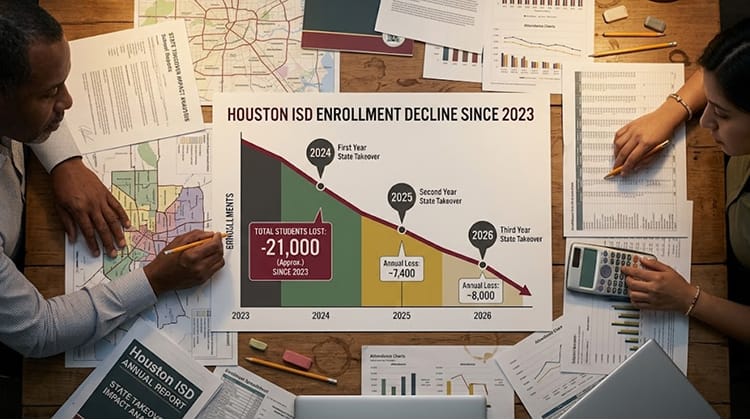
But the pace of the decline has changed.
According to The Texas Tribune’s September 21 analysis, HISD lost approximately 5,800 students during the first year of the takeover, 7,400 during the second year and nearly 8,000 during the third. That brought the cumulative decline to roughly 21,000 students. The rate of loss has also accelerated during each year of the takeover.
Earlier Houston Chronicle analysis of Texas Education Agency enrollment data found that HISD’s enrollment had been declining by approximately 2% annually during the five years before the takeover. Since the takeover began, the district’s annual decline has been closer to 4%. The sharper losses have been particularly visible at campuses participating in the New Education System, or NES.
The distinction matters because enrollment is more than a headcount. In Houston, fewer students affect staffing allocations, transportation, classroom organization, campus utilization and the amount of state funding available to the district.
Families have also made decisions that show enrollment changes are not simply the result of people moving away from Houston. The Texas Tribune reported that many students leaving HISD have moved into nearby charter schools, including YES Prep Public Schools and KIPP Texas Schools. Other families have changed neighborhoods or school districts specifically to attend different schools.
For families researching Houston’s changing school landscape, HISD enrollment data provides an important reference point for understanding how individual campuses fit into the larger district trend.
The New Education System Requires Significant Investment
The academic transformation launched under Miles is centered on the New Education System, a model that has expanded to roughly 130 HISD campuses.
The model uses several strategies intended to raise student achievement. Campuses can receive additional instructional support, learning coaches, higher teacher salaries, longer instructional schedules and new technology. Lessons are more standardized, while educators in participating schools operate under a different structure than traditional HISD campuses.
At Fonville Middle School in north Houston, for example, the transformation has coincided with a major change in the school’s accountability rating. The campus went from an F rating before the takeover to an A rating in the latest state accountability results cited by the Tribune. The school has added learning coaches, technology and longer school days as part of the reform model.
Those changes, however, carry a substantial price.
HISD budget documents analyzed by the Tribune estimate that implementing the reforms costs approximately $700,000 more per NES campus during the first year. After that, the additional expense works out to about $2,200 more per student at those campuses.
At roughly 130 schools, those additional expenses represent a significant recurring commitment. The district therefore faces a financial equation in which it is attempting to spend more per student on selected reforms while simultaneously serving fewer students overall.
That creates a challenge that cannot be measured through test scores alone.
Enrollment Losses Are Also Reducing State Revenue
Texas public schools rely heavily on enrollment and attendance in the state’s school finance system. When students leave, districts generally lose funding associated with those students.
For HISD, the effect has become substantial.
The Texas Tribune calculated that the district experienced approximately $190 million less in state funding during the first three years of the takeover as a result of the enrollment decline.
That amount is large enough to influence decisions across the district. HISD cannot simply continue adding expenses for academic reforms without accounting for the smaller revenue base created by enrollment losses.
The district has responded by cutting costs in other areas.
According to the Tribune, HISD eliminated roughly 1,500 central-office positions, more than 200 wraparound specialist positions and 85 bus routes during the first years of the takeover. These reductions helped free recurring dollars for other priorities, but they also changed services and staffing structures available to students and families.
The tradeoff is especially important in a district serving a large population of economically disadvantaged students. Wraparound specialists, transportation routes and other support services can affect whether students are able to attend school consistently and access resources outside the classroom.
This means the financial story is directly connected to the student experience.
The District Is Spending More While Cutting Elsewhere
HISD’s strategy has therefore involved two simultaneous moves: investing heavily in selected academic initiatives while reducing spending in other parts of the organization.
The district’s financial position had already been under pressure before the latest enrollment figures were available.
A 2026 Houston Chronicle report said HISD expected to lose another 4,000 students and approximately $50 million in funding during the 2026-27 school year. The district planned roughly $35 million in central-office cuts and another $15 million in savings connected to school closures.
That forecast illustrates how enrollment decline can create a continuing cycle. Fewer students reduce revenue. Lower revenue creates pressure to reduce expenses. Some reductions can affect programs, transportation or staffing. At the same time, the district is trying to preserve funding for initiatives intended to improve academic outcomes.
The result is a district budget where every major decision has a student-level consequence.
| Indicator | Recent Figure |
|---|---|
| HISD enrollment lost since takeover | About 21,000 students |
| Estimated state funding reduction | About $190 million |
| NES campuses | About 130 |
| Additional first-year NES cost | About $700,000 per campus |
| Additional recurring NES cost | About $2,200 per student |
| Central-office positions eliminated | About 1,500 |
| Wraparound specialist positions eliminated | More than 200 |
| Bus routes eliminated | 85 |
The figures show why the sustainability question has become increasingly important. Academic reforms can require substantial upfront and recurring investment, but the district’s available revenue depends in large part on how many students remain enrolled.
NES Campuses Are Seeing Some Of The Steepest Enrollment Declines
The enrollment pattern becomes even more significant when campuses are separated by reform model.
The roughly 130 HISD schools participating in the New Education System have experienced some of the sharpest enrollment declines since the takeover. The Texas Tribune found that the steepest losses occurred among campuses receiving the most intensive intervention.
Houston Chronicle reporting has also documented the difference between NES and non-NES campuses. A 2025 analysis found that HISD’s overall annual enrollment decline increased from about 2% before the takeover to approximately 4% afterward, with NES campuses accounting for a substantial share of the change.
That does not establish a single cause for the enrollment losses.
Houston is experiencing several demographic and competitive changes simultaneously. Lower birth rates mean fewer children entering public schools. Charter school enrollment has expanded. Private-school options have become more significant, and changes in immigration patterns have affected urban school enrollment.
Still, the concentration of losses at some NES campuses has raised questions about whether the reform itself has influenced family decisions.
Parents interviewed by the Tribune have described dissatisfaction with aspects of the model, including frequent testing and changes to school culture. Other families have chosen different schools because of leadership changes, campus restructuring or dissatisfaction with specific reforms.
Those individual decisions become financially important when repeated across thousands of families.
Academic Gains And Enrollment Losses Can Happen At The Same Time
One of the most important aspects of HISD’s situation is that academic improvement and enrollment decline are not mutually exclusive.
A school can improve its test scores while losing students.
Fonville Middle School provides one example. Its move from an F to an A rating represents a major improvement in the state’s accountability system, while the district as a whole continues to lose students.
This distinction matters because school performance and school demand measure different things.
Academic ratings primarily evaluate student outcomes and other accountability indicators. Enrollment reflects family decisions, demographics, school options, neighborhood changes and perceptions of the educational experience.
For HISD, both measures now have financial consequences.
State leaders have pointed to academic improvements in Houston as evidence that state intervention can produce changes in struggling schools. Commissioner Mike Morath has described Houston’s reform approach as a potential model as other Texas districts face accountability problems. At least 14 Texas districts had campuses with four consecutive failing ratings in the preliminary 2026 results, putting them closer to potential state intervention under Texas law.
That makes HISD’s financial experience relevant beyond Houston.
If other districts adopt similar strategies, they will have to consider whether their budgets can absorb the additional costs, particularly if enrollment is simultaneously falling.
The Cost Of Losing Students Extends Beyond The Budget
Enrollment declines can also reshape the physical structure of a school district.
HISD has already faced significant campus utilization problems. A recent Houston Chronicle report found that more than 100 HISD schools were operating below 60% capacity, while some were below 50%. The district has also closed or consolidated campuses as it responds to declining enrollment.
Under-enrolled schools create difficult operational choices.
Buildings still require electricity, maintenance, security and basic upkeep even when fewer students occupy classrooms. Transportation routes may become less efficient. Staffing structures may need to change. Schools can lose the economies of scale that come with larger student populations.
For students, those decisions can mean longer transportation distances, new school assignments or the loss of familiar programs and community institutions.
HISD’s challenge is therefore broader than deciding which academic model produces higher test scores. The district must determine how many campuses it can realistically operate, which services should receive priority and how to allocate resources among schools with very different enrollment patterns.
Houston Families Are Experiencing A Changing School Market
The growth of charter schools adds another dimension to the story.
The Tribune found that a majority of students leaving HISD for another public-school option chose charter schools, including established Houston operators such as YES Prep and KIPP Texas.
That suggests at least some families are changing schools without necessarily leaving the Houston region.
For parents, school choice can involve academic ratings, transportation, school culture, specialized programs, extracurricular opportunities and the stability of campus leadership. When a district changes those conditions quickly, families may respond by exploring alternatives.
The effect is cumulative.
A campus that loses a small number of students may be able to adjust without major disruption. A campus that loses hundreds can face staffing changes and budget pressure. If dozens of campuses experience similar declines, the district itself must eventually reconsider its overall structure.
That is why HISD’s enrollment figures are becoming one of the most important measures of the takeover’s long-term impact.
The Special Education Changes Add Another Layer
The district’s transformation is also affecting special education.
In September, federal officials opened a civil rights investigation into HISD’s plan to relocate some students with disabilities into more centralized programs. HISD said the changes are intended to create smaller, age-appropriate classrooms and improve individualized instruction. The U.S. Department of Education’s Office for Civil Rights is examining whether the plan complies with federal requirements concerning educating students with disabilities alongside their nondisabled peers to the greatest extent appropriate.

The special education changes demonstrate how district-wide reforms can have very different consequences for different groups of students.
For some families, smaller classrooms and more specialized staffing may offer benefits. For others, changes in campus assignment, transportation or classroom placement can create significant disruption.
The issue is also a reminder that measuring the success of a district transformation requires more than one indicator.
Test scores, enrollment, graduation outcomes, teacher retention, transportation reliability, special education services and family satisfaction all tell different parts of the story.
The Sustainability Question Will Follow HISD Beyond The Takeover
Houston ISD’s state takeover began in 2023, but the financial and academic decisions made during the intervention will continue to affect the district after state-appointed leadership eventually ends.
That makes sustainability a central issue.
Superintendent Mike Miles has argued that HISD can maintain its academic improvements after the takeover by prioritizing spending and restructuring the district. He has pointed to reductions in central-office staffing and changes in teacher compensation as examples of decisions intended to redirect resources toward classrooms.
The counterpoint is that a district cannot sustain programs indefinitely if its enrollment and revenue continue to decline.
The next phase will therefore depend heavily on whether HISD can stabilize enrollment while preserving the academic improvements achieved at some campuses.
The district may also have to determine which parts of the NES model should remain, which programs can be funded at scale and how schools with dramatically different enrollment levels should be operated.
For students and families, those decisions will shape daily school life long after the headlines about the takeover fade.
Houston ISD Faces A Different Financial Reality In 2026
Three years after the state takeover began, HISD is operating in a much different financial and demographic environment.
The district has invested heavily in academic reform while losing roughly 21,000 students and an estimated $190 million in state funding. It has also eliminated thousands of positions and reduced services in an effort to offset some of the financial pressure.
At the same time, some campuses have recorded substantial academic improvements, giving state officials evidence they say supports the reform strategy.
Those facts can exist simultaneously.
The real test for HISD is whether academic gains can be maintained while the district adjusts to a smaller student population and a lower recurring revenue base. If enrollment continues to fall, the district will have fewer students across which to distribute fixed facility and administrative costs.
That could accelerate campus consolidation, staffing changes and program decisions.
Houston’s experience is therefore becoming a case study in a larger Texas education question: How does a school district sustain expensive academic reforms when the number of students it serves is shrinking?
The answer will affect far more than HISD’s balance sheet. It will determine how schools allocate teachers, support services, transportation, technology and classroom resources, and it will shape the educational options available to thousands of Houston students in the years ahead.
A broader look at Texas school enrollment trends can also help place Houston’s numbers within the larger demographic and educational changes affecting districts across the state.