
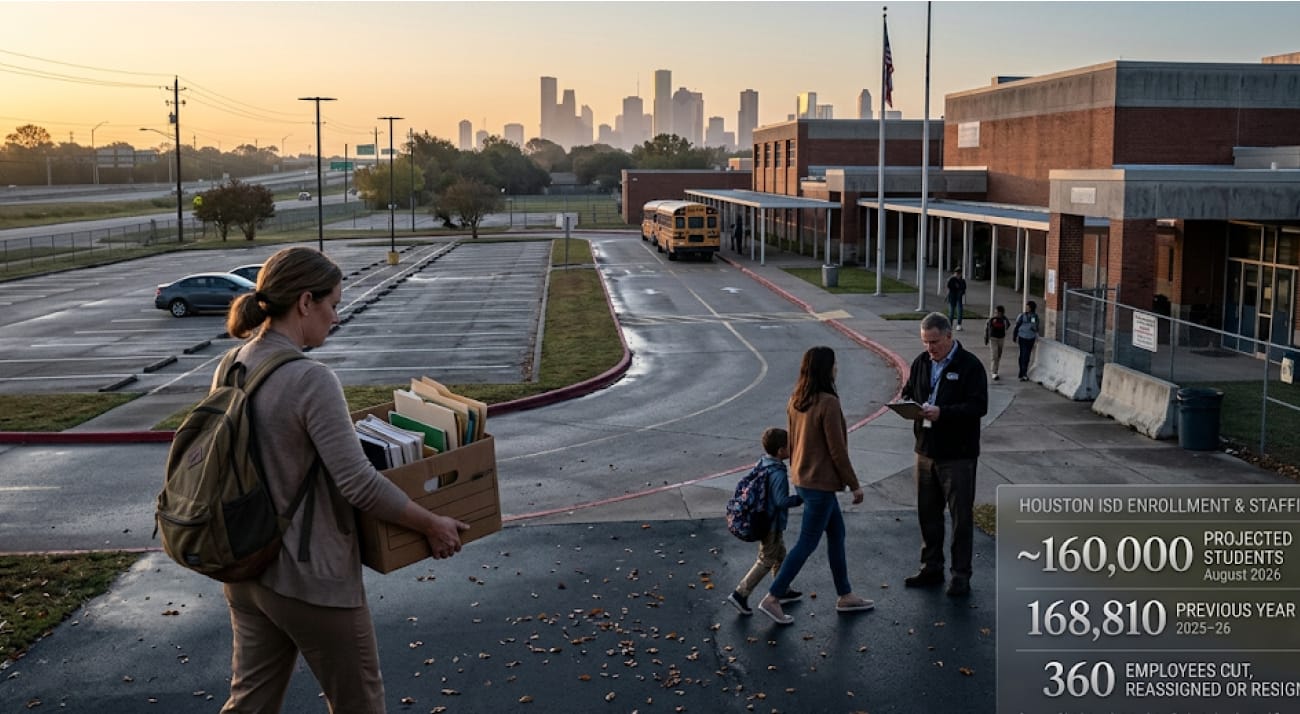
Houston Independent School District is making another major staffing adjustment after enrollment fell much further than district leaders expected, with at least 360 employees terminated, resigned or reassigned across campuses. The latest changes come as Superintendent Mike Miles projects that HISD will serve about 160,000 students during the 2026–27 school year, compared with approximately 168,800 students the previous year. The sharper decline is putting pressure on campus budgets, staffing levels and the programs available to students across one of Texas’ largest school systems.
The staffing changes are part of HISD’s annual “leveling” process, which adjusts personnel and resources according to student enrollment. According to reporting published Oct. 20, 2026, 160 employees had been let go as of Oct. 3, while another 12 had resigned and approximately 200 employees had been reassigned to different positions or campuses. The changes affected 101 schools.
For students and families, the issue is bigger than the number of employees leaving the district. A reduction in enrollment can change the size of classes, availability of electives, student support services, extracurricular opportunities and the number of adults available on a campus. In HISD, those decisions are also occurring while the district continues to implement the reforms introduced during the state takeover that began in 2023.
HISD’s Enrollment Loss Is Larger Than Its Budget Expected
HISD began the 2026–27 school year expecting enrollment to decline, but the size of the drop has exceeded the assumption used to construct the district’s budget.
The district had planned around an enrollment figure of approximately 164,812 students, representing a loss of roughly 4,000 students from the 168,810 reported in the October 2025 official enrollment count. Instead, Miles told the Texas Senate Education Committee on Oct. 6 that HISD had already passed 159,000 students in its latest count and expected the final number to settle around 160,000.
That would represent a decline of about 8,800 students from the previous year’s figure and more than twice the loss incorporated into the original budget assumptions.
The financial consequences are significant because Texas school funding is closely connected to student attendance. The Texas Education Agency’s school-finance system uses average daily attendance and other student counts in calculating state aid, while the agency periodically updates districts’ funding estimates as additional attendance data becomes available.
That means an enrollment decline is not simply a statistical problem for HISD. Fewer students can translate into less revenue available to operate schools, particularly when buildings, transportation, utilities and other costs cannot immediately shrink at the same rate.
For families, that financial pressure eventually appears in decisions about staffing and programming.
More Than 100 Schools Are Feeling the Staffing Pressure
The latest staffing adjustment reaches well beyond a handful of campuses.
HISD reported that 101 schools were affected by terminations, while approximately 200 employees were reassigned. Some employees moved into different positions at their existing schools, while others were sent to campuses with greater staffing needs. The district has described the process as necessary to align resources with current enrollment and maintain financial sustainability.
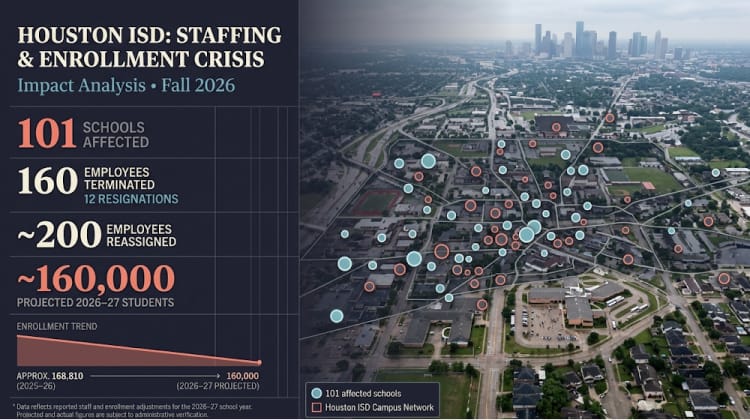
Some schools are experiencing especially visible changes.
Hilliard Elementary and Long Academy were among the campuses with the largest numbers of terminations after experiencing substantial enrollment declines. At other schools, the impact has involved individual teaching positions, administrative changes or adjustments to programs.
The staffing reductions are also occurring outside HISD’s New Education System campuses. Earlier reporting showed that both NES and non-NES schools were being affected by enrollment-related staff changes, demonstrating that the current problem extends across different types of campuses.
That distinction matters for families because it means the enrollment issue cannot simply be viewed as a problem affecting one particular school model. The district’s overall student count is driving a systemwide response.
For students, the practical effects will vary by campus. A reassignment could leave a school with a needed teacher arriving from another campus, while a termination could eliminate a position entirely. A reduction in one subject area could also affect electives or specialized programs even when core classroom staffing remains stable.
Campus Programs Are Already Being Adjusted
The staffing changes follow several weeks of budget reductions at individual HISD schools.
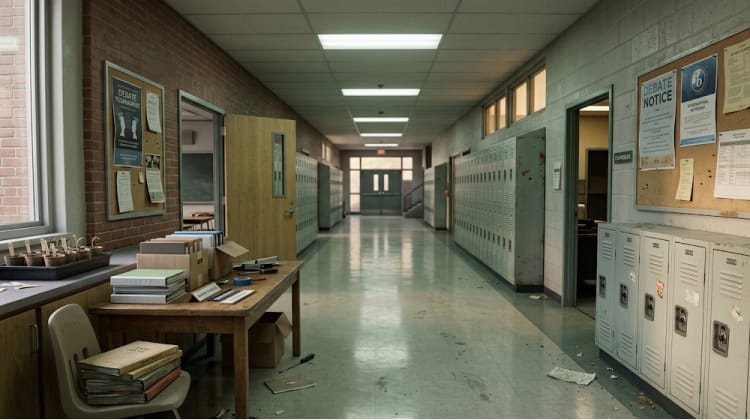
In September, HISD instructed campuses to reduce spending and adjust staffing because enrollment was running below expectations. Some schools reported changes affecting programs and services. At Lamar High School, for example, campus communications identified potential effects on choir, agriculture, debate, IB Career-related Programs, a pre-K partnership program and student support services. Carnegie Vanguard High School also eliminated an English teaching position.
Those examples illustrate why enrollment statistics matter to students.
A school does not simply remove an equal percentage of teachers every time enrollment falls. Administrators have to decide which positions remain essential, which vacancies can be left unfilled, which employees can be moved elsewhere and which programs can continue with smaller staffing levels.
That can create very different experiences from campus to campus.
A student at a school that loses 10% of its enrollment may see little immediate change if staffing remains relatively stable. Another student at a campus with a larger decline could see a favorite elective disappear, a counselor reassigned or a class schedule changed.
That makes the district’s staffing process an important part of the broader conversation about youth development in Texas.
The District Has Been Losing Students for Several Years
The latest decline is part of a longer enrollment trend.
HISD reported approximately 176,727 students in 2024–25 before enrollment fell to about 168,810 for 2025–26. The latter figure represented a decline of more than 7,900 students, or about 4.5%, in one year.
The Texas Tribune reported in September that HISD had lost approximately 21,000 students during the first three years of the state takeover, with enrollment coming in below district projections during each of those years. Its analysis also found that those losses had already reduced district revenue by an estimated $190 million before the newest round of cuts.
The reasons for declining enrollment are disputed and complex.
HISD officials have pointed to broader demographic trends, including lower birth rates, changing population patterns and shifts in where families choose to educate their children. The district also operates in a Houston education market that includes charter schools, private schools, homeschooling and alternative learning options.
Critics, meanwhile, have questioned whether changes made during the state takeover have contributed to families leaving HISD.
The enrollment numbers alone do not establish a single cause. They do show that the district has fewer students to serve than it did several years ago, and that the pace of decline has recently exceeded the assumptions used in its financial planning.
Why Enrollment Matters to Texas School Funding
The connection between enrollment and school finances is particularly important in Texas because districts must continually update their expectations about student attendance.
The Texas Education Agency opened its latest attendance-projection process on Oct. 15, 2026. TEA says school systems must consider local enrollment trends and other factors when developing projections for future state funding. Final payments are ultimately adjusted using actual attendance data reported during the school year.
For 2026–27, Texas also has a new attendance-reporting schedule under the state’s updated school finance framework. The first six weeks of attendance data were due to TEA on Oct. 9, with those figures scheduled to begin appearing in state finance estimates in November.
This creates a financial balancing act for HISD.
District leaders have to staff schools based on the students actually attending while also planning for potential changes during the year. Hiring too many employees can leave a district with costs it cannot sustain. Cutting too deeply can leave campuses without enough teachers and support personnel if enrollment rebounds.
That tension becomes particularly important in a district as large as HISD, where relatively small percentage changes represent thousands of students.
The 2026–27 Cuts Could Shape Student Experience
The immediate question for families is what happens inside classrooms after the staffing adjustments.
HISD has said the goal is to maintain educational quality while moving employees to campuses that need them. From the district’s perspective, reallocating personnel can be more efficient than maintaining the same staffing structure at schools that have lost students.
But staffing changes can still disrupt school communities.
Teachers may have to adjust to new assignments. Students may lose familiar staff members. Counselors and support personnel may be spread across different responsibilities. Clubs and electives may face staffing constraints. Schools may also have to reorganize schedules after the school year has already begun.
Those effects are especially important for students who rely on specialized academic or support programs.
At the same time, the district’s strongest-enrollment campuses may become destinations for reassigned employees if they have staffing shortages. In that sense, the leveling process can shift resources rather than simply eliminate them.
The distinction between a termination and a reassignment therefore matters. A reassigned teacher remains part of HISD’s workforce, but the change can still alter the relationship between that employee and the students previously served.
HISD Is Trying to Balance Reform With Financial Pressure
The staffing issue is unfolding alongside Mike Miles’ broader effort to transform HISD through the New Education System.
The state-appointed superintendent has argued that the reforms can remain financially sustainable as enrollment declines because the district can reduce purchased services and staffing while directing more resources toward classroom instruction. Miles told state senators in October that he remained confident in the sustainability of the reforms.
That position is being tested by the size of the enrollment decline.
Earlier Texas Tribune reporting found that the NES model can cost a campus significantly more during its first year of implementation and add substantial per-student costs in subsequent years. The Tribune reported that implementing NES cost about $700,000 for a campus during its first year and approximately $2,000 more per student in later years, based on its analysis.
If enrollment continues falling, HISD will have fewer students across which to spread fixed and reform-related expenses.
That does not automatically mean the model will fail. It does mean the district has less room for financial error.
What Houston Families Should Watch Next
The Oct. 31 enrollment snapshot will be an important benchmark because Texas districts use that date for their official fall enrollment reporting. The current estimate of approximately 160,000 students could change before the final count is established.
Families should also watch how individual campuses respond after the latest staffing decisions.
The most meaningful indicators will be visible at the school level: whether class sizes change, whether electives remain available, whether counseling and special education services maintain staffing, and whether reassigned employees fill vacancies at schools that need them.
The district’s financial reports will provide another important measure. If enrollment remains below the 164,812 figure used in the original budget, HISD will have to account for the additional gap between projected and actual revenue.
Houston’s experience also reflects a larger issue facing public education in Texas. TEA’s newest statewide attendance projections acknowledge that recent statewide average daily attendance declined and that districts must account for local enrollment trends when planning future finances.
For HISD students, however, the issue is much more immediate. Every staffing decision eventually reaches a classroom, a school program or a student who depends on that adult.
The latest 360-employee adjustment therefore represents more than another budget exercise. It is a visible sign that Houston ISD is being forced to reshape its schools around a student population that is shrinking faster than district leaders anticipated.