
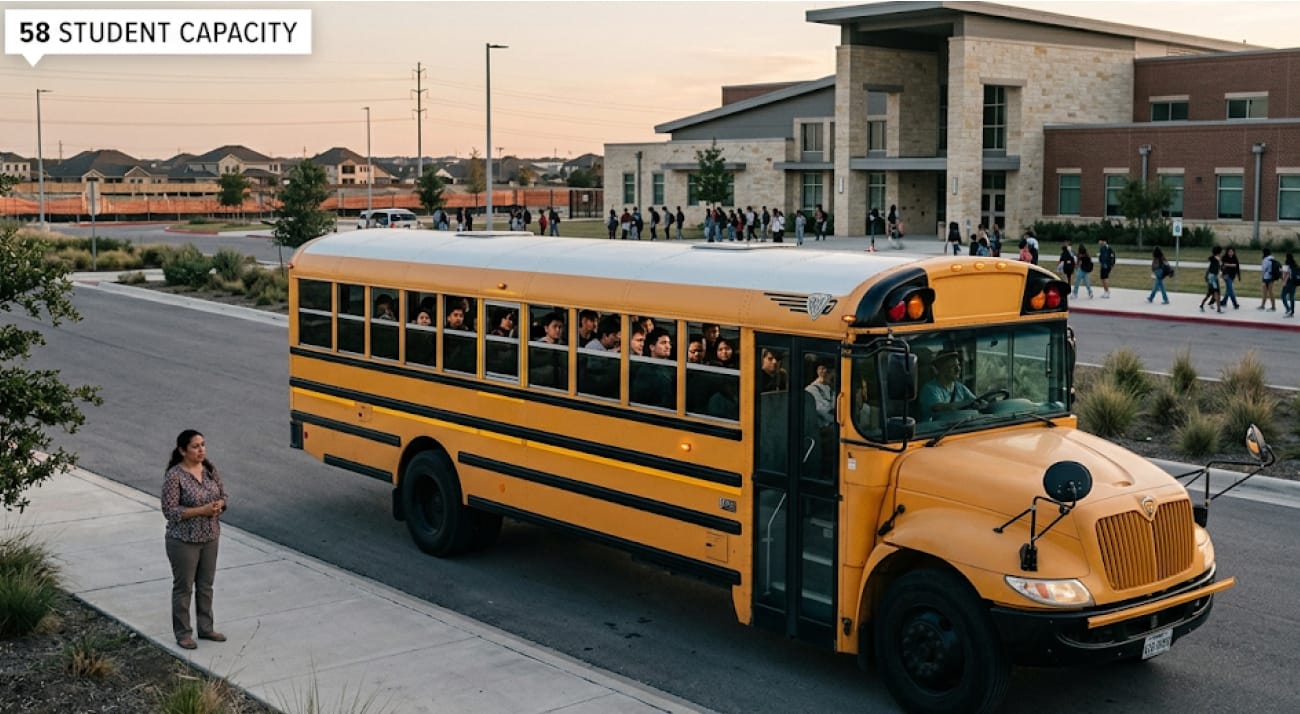
A Northside Independent School District bus route serving students from Harlan High School to the Redbird Ranch neighborhood in San Antonio has raised new questions about school transportation safety after a parent shared images appearing to show students sitting on the floor of a crowded bus.
The concerns surfaced publicly on September 30, 2026, when a Facebook post showing students inside the bus drew attention from parents and the wider San Antonio community. The route has a reported maximum capacity of 58 students, and parents said overcrowding has been a recurring concern rather than an isolated complaint. Northside ISD spokesperson Barry Perez confirmed that district officials were aware of the situation but said surveillance footage showed available seats at the time of the incident.
The disagreement puts the focus on a basic question for families: how should a school district respond when reported conditions on a student bus appear inconsistent with transportation rules?
Texas law provides a clear standard. Under Texas Transportation Code Section 545.426, a school bus cannot operate with more passengers than the manufacturer’s design capacity, and passengers may not stand or sit on the floor or in a location that was not designed as a seat.
Northside ISD has responded by implementing a seating chart for the route and reminding drivers of transportation policies. The district’s response addresses the immediate complaint, but the broader issue involves capacity planning, driver availability, route growth and the ability to consistently monitor transportation conditions during daily student commutes.
Parents Raised Concerns About Students Sitting On The Floor
The issue became public after a parent shared a photograph showing students apparently sitting on the floor of a Northside ISD bus serving the Redbird Ranch area.
According to reporting by the San Antonio Express-News and MySA, one parent said her daughter reported being on a bus where students were sitting on the floor because of limited seating. The parent also said students were told by the driver that photographs and videos were not permitted. Those claims come from the parent and student account and are separate from the district’s response.
Northside ISD spokesperson Barry Perez provided a different account of what happened.
Perez said district surveillance footage showed that seats were available at the time in question. The district nevertheless acknowledged the concern and said it had taken steps to reinforce seating procedures.
That distinction matters because the available reporting does not establish that students were routinely transported on the floor or that every trip on the route exceeded the legal capacity of the vehicle.
It does establish that parents observed or reported conditions they considered unsafe, that the district investigated the complaint, and that the district subsequently introduced a seating chart and reinforced its expectations with drivers.
For families, the dispute is significant because school transportation is one of the few parts of a student’s school day that occurs away from direct supervision by teachers and campus administrators.
Once students board a bus, the driver becomes responsible for operating the vehicle and maintaining order among the passengers. Seating capacity therefore becomes both a transportation issue and a student-safety issue.
Texas Law Prohibits Students From Sitting On The Floor
The legal standard governing the situation is unusually direct.
Texas Transportation Code Section 545.426 states that a school bus may not be operated when the number of passengers exceeds the manufacturer’s design capacity. The same section requires the bus operator to prevent passengers from standing or sitting on the floor or in another location that is not designed as a seat.
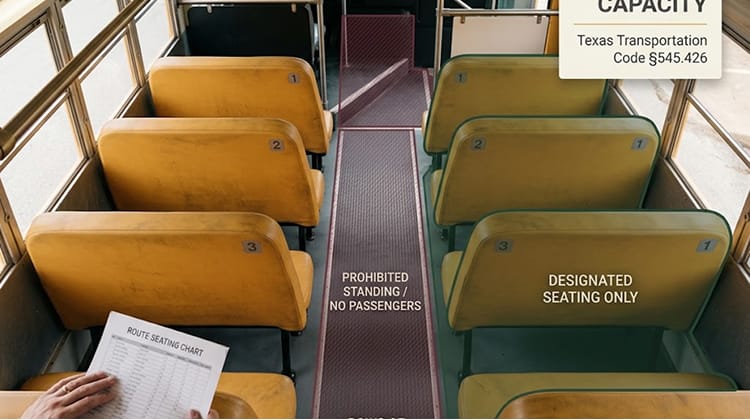
That means a bus reaching its maximum passenger capacity does not create permission for additional students to use the aisle or floor.
The law also distinguishes between the manufacturer’s design capacity and a driver’s judgment about how many students can physically fit inside the vehicle. A bus may appear to have additional physical space while still being at or beyond its legally applicable capacity.
| Transportation Question | Texas Standard |
|---|---|
| Maximum passengers | Cannot exceed the manufacturer’s design capacity |
| Standing passengers | Not permitted while the bus is operating |
| Sitting on the floor | Not permitted |
| Sitting outside a designated seat | Not permitted |
| Route in question | Harlan High School to Redbird Ranch |
| Reported bus capacity | 58 students |
The rule creates a straightforward operational responsibility for school districts: when the number of students assigned to a route approaches the available seating capacity, transportation departments need a plan that keeps every passenger within the designated seating area.
The situation also illustrates why capacity numbers alone do not tell the complete story.
A bus rated for 58 passengers does not necessarily mean every student will experience the same seating arrangement on every trip. Route changes, students boarding at different stops, absences, athletic schedules and daily attendance can change the number of passengers on a particular run.
That variability makes monitoring important.
The Redbird Ranch Route Has Faced Recurring Complaints
The current controversy did not emerge in isolation.
According to the recent reporting, concerns about overcrowding on the Redbird Ranch route have been raised repeatedly, with complaints dating back to at least 2018. Parents have questioned whether the district has enough transportation capacity to consistently serve students in the rapidly growing Far Westside area.
The geographic context is important.
The Far Westside of San Antonio has experienced substantial residential development, including neighborhoods surrounding major Northside ISD campuses. As communities grow, school districts have to adjust more than classroom capacity. Transportation routes must also expand or change to accommodate students living farther from campuses.
A route that worked several years ago can become less practical when housing development adds hundreds of families to the surrounding area.
That does not mean every complaint reflects a systemic failure. It does mean transportation departments have to continually compare route assignments against actual student demand.
Northside ISD’s current district website identifies transportation as part of its broader school operations and provides information for families alongside campus, athletics, school health and other student services.
The district’s current 2026–27 budget information is also publicly posted as part of its financial and administrative reporting, giving families a way to examine how transportation fits within the broader school system.
Bus Driver Availability Can Affect Route Capacity
Transportation capacity depends on more than the number of buses a district owns.
A district also needs enough qualified drivers to operate those buses on the required schedules.
The recent report on the Redbird Ranch route cited challenges Northside ISD faces in hiring and retaining bus drivers. Those staffing pressures can make route redesign more difficult because adding another run requires both an available vehicle and an available driver.
This creates a practical problem for large school systems.
If one route becomes overloaded, the simplest solution might appear to be adding another bus. But a second route requires a driver, a schedule, a vehicle, fuel, maintenance and coordination with the school dismissal schedule.
A district may therefore have to balance several competing transportation demands at once.
That is particularly relevant at the end of the school day, when hundreds of students may leave campus within a relatively short period.
A delay of only a few minutes on one route can affect subsequent departures, while a shortage of drivers can reduce the flexibility transportation administrators have when adjusting routes.
The result can be a system that technically operates within planned capacity most days but becomes difficult to manage when attendance spikes or routes change.
Seating Charts Are Northside ISD’s Immediate Response
Northside ISD said it has implemented a seating chart for the affected route and reminded drivers of transportation policies following the complaint.
A seating chart may appear to be a simple administrative measure, but it can give transportation staff a clearer way to identify how many students are assigned to each bus and where each student is expected to sit.
It can also help identify a problem before the bus leaves campus.
If the number of assigned students exceeds the available seats, transportation staff can theoretically identify the conflict before students begin boarding.
The approach also creates greater accountability.
A driver can verify whether students are remaining in assigned seating, while transportation administrators can compare the route’s planned passenger list with actual ridership.
For parents, that can be more useful than simply being told that the district is monitoring the situation.
A clear system allows families to understand how the district intends to prevent a repeat incident.
A Previous Northside ISD Bus Crash Adds Transportation Context
The concerns also come several months after another Northside ISD transportation incident.
On April 16, 2026, a Northside ISD bus was involved in a traffic collision near FM 1560 and Loop 1604 on San Antonio’s Far Northwest Side. Three elementary-aged students were aboard the bus, according to district officials. Northside ISD spokesperson Barry Perez said the students and the two drivers involved were assessed at the scene and that there were no injuries.
The April crash is not evidence that overcrowding contributed to that collision.
The incidents involved different circumstances, and there is no indication in the available reporting that the two events were connected.
However, the earlier incident demonstrates why transportation safety receives close attention from parents.
School buses operate in traffic every weekday carrying children who depend on trained drivers and established safety procedures. The goal of those systems is to reduce risks before an accident or other emergency occurs.
That makes seating capacity more than an administrative statistic.
Student Transportation Safety Extends Beyond The Bus
Northside ISD has also introduced transportation-related safety rules in other parts of its student programs.
For the 2026–27 school year, the district’s athletic travel policy requires student-athletes traveling to away contests to depart from Northside ISD on the team bus rather than meeting the bus elsewhere along the route. The district says the policy is intended to improve safety, accountability and supervision.
Although athletic travel is separate from daily school transportation, the policy reflects the same basic principle: keeping students under predictable adult supervision during transportation reduces uncertainty.
The district has also emphasized student safety in other policy areas.
For example, Northside ISD implemented restrictions on off-campus lunch for high school students after student pedestrian incidents near campuses prompted transportation and traffic-safety concerns. The policy was introduced as the district dealt with increased traffic density around several high schools.
These examples show that student transportation safety is broader than school buses.
Students travel between homes, campuses, athletic events and community locations throughout the school day. Each setting creates different risks, and districts have to establish procedures that account for those differences.
San Antonio Growth Is Increasing Transportation Pressure
The Redbird Ranch issue also fits into a larger challenge facing school systems in the San Antonio region: growth is changing where students live and how far they travel to school.
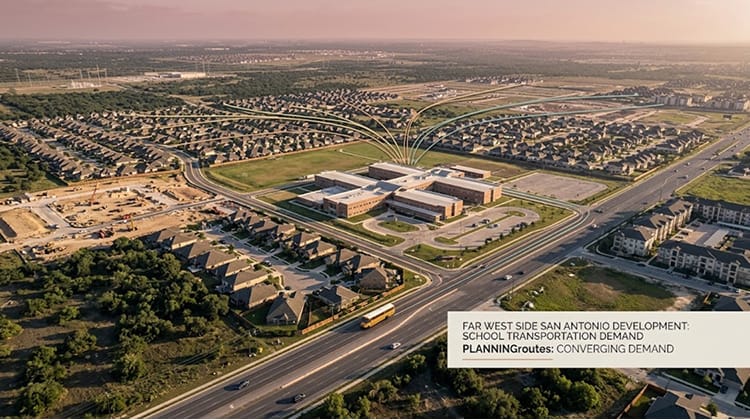
Northside ISD serves a large geographic area on the city’s western and northwestern sides. Its campuses include elementary, middle and high schools spread across communities with different development patterns.
When residential development expands into areas farther from established campuses, transportation routes can become longer and more complicated.
A route that serves a relatively concentrated neighborhood can be easier to operate efficiently than one that has to cover several subdivisions separated by major roads.
The problem can become particularly visible during afternoon dismissal.
Students may leave a high school at roughly the same time, while buses have to travel through traffic before returning for additional routes or completing their assignments.
The more students a route serves, the less flexibility there may be when a bus is delayed or a driver is unavailable.
That makes transportation planning an important part of school capacity planning.
What Parents Can Watch For
For families using Northside ISD transportation, the recent controversy provides several practical points to monitor.
Parents do not need to assume that every crowded-looking bus violates Texas law. A full bus can still operate legally if it remains within its manufacturer’s design capacity and all passengers are seated in designated locations.
At the same time, parents have a legitimate reason to report conditions that appear inconsistent with transportation requirements.
The most useful information can include:
- The bus route or campus involved.
- The approximate date and time of the trip.
- Whether students were standing or sitting outside designated seats.
- Whether the issue occurred repeatedly or on one particular trip.
- Whether the bus appeared to exceed its stated capacity.
Families can also use the district’s existing parent and student resources when raising concerns. Northside ISD maintains information on its website covering student resources, policies and district contacts.
The purpose of reporting should be to give transportation administrators enough information to identify a recurring operational problem.
That is especially important when a concern involves student safety.
The Bigger Question Is Whether Capacity Matches Growth
The Northside ISD controversy is ultimately less about one photograph than about how a large school district manages transportation demand.
The district says the affected bus had available seats according to surveillance footage, while a parent account and photograph raised concerns that students had been sitting on the floor. Those accounts have not been fully reconciled in the public reporting.
What is not disputed is that Texas law prohibits students from standing or sitting on a school bus floor while the vehicle is operating, and that the number of passengers cannot exceed the manufacturer’s design capacity.
Northside ISD’s decision to introduce a seating chart and reinforce transportation rules provides an immediate response.
The longer-term question is whether route capacity, bus availability and driver staffing are keeping pace with student demand in San Antonio’s growing communities.
That question matters beyond the Redbird Ranch neighborhood.
A school bus is part of the school system from the moment a student boards it in the morning until that student arrives home. For families, transportation reliability is therefore part of the educational experience itself.
Northside ISD’s response to the latest complaint will likely be measured less by the public debate surrounding one photograph and more by whether students consistently have a designated seat, whether routes remain within capacity and whether parents see the same concern disappear from their daily commutes.
For Northside ISD transportation, the immediate challenge is clear: ensure that the district’s transportation procedures work in practice every day, particularly on routes serving fast-growing neighborhoods where student demand can change quickly.
The Redbird Ranch complaints have put that responsibility into sharper focus for San Antonio families.