
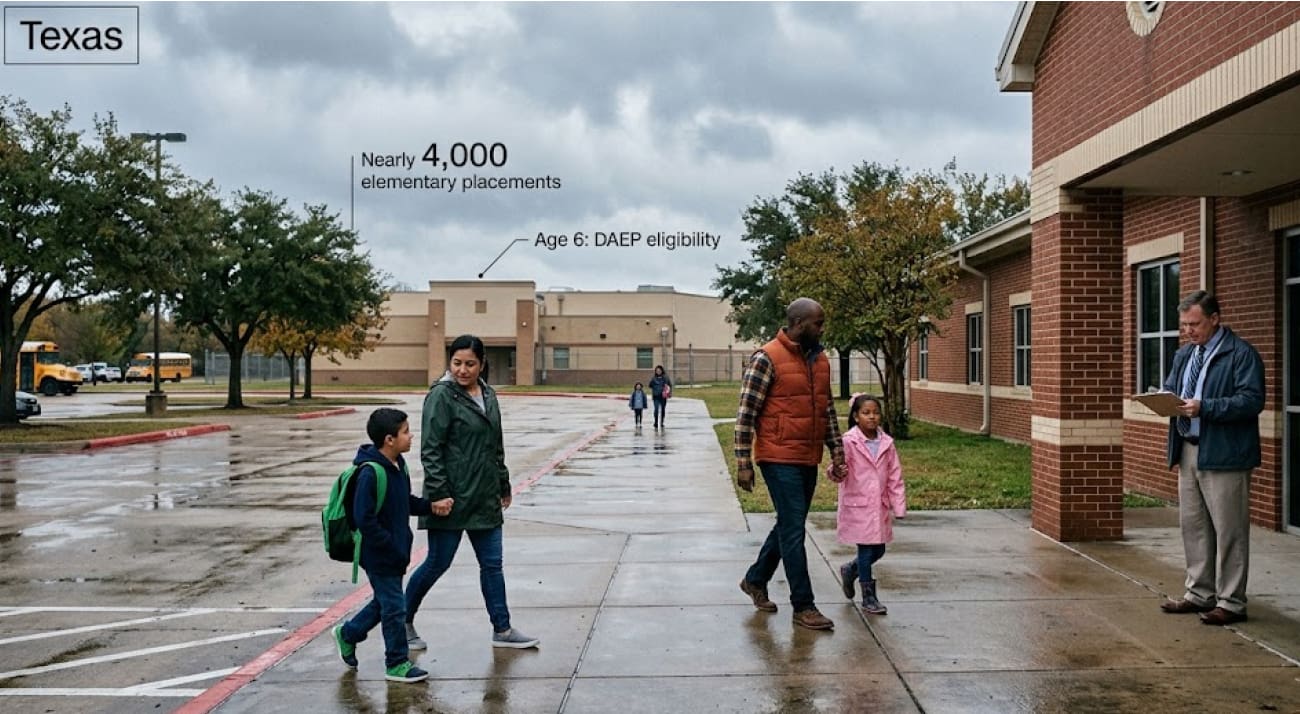
Texas law allows public school districts to place children as young as 6 years old into Disciplinary Alternative Education Programs, or DAEPs, a system originally established for students who commit serious disciplinary offenses.
A September 29, 2026 investigation by The Hechinger Report and The Texas Tribune has brought renewed attention to how the system is being used with elementary school students. State data show that nearly 4,000 DAEP placements involving elementary school students occurred in 2022–23, the most recent year for which the reporting found grade-level data available. The broader Texas DAEP system handles more than 100,000 student placements each year.
The issue is significant because disciplinary alternative campuses are fundamentally different from the regular elementary school environment. Students can spend weeks or months away from their home campus, often completing lessons in highly structured settings.
Texas Education Agency guidance states that a student younger than 6 generally cannot be removed from class and placed in a DAEP, except in a case involving a firearm. Once a child reaches age 6, however, state law does not establish a general upper limit on the use of DAEP placement based on age. Elementary students assigned to these programs must be separated from middle and high school students.
That creates a difficult question for families, educators and school administrators: how should schools respond when very young children display behavior that disrupts classrooms or creates safety concerns?
Texas DAEPs Were Created For Serious Discipline Cases
Disciplinary Alternative Education Programs have been part of the Texas public education system since the Legislature required school districts to establish them in 1995.
The programs were created to provide an educational setting for students who commit specified disciplinary or criminal offenses. Under Texas law, some DAEP placements are mandatory, while others are discretionary and depend on a district’s student code of conduct. The Texas Education Agency says districts must establish guidelines for the length of DAEP assignments and must separate elementary students from secondary students in these programs.
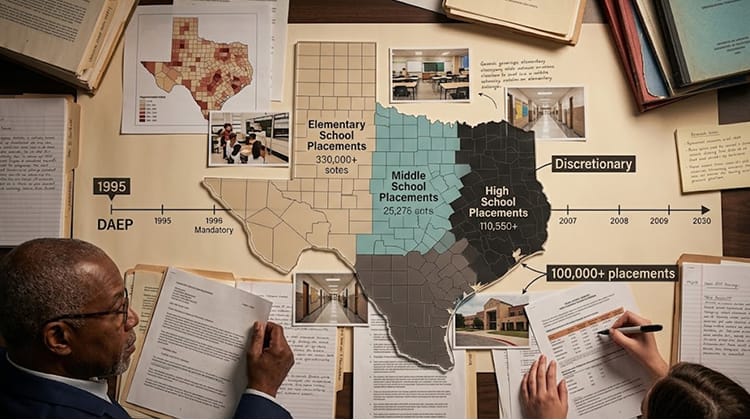
The original concept was therefore closely associated with serious student misconduct.
Over time, however, DAEP placements have expanded beyond the types of incidents that many families might immediately associate with alternative disciplinary schools.
Texas discipline data cited in the recent investigation show that nearly 36,000 DAEP placements in 2024–25 were recorded under the broad category of violating a local student code of conduct. That compared with fewer than 12,000 placements related to assault and 208 related to possession of a weapon, according to the reporting.
Those numbers do not mean every local-code placement involved a minor incident. Local codes can cover a wide range of conduct, and districts retain responsibility for determining how their policies apply.
They do show, however, why the current discussion extends beyond the most serious safety incidents.
The Texas Education Agency discipline resources provide statewide, regional, district and campus-level information on disciplinary actions, including DAEP placements, suspensions and expulsions.
Nearly 4,000 Elementary Placements Were Recorded In One Year
The scale of elementary-school DAEP use is one of the most significant findings in the latest reporting.
In 2022–23, nearly 4,000 placements involving elementary school students were recorded, according to the investigation. Texas does not regularly publish DAEP placement data broken down by individual grade, making it difficult to determine from statewide public reports exactly how many kindergarteners or first graders enter these programs each year.
That distinction matters.
A statewide figure for elementary students includes children across several grade levels. It should not be interpreted as thousands of six-year-olds being placed in DAEPs.
The available data instead show that DAEP use extends into elementary education on a meaningful scale while leaving a more detailed public picture of individual grades less complete.
Texas has also maintained a large overall disciplinary system. A 2024 Texas Education Agency report documented 141 DAEP campuses operating in the 2023–24 school year, including 14 elementary-level DAEP campuses, 18 middle-school campuses and 109 high-school campuses. Those figures show that alternative disciplinary education is an established component of the state’s public school infrastructure.
| Texas DAEP Data | Figure |
|---|---|
| Elementary DAEP placements, 2022–23 | Nearly 4,000 |
| Overall annual DAEP students/placements | More than 100,000 |
| DAEP campuses, 2023–24 | 141 |
| Elementary DAEP campuses, 2023–24 | 14 |
| DAEP placements for local-code violations, 2024–25 | Nearly 36,000 |
| DAEP placements involving assault, 2024–25 | Fewer than 12,000 |
| Weapon-possession DAEP placements, 2024–25 | 208 |
The numbers come from different reporting years and should therefore be viewed as separate measurements rather than combined into a single annual total. The distinction between placements, students and actions also matters because one student can have more than one disciplinary action or placement.
Young Students May Face Different Challenges In Alternative Schools
The educational needs of a six-year-old are different from those of a teenager.
Elementary students are still developing foundational reading, writing, mathematics, communication and social skills. A lengthy removal from a regular classroom can therefore affect more than a child’s immediate disciplinary record.
The September investigation reviewed handbooks from 75 Texas districts and reported that DAEP programs commonly require students to work quietly or independently through lessons, frequently using computer-based instruction. Education researchers interviewed for the investigation questioned whether that structure is appropriate for very young children, who generally learn through interaction with teachers and peers.
Shantel Meek, executive director of the Children’s Equity Project at Arizona State University, said in the reporting that young students can return from lengthy removals having missed foundational lessons and experiencing changes in their relationships with classmates and teachers.
These concerns represent an expert interpretation of potential educational effects rather than a finding that every DAEP placement produces the same result.
The Texas Education Agency has also acknowledged the availability of alternatives to disciplinary placement. TEA spokesperson Ricky Garcia told the reporters that the agency promotes approaches such as restorative practices, particularly for younger students.
The Texas Education Agency’s student discipline guidance also provides districts with discipline resources, including guidance concerning students with disabilities and procedures for determining disciplinary placements.
Six-Year-Old Students Can Enter The System
The age question became especially visible through a case involving a kindergartner in McKinney, Texas.
According to the September 29 investigation, the child, identified through his mother only as Melissa’s son to protect his privacy, was assigned to a disciplinary campus for 30 days in April 2024, around the time of his sixth birthday. His mother said the assignment followed an incident in which the child struggled during a restraint and kicked a teacher.
The timing was significant because Texas law prohibits students younger than 6 from being placed in a DAEP except for the firearm exception. The child’s assignment came after he reached the statutory minimum age.
The family had previously reported behavioral difficulties in kindergarten. His mother said she suspected that an undiagnosed disability could have been contributing to his behavior and had attempted to obtain an evaluation.
The reporting said the child had received repeated reports involving difficulty remaining seated, screaming and climbing furniture. His mother also said administrators had restrained and suspended him before the DAEP placement.
The McKinney Independent School District did not respond to requests for comment from the reporters, according to the investigation.
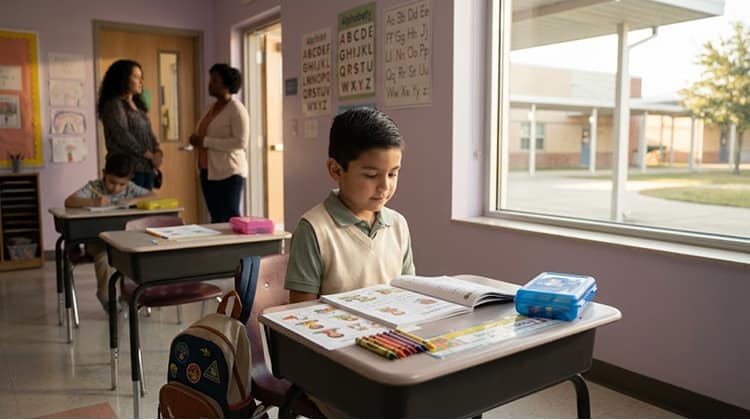
The case does not establish that every young child placed in a DAEP has similar circumstances. It does illustrate how the state’s minimum age can become relevant when disciplinary problems emerge during the earliest years of formal schooling.
For a six-year-old, a month away from a regular elementary classroom represents a substantial portion of a school year.
Disability And Student Support Can Become Part Of The Discipline Question
Another issue raised by the recent reporting is the relationship between student behavior and disabilities.
The McKinney case described by The Hechinger Report involved a child whose mother believed an undiagnosed disability contributed to his behavior. Under federal special education law, students receiving special education services have specific protections related to school discipline, including requirements concerning changes in placement and the consideration of disability-related factors.
This does not mean a disability prevents a school from taking disciplinary action.
Instead, schools must account for the student’s disability status and applicable federal requirements when determining how discipline is handled.
The distinction is important because elementary students may have limited ability to explain their behavior, recognize how school rules apply to a particular situation or communicate an underlying need.
The Texas Education Agency’s discipline resources specifically include materials for students with disabilities and a discipline flowchart addressing students identified with or suspected to have disabilities under the Individuals with Disabilities Education Act.
For families, the practical issue is therefore broader than whether a child broke a rule. It can also involve what supports were already available, whether the student had been evaluated, what the school documented and which disciplinary process the district followed.
House Bill 6 Changed Texas School Discipline Rules
The current discussion is also taking place after Texas lawmakers changed several school-discipline provisions.
House Bill 6, authored by Rep. Jeff Leach and sponsored in the Senate by Sen. Charles Perry, became effective on June 20, 2025. The law revised several provisions governing discipline management in public schools and applied beginning with the 2025–26 school year.
The legislation changed provisions involving classroom removals, disciplinary placements and teacher authority. It also requires districts to provide students and parents with information explaining discipline-law changes made by the Legislature.
During a 2025 legislative hearing, Sen. José Menéndez specifically asked whether young students would remain eligible for DAEP placement under the proposed changes. Sen. Perry responded that students age 10 and younger could be placed in a DAEP under Texas law, while also saying he did not expect districts to routinely use the system for six-year-olds.
The distinction between what the law permits and what districts typically choose to do is central to the current debate.
Texas law establishes the authority and requirements. Individual school districts then apply their own codes of conduct and disciplinary procedures within those legal boundaries.
That means families in McKinney, Round Rock, San Antonio, Houston, Dallas and other Texas communities can encounter different local policies even though they operate under the same state framework.
Local District Policies Shape The Student Experience
DAEP placement does not occur in exactly the same way across every Texas school district.
The state establishes mandatory placement categories and broader legal requirements, while local districts develop student codes of conduct that can provide additional grounds for discretionary disciplinary action.
The Texas Education Agency describes DAEP actions as including both mandatory and discretionary placements. Districts must establish guidelines for the length of assignments, and their programs must provide educational services while students are removed from their regular campuses.
This local authority helps explain why the reasons for elementary DAEP placements can vary.
The recent investigation identified district records involving elementary students placed for attendance violations, defiance and violations of local codes of conduct. In one Lamar Consolidated Independent School District case, a first grader received a 15-day DAEP assignment after putting feces in a water fountain. In another case, a second grader received 20 days for inappropriate language toward staff.
Those individual cases should not be treated as representative of every district or every DAEP placement.
They do demonstrate, however, the range of behavior that can enter the disciplinary alternative system under local policies.
What Families Should Watch In The DAEP Process
The current reporting places renewed attention on how districts balance classroom safety, teacher authority, student behavior and the developmental needs of young children.
For parents, several parts of the process can be particularly important when a DAEP placement is being considered:
- The reason for the placement: Families should understand whether the action is mandatory under state law or discretionary under the district’s code of conduct.
- The length of the assignment: District policies establish guidelines for how long students can remain in alternative programs.
- The student’s age and grade: Elementary students must be separated from secondary students in DAEP settings.
- Disability-related protections: Applicable federal special education requirements must be considered when a student has a disability or is suspected of having one.
- The educational program: Students in a DAEP remain entitled to educational services while assigned to the program.
- The return-to-class process: Texas law and district policies establish procedures connected to a student’s return to the regular classroom.
The TEA also says discipline conferences related to DAEP placements must be held within three days of administrators learning of the student’s misconduct.
That procedural requirement is especially relevant in cases involving very young students because disciplinary decisions can affect a substantial portion of an elementary student’s school year.
The Central Question Is What Happens After Removal
Texas’ DAEP system is now facing a closer examination because the students entering it can be much younger than many people might expect.
The available data establish several facts: nearly 4,000 elementary students received DAEP placements in 2022–23; Texas has more than 100 DAEP campuses; more than 100,000 students enter these programs across a year; and state law allows children to be placed in a DAEP beginning at age 6, with a narrow firearm exception allowing placement for a younger child.
What the numbers cannot answer by themselves is whether a particular disciplinary placement improves a student’s behavior or academic trajectory.
That question depends on the circumstances surrounding the placement, the student’s age, the reason for removal, the quality of instruction in the alternative setting, available behavioral or special education supports and what happens when the student returns to the regular classroom.
Research cited in the recent reporting has raised concerns about possible academic, social and behavioral consequences of prolonged removal, while Texas officials point to restorative practices and existing discipline procedures as tools available to districts. Those positions reflect different perspectives on how schools should respond to student behavior, rather than a settled conclusion about every DAEP placement.
For Texas families, the next part of the story will be found at the district level. As schools continue implementing the discipline rules that took effect with the 2025–26 school year, the records of young students entering DAEPs will provide a clearer picture of how often these placements occur, why they happen and what educational services students receive while away from their regular classrooms.
The growing attention to six-year-old eligibility also puts a specific age on a much broader question in Texas education: how schools can maintain safe and orderly classrooms while responding to the developmental, academic and behavioral needs of children in the earliest years of public school.