
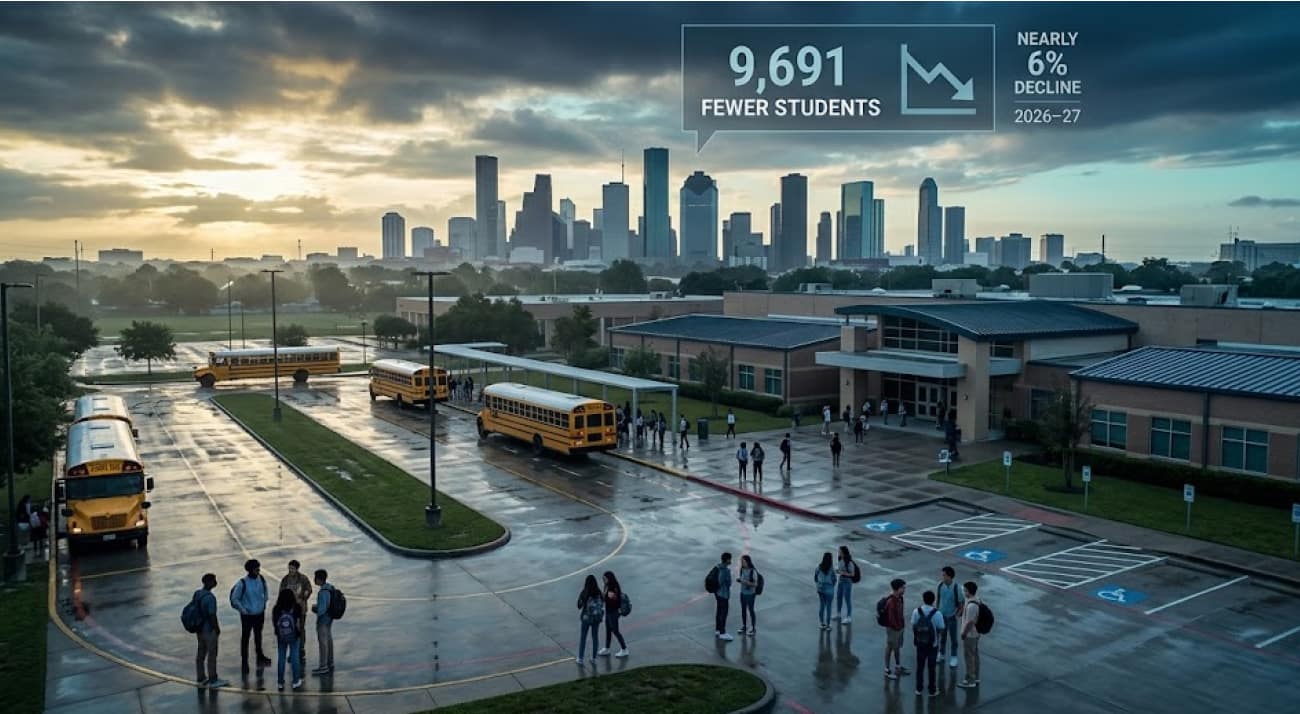
Houston Independent School District is facing a much larger enrollment decline than it anticipated for the 2026–27 school year, and the financial consequences are already reaching classrooms, staffing decisions and student programs.
District records showed just over 155,600 students enrolled as of September 4, about 9,691 fewer students than the comparable count from September 2025. That represents a decline of nearly 6% and is more than twice the roughly 4,000-student decrease HISD had built into its budget projections. The district’s official enrollment count will not be submitted until October 31, meaning the final figure could change as students continue enrolling.
The significance for students is already visible. HISD has begun what it calls its annual “campus leveling” process, adjusting staffing and campus spending when actual enrollment differs from spring projections. This year, however, the process is occurring unusually early and is affecting schools that have traditionally maintained strong enrollment.
At Lamar High School, administrators reported more than $500,000 in budget reductions. At T.H. Rogers School, an assistant principal and librarian are being reassigned despite the campus having enrollment close to its previous official count. Other campuses, including Carnegie Vanguard High School and Marshall Middle School, are also experiencing staffing or program changes.
The result is a financial issue that is quickly becoming a student-experience issue.
HISD Lost Nearly 10,000 Students From Last Year
The September enrollment figure is important because public school funding in Texas is closely tied to student attendance and participation. A smaller student population means less revenue available to operate schools, while many expenses such as buildings, transportation and basic staffing do not immediately fall at the same rate.
HISD had 168,800 students during the 2025–26 school year, according to reporting based on district and state data. That was already a decline of about 4.5% from the preceding year. The district had approximately 189,290 students in 2022–23, the final school year before the state takeover began.

The latest numbers therefore extend a longer enrollment trend rather than representing a single-month fluctuation.
Still, the size of the current decline has caught attention because HISD expected to lose approximately 4,000 students during the 2026–27 school year. That projection was connected to an anticipated loss of roughly $50 million in funding. The early September count suggests the eventual financial gap could be substantially larger if the enrollment decline persists through the state’s official October count.
HISD has also emphasized that enrollment losses are occurring across public education, with district officials pointing to a broader financial environment and declining student populations. Researchers cited by the Houston Chronicle have also identified factors such as lower birth rates, charter schools and expanded school-choice options as contributors to enrollment changes in districts around the country.
For Houston families, however, the immediate question is less about the national enrollment picture and more about what happens inside their children’s schools.
The district’s student enrollment information continues to direct families through the 2026–27 enrollment and annual student-update process, while HISD works toward the official count later this fall.
T.H. Rogers Shows Why Enrollment Alone Does Not Tell The Whole Story
T.H. Rogers School illustrates another dimension of the issue.
The K–8 campus near the Galleria serves a student population heavily centered on Vanguard, HISD’s gifted-and-talented program. By September 4, the school had nearly reached its previous official enrollment of approximately 1,100 students. Despite that relatively stable enrollment picture, campus leaders told parents that an assistant principal and librarian would be reassigned as part of the district’s spending reductions.
Principal Suparna Vashisht acknowledged the difficulty of staffing changes while emphasizing that the school intended to maintain instruction, services and programs for students.
The situation highlights an important distinction in district budgeting: a campus does not necessarily have to lose thousands of students before students notice financial pressure.
When a district loses thousands of students overall, it has to make decisions about where available personnel and funding are allocated. Those decisions can affect individual schools even when their enrollment remains relatively stable.
That is especially relevant for specialized campuses. Schools serving gifted students, students with particular academic interests or students participating in specialized extracurricular programs may depend on specific personnel and course offerings. Removing one position can have a different effect at a specialized campus than it would at a much larger comprehensive school.
The Houston enrollment story is therefore about more than empty seats. It is also about how a shrinking district determines which educational opportunities it can continue to provide at each campus.
The Financial Gap Is Larger Than HISD Expected
HISD’s original 2026–27 budget assumptions were based on a loss of approximately 4,000 students. The September 4 count showed a gap of 9,691 students compared with the same period a year earlier.
The difference between those two numbers is roughly 5,700 students.
| Measure | Figure |
|---|---|
| HISD enrollment, Sept. 4, 2026 | Just over 155,600 |
| Year-over-year decline | 9,691 students |
| Approximate percentage decline | Nearly 6% |
| Enrollment decline originally projected for 2026–27 | About 4,000 students |
| Projected funding impact of 4,000-student decline | About $50 million |
| HISD enrollment in 2025–26 | 168,800 |
| HISD enrollment in 2022–23 | 189,290 |
The official enrollment count is still ahead. Texas districts report their official student numbers later in the fall, and HISD’s enrollment has historically increased between the opening of school and the October count. In 2025, for example, the district’s enrollment increased by roughly 3,500 students between September 5 and October 31.
That means the September figure should not be treated as the final 2026–27 enrollment total.
It does, however, establish the scale of the challenge facing HISD as administrators make decisions before the official count is available.
The Texas Tribune’s HISD enrollment analysis reported that the district had already lost approximately 21,000 students during the first three years of the state takeover. Those enrollment losses had reduced district revenue by an estimated $190 million before the latest round of cuts.
The financial pressure is particularly significant because HISD has an annual operating budget of roughly $2 billion and a workforce of more than 22,000 employees. Even a relatively small percentage change in enrollment can therefore affect decisions involving thousands of employees and hundreds of campuses.
Campus Leveling Is Reaching Student Programs
Campus leveling is not new at HISD. School districts regularly adjust staffing after the beginning of a school year because enrollment changes can leave some campuses with more employees than their funding formulas support.
What makes the current situation significant is the scale and timing.
According to The Texas Tribune, HISD administrators directed some campuses to reduce staff and spending roughly one month after the beginning of the school year. Employees affected by the reductions can be reassigned to other available positions, but the changes can still alter the services and programs available at individual campuses.
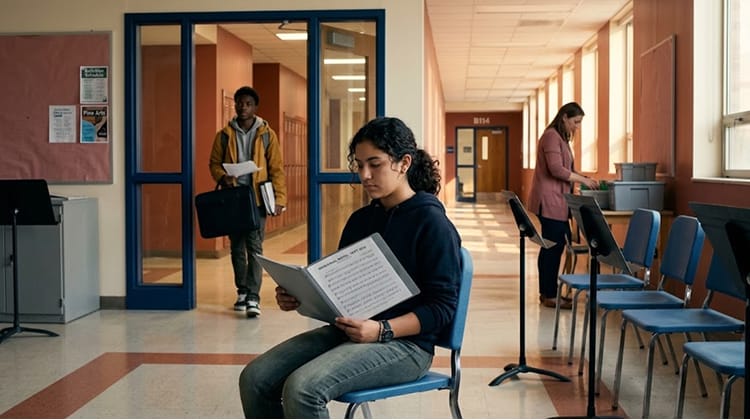
Lamar High School provides one of the clearest examples.
Principal Rita Gaves informed families that the campus was facing more than $500,000 in budget cuts tied to districtwide enrollment and property-tax revenue issues. The reductions affect employees and several student-facing areas, including choir, agriculture, debate and student support services. Lamar had approximately 2,700 students enrolled as of September 4, compared with about 2,790 at the end of October 2025.
That contrast matters. Lamar’s enrollment has declined, but the program impact is not limited to the size of the student population. A relatively small enrollment change can create a much larger disruption when a school has to eliminate or reassign specific positions.
For a student involved in debate, choir or agriculture, the district’s enrollment numbers can therefore become very tangible. A financial adjustment that appears on a spreadsheet can translate into a reduced course offering, a different staff member or fewer extracurricular opportunities.
HISD’s campus demographics resources show why enrollment is closely connected to planning for school programs, facilities and staffing. The district operates hundreds of campuses, each with different enrollment patterns and program needs.
New Education System Costs Add Another Layer
Enrollment losses are occurring alongside HISD’s effort to operate the New Education System, or NES, across a large portion of the district.
The system was introduced under state-appointed Superintendent Mike Miles after the 2023 state takeover and has expanded across dozens of campuses. According to a September investigation by The Texas Tribune, the district spent approximately $31.7 million to expand NES to 45 additional schools in the 2024–25 school year, or about $704,000 per campus during the first year.
The Tribune also reported that HISD’s 2026 budget allocated roughly $8,500 per student at an NES campus compared with approximately $6,300 per student at other HISD campuses. The difference reflects the additional resources associated with the model.
Those expenses become more difficult to absorb when the total student population is shrinking.
A district can add resources to individual schools while simultaneously losing revenue as students leave. Eventually, administrators have to reconcile those two trends.
That tension helps explain why the current enrollment decline is affecting decisions beyond classroom headcounts.
The HISD financial and enrollment picture shows the broader challenge: the district is trying to fund an expensive reform structure while its student population has fallen substantially since 2023. The Tribune reported that some NES campuses cost about $2,200 more per student in ongoing spending than comparable non-NES campuses.
What The Enrollment Decline Could Mean For Students
The most immediate effects are likely to appear differently from school to school.
At some campuses, the changes may involve staff reassignment. At others, students may see reductions in extracurricular activities, support positions or specialized programs. Some schools may experience larger class sizes or fewer available personnel if enrollment and funding continue to fall.
The district’s own enrollment strategy recognizes that student population trends influence school programs, facilities and long-term planning. But the current situation demonstrates how quickly those demographic changes can become operational decisions.
Several issues will be particularly important to watch through the fall:
- The official October enrollment count: The September figure is preliminary, and additional students could enroll before the official count.
- Which programs lose positions: Lamar’s experience shows that extracurricular and support programs can be directly affected.
- Whether stable campuses continue losing staff: T.H. Rogers demonstrates that districtwide reductions can reach schools without major enrollment losses.
- How many employees are reassigned: The full number of affected positions has not yet been publicly detailed.
- Whether additional campuses report reductions: HISD’s current list of affected schools could expand as the leveling process continues.
The district’s stated objective is to adjust spending as enrollment and revenue change while continuing to prioritize investments that affect student achievement. But the practical test will occur inside individual schools, where families will see whether those adjustments preserve the programs and services students rely on.
For Youth Rise Texas readers, that is the most important part of the story. Enrollment statistics are useful for measuring the size of a district, but they become much more meaningful when connected to what students can actually access during the school day and after the final bell.
Houston ISD’s nearly 10,000-student year-over-year enrollment gap is still subject to an official October count. Yet the early consequences are already visible: staff are being reassigned, campus budgets are being reduced, and programs such as choir, agriculture and debate are facing cuts.
The next stage of the story will depend on whether enrollment rebounds before October 31 and whether HISD can close the resulting financial gap without further reducing the educational opportunities available to students across Houston.