
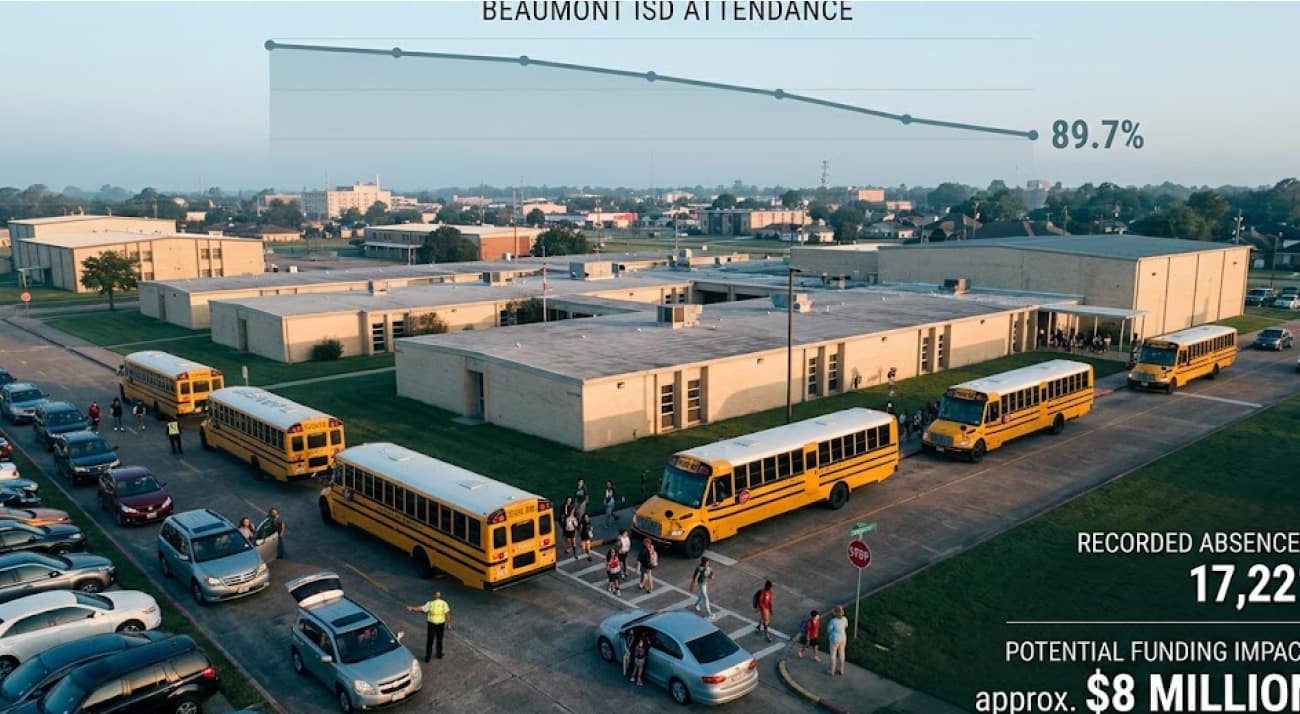
Beaumont Independent School District is confronting a serious attendance problem only weeks into the 2026-27 school year, with thousands of student absences already recorded and district officials warning that attendance could have a direct impact on school funding.
As of September, Beaumont ISD had 14,574 students enrolled and had recorded 17,221 student absences since August 12, according to Superintendent Sandi Massey. The district had also recorded 1,005 teacher absences during the same period. Attendance rates across campuses ranged from 91.15% to 98.34% through September 14, while the district’s attendance rate had fallen from approximately 96% at the same point the previous year to about 89.7% by the end of the 2025-26 school year.
Massey told parents and community members that the previous year’s attendance decline represented approximately $8 million in lost district funding. The number places attendance at the center of Beaumont ISD’s financial planning, but the issue extends well beyond the district’s budget. Every missed school day can also mean lost instructional time, interrupted learning and additional challenges for students who are already struggling academically.
The district is now asking the Beaumont community to help identify why students are missing school and what schools, families and local organizations can do to reverse the trend.
Beaumont ISD Has Already Recorded Thousands Of Absences
The scale of the attendance issue becomes clearer when the district’s current numbers are placed against the size of its student population.
With 14,574 students enrolled, Beaumont ISD has already recorded more absences than its entire current enrollment since the start of the school year. That does not mean every student has been absent or that each absence represents a different student. Rather, the number reflects the cumulative total of individual student absence events.

On September 22, Massey said 868 students were absent in a single day. The highest single-day total during the preceding month was 1,168 students. Campus totals through September 14 ranged from about 100 absences to as many as 2,597 at one campus.
Those figures matter because attendance is cumulative. A student who misses several days can lose instructional time even if that student eventually returns to school regularly. Repeated absences can also make it harder for teachers to keep students at the same pace as their classmates.
The district has already reached the point where hundreds of students have met the threshold for truancy procedures, according to Massey. Beaumont ISD says those procedures are triggered after four absences within one month.
For families who want to understand how Beaumont ISD tracks attendance, enrollment and student services, the district’s official student resources provide information about schools, programs and district operations.
The Funding Impact Could Reach Millions
Attendance has a direct financial dimension for Texas school districts because state funding is tied in part to average daily attendance.
Beaumont ISD has experienced this connection before. The district’s recent attendance decline contributed to an estimated $8 million funding loss, according to Massey’s September presentation.
The financial issue is particularly important because the district is also dealing with a declining enrollment base.
Beaumont ISD’s 2026 accountability data showed enrollment falling from 16,315 students in 2025 to 15,838 in 2026. The district also reported a 90.4% attendance rate during 2024-25 and a 33% chronic absenteeism rate.
That means Beaumont ISD is dealing with two related pressures: fewer students enrolled in the district and a significant share of enrolled students missing school.
The two problems can compound each other financially. Enrollment determines the potential student population the district serves, while attendance affects how consistently those students generate funding under the state’s school finance system.
The result is a district that may have fewer resources available even though many of its basic operating costs remain.
Student Absences Are Connected To More Than Motivation
One of the most important elements of Beaumont ISD’s current attendance discussion is the range of barriers identified by district officials.
Massey pointed to transportation problems, poverty, access to health care and family responsibilities as factors that can make regular attendance difficult. She also said schools need to make learning more engaging so students have stronger reasons to remain connected to school.
That distinction matters because an attendance problem cannot necessarily be solved through disciplinary measures alone.
A student who misses school because of unreliable transportation faces a different problem from a student who stays home because of illness. A teenager who has family responsibilities may have different challenges from a student who has become disengaged academically.
The district’s community meetings are therefore attempting to identify the practical circumstances behind the attendance numbers.
Some of the ideas raised during the September community discussion included carpools, walking groups, attendance incentives and additional community support.
These approaches point toward a broader role for Beaumont’s neighborhoods and organizations. If transportation, family responsibilities and health access are contributing to absences, schools may need help from organizations outside the school system.
Beaumont’s Transportation System Is Part Of The Attendance Picture
Transportation deserves particular attention because getting students to school consistently is a basic requirement for improving attendance.
BISD has already expanded free bus transportation for K-12 students, and the district’s transportation operations have faced challenges of their own. In September, a Beaumont mother, Apryl Essien, filed a complaint with the Texas Education Agency after her five-year-old daughter with autism arrived home hours late from Dishman Elementary School following a bus-routing error.
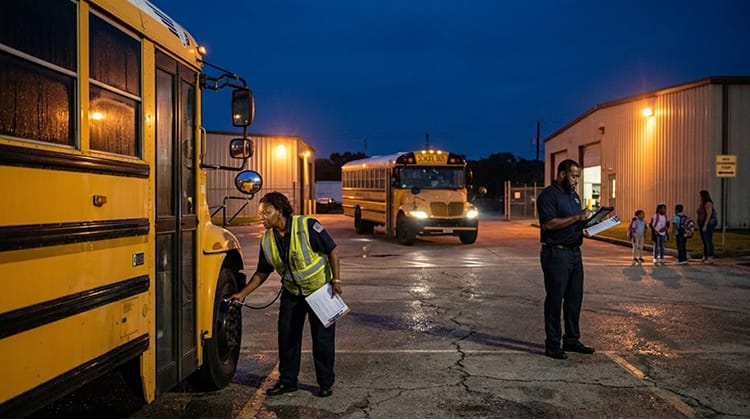
The district acknowledged operational failures in that incident and announced corrective measures that included improved communication procedures, designated route pairings and additional training for special education transportation.
That incident should not be treated as proof that transportation is the cause of Beaumont ISD’s broader attendance decline. It does, however, illustrate why transportation is relevant to the district’s attendance discussion.
For some students, particularly younger children and students receiving special education services, reliable transportation is closely connected to whether attending school is practical for their families.
Beaumont ISD also used school buses for community meal deliveries after Tropical Storm Edouard forced campuses to remain closed in early September, demonstrating the transportation system’s wider role in supporting students and families.
Academic Performance And Attendance Are Interconnected
Beaumont ISD’s attendance challenge is unfolding alongside significant differences in academic performance across its campuses.
The district received an overall 69 rating in the 2026 Texas accountability system, up one point from 68 in 2025. But campus-level results were more concerning: the number of F-rated campuses increased from seven in 2025 to 11 in 2026.
The relationship between attendance and academic performance is visible in the district’s own campus data.
The 11 F-rated campuses averaged a 37.6% chronic absenteeism rate, compared with approximately 21% among campuses rated D or higher. Six of those F-rated campuses had chronic absenteeism rates of at least 40%.
At Dr. Mae E. Jones-Clark Elementary, for example, the campus received a 2026 accountability score of 41, down from 74 the previous year. The school served 504 students and reported an 89.3% attendance rate and a 44% chronic absenteeism rate.
Pietzsch-MacArthur Pre-K-8 Center had a similar attendance challenge, reporting an 89.2% attendance rate and a 40% chronic absenteeism rate while remaining F-rated despite improving its overall score.
The data does not establish that absences alone caused the lower accountability results. Academic achievement is influenced by many factors. But the overlap between high chronic absenteeism and lower-rated campuses gives Beaumont ISD another reason to treat attendance as an academic issue rather than simply an administrative metric.
Some Beaumont Schools Are Showing A Different Pattern
The district’s numbers also show why Beaumont ISD cannot treat every campus in the same way.
Dr. Martin Luther King Collegiate Academy was the district’s only A-rated campus in 2026, earning an overall score of 97. It served 334 students and reported a 96.8% attendance rate with only 2% chronic absenteeism.
West Brook High School was the only Beaumont campus to earn a B, rising from 77 to 83. Beaumont United High School increased its score by 10 points, moving from a D to a C.
These examples show that Beaumont ISD has schools where attendance and academic outcomes are considerably stronger.
The differences could help the district identify practices that may be transferable to campuses with higher absenteeism. They also suggest that the attendance problem is not uniform across Beaumont.
Campus size, student demographics, transportation needs, academic programs, neighborhood conditions and school culture can all affect attendance patterns.
Chronic Absenteeism Could Become A Bigger Concern
The district’s current attendance rate is concerning partly because September is still early in the academic year.
Massey told community members that attendance had worsened during December and May of the previous school year. She warned that the numbers would not improve automatically without a significant change in behavior and support.
That seasonal pattern creates a challenge for Beaumont ISD.
If attendance drops again during periods when absences historically increase, the district could face another year of significant funding pressure.
The issue is also more complicated than simply increasing the percentage of students present on a given day.
Schools need to identify students who are repeatedly absent before those missed days become a larger academic problem. Chronic absenteeism can affect reading progress, mathematics performance, credit accumulation and graduation pathways, particularly when students are already behind.
Early intervention therefore becomes important.
Teacher Attendance Is Another Part Of The Challenge
Beaumont ISD is also examining employee attendance.
The district reported a teacher attendance rate of 89.61% during the 2025-26 school year. Massey raised the issue during the September community meeting but emphasized that teachers should take legitimate sick days when necessary.
Teacher absences can create additional pressure for schools because campuses must find substitutes or redistribute responsibilities when teachers are unavailable.
For students, frequent changes in classroom coverage can disrupt instructional continuity.
The district’s decision to discuss both student and teacher attendance reflects the broader concern about school attendance culture. At the same time, the two issues require different solutions. Student absences can involve transportation, family and health barriers, while teacher attendance can involve health, staffing, working conditions and substitute availability.
Treating the numbers as identical would overlook those differences.
Beaumont ISD Is Looking For Community Solutions
The district has begun using its Community Action series to bring parents, families, employees and community members into discussions about school improvement.
The September attendance meeting was part of that effort. Rather than relying exclusively on district-level policy, Beaumont ISD is asking local residents to identify barriers and propose ways to help students attend school more consistently.
That approach could become important if the district’s financial losses continue.
Community organizations can potentially contribute transportation support, mentoring, attendance incentives, health resources and family assistance. Local employers and nonprofit organizations can also play a role when students face responsibilities outside school.
The central challenge is coordinating those resources around the students who need them most.
The Attendance Problem Comes As Beaumont ISD Faces Broader Pressure
Attendance is only one of the financial and academic pressures confronting Beaumont ISD.
The district’s enrollment fell by hundreds of students between 2025 and 2026, while the number of F-rated campuses increased. At the same time, Beaumont ISD is trying to improve instruction and strengthen student outcomes across schools with very different attendance and academic profiles.
That makes attendance one of the few areas where relatively small changes in daily behavior can have consequences across several parts of the system.
More students attending school means more instructional time. It can improve continuity for teachers. It can help students stay on pace academically. And because attendance is tied to state funding, it can also protect revenue.
The reverse is also true.
If attendance remains near current levels, Beaumont ISD could continue losing millions of dollars while schools simultaneously face greater pressure to improve academic outcomes.
The Next Attendance Numbers Will Matter
Beaumont ISD’s September figures should be viewed as an early warning rather than a final measurement of the 2026-27 school year.
The district will need to track whether attendance improves after its community outreach, whether transportation problems are reduced, whether students with repeated absences receive earlier intervention and whether the campuses with the lowest attendance can change their patterns.
The district will also have to determine whether its strongest-attendance campuses have practices that can be adapted elsewhere.
For Beaumont students, the stakes are more immediate than the funding figures suggest. Missing school means missing instruction, relationships with teachers and classmates, extracurricular opportunities and the routines that help students stay connected to education.
For Beaumont ISD, the financial stakes are equally clear. The district has already estimated that the previous year’s attendance decline cost approximately $8 million in funding. With 17,221 student absences recorded by September and a district attendance rate that has already fallen sharply from previous levels, improving attendance has become both an educational priority and a financial necessity.
The coming months will show whether Beaumont can reverse the trend before another school year of missed instructional days turns into another multimillion-dollar funding problem.