
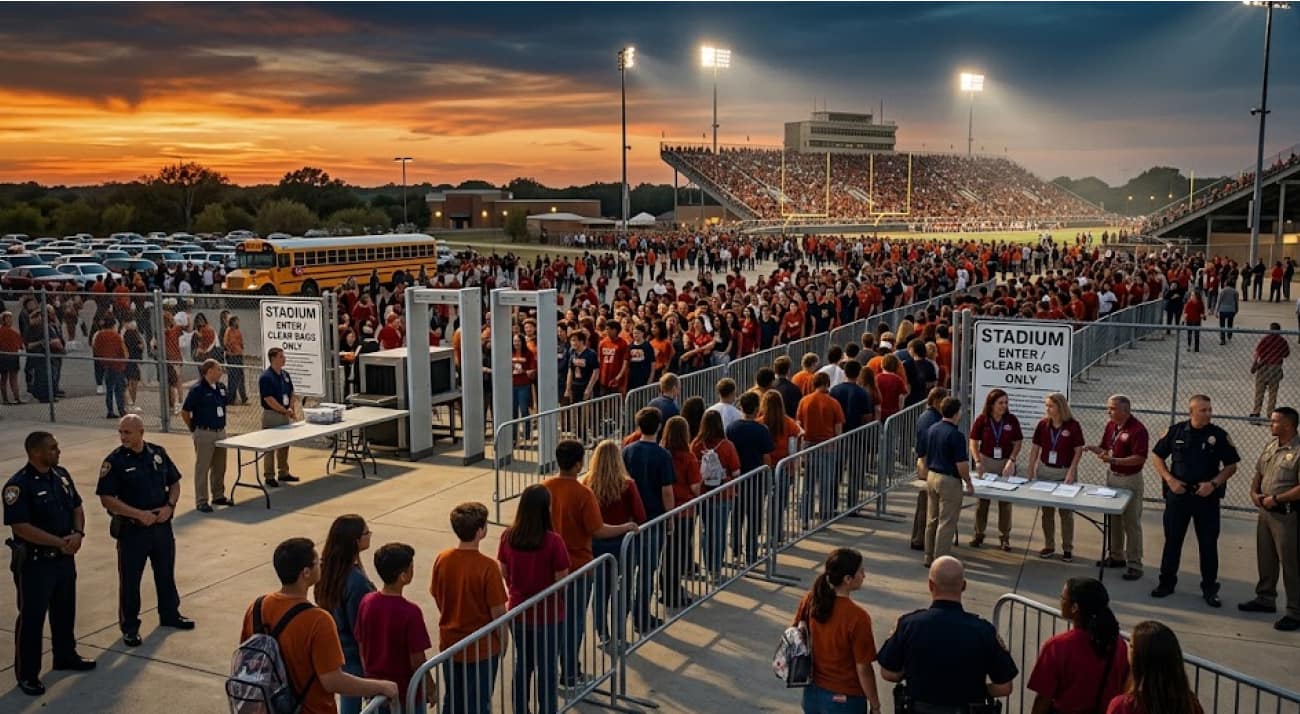
Texas high school sports are entering a new era of event security after new statewide requirements took effect in September, placing additional responsibilities on school districts that host football games, rivalry contests, graduations and other large extracurricular gatherings. The rules establish minimum security staffing, written emergency plans and medical preparedness standards for events involving students, staff and spectators.
The requirements come from new Texas Education Agency rules adopted under House Bill 121, which was passed by the Texas Legislature in 2025. The new provisions became effective on September 23, 2026, just as the fall high school football season was moving into one of its busiest stretches. The Texas Education Agency’s school safety guidance confirms that the rules apply to extracurricular activities and establish specific requirements for large events.
For Texas students, the changes are significant because school sporting events can draw thousands of people into a single venue. Football stadiums, playoff contests and traditional rivalry games can bring together students, families, alumni, school employees and visitors from multiple communities. The new standards are intended to make the response to emergencies more predictable before a crisis occurs.
Texas Schools Must Prepare For Larger Crowds
One of the clearest changes involves security staffing at events expected to attract more than 1,000 people. Under the adopted rule, a host school system must provide at least one uniformed peace officer for every 1,000 attendees once an event exceeds that threshold.
That means a football game expecting 1,200 spectators cannot simply rely on the same security arrangement used for a smaller gathering. The rule creates a minimum staffing expectation tied to attendance, while also giving school districts room to consider additional personnel based on the circumstances.
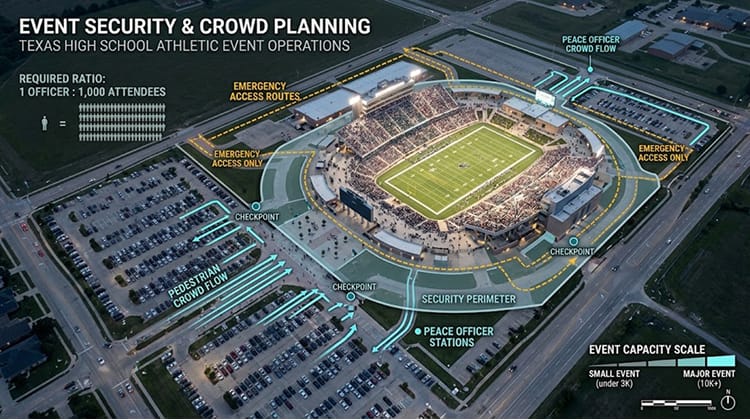
The final requirement is less restrictive than the original proposal. The Texas Register shows that the proposed rule initially called for one uniformed peace officer per 750 attendees at events exceeding 500 people. Following public comments, the final version raised the mandatory threshold to events exceeding 1,000 attendees and changed the ratio to one officer per 1,000 attendees. The final Texas Register rule documents that change.
The distinction matters for school districts because the number of large events across Texas is substantial. A district hosting multiple football games, basketball tournaments, marching band competitions or graduation ceremonies may now need to evaluate security requirements for each location and anticipated crowd.
The rule also makes clear that the host school system is responsible for security, even when another school is participating in the event.
Rivalry Games Receive Additional Attention
Attendance is only one part of the new framework. Texas specifically identifies rivalry events and other contests with a heightened potential for violence or confrontation as situations requiring additional security consideration.
A rivalry event is defined as a school-sponsored athletic contest or extracurricular competition between entities with a recognized competitive relationship. The definition recognizes that long-standing geographic, historical or competitive rivalries can generate larger crowds and stronger emotions.
For these events, districts must provide an appropriate number of uniformed peace officers based on the circumstances. The rule does not establish a single numerical ratio for every rivalry game because the appropriate staffing level can depend on factors such as projected attendance, venue size and the potential for confrontation.
That approach is particularly relevant during the second half of the Texas football season, when traditional rivalry games can become major community events. Recent examples reported in South Texas include LBJ vs. United South on November 5, Alexander vs. United on November 6, and Nixon vs. Martin on November 7. Those games illustrate why security planning can extend beyond simply counting spectators. Local history, school identities and the expected atmosphere can also influence the level of preparation required.
The Texas school event security rules provide additional context on how the requirements are expected to affect upcoming football contests.
Written Security Plans Now Matter Before The Crowd Arrives
The new requirements also move school-event security beyond the presence of officers. School systems must develop written security and medical plans for each specific event location expected to have more than 250 attendees.
Those plans are intended to address the conditions of the location rather than function as a generic district document. Schools must account for emergency communication, crowd control, evacuation procedures, emergency equipment and coordination with responders.
The rule also requires an on-site designated incident commander who can manage an emergency. That creates a defined leadership role during a crisis rather than leaving event personnel to determine responsibilities after something has already happened.
This is especially important at large athletic facilities because an emergency can involve several organizations at once. A football stadium may contain school administrators, coaches, athletic trainers, law enforcement officers, emergency medical personnel, officials, concession workers, volunteers and spectators. Without a defined command structure, those groups can receive conflicting information or duplicate responsibilities.
The rule requires school systems to establish communication channels between school administrators, coaches, emergency services and law enforcement. A telephone or other communication device must also be available at extracurricular activities so medical services or law enforcement can be contacted immediately.
Weather Is Part Of The Security Plan
Texas school-event safety is also broader than the possibility of violence. The new requirements specifically address adverse weather, including lightning, heavy rain and extreme heat.
Schools must establish protocols for severe weather and identify temporary emergency shelter locations or evacuation measures for event participants and spectators.
That provision has particular relevance to Texas high school football because many games take place outdoors during months when weather conditions can change quickly. Heat remains a concern early in the football season, while thunderstorms can create risks later in the year.
A stadium may be full when lightning develops nearby. The school therefore needs more than a general statement that spectators should seek shelter. Event personnel must know what areas can be used, how information will reach the crowd and who has authority to initiate an evacuation.
The Texas Education Agency safety requirements also require districts to maintain emergency equipment and establish procedures for emergency response during extracurricular activities.
AEDs And CPR Training Become Part Of The Event Framework
Medical preparedness is another major component of the new standards.
Automated external defibrillators, commonly known as AEDs, must be available and accessible at athletic practices and events and inspected monthly. The rules also connect extracurricular activities to existing CPR and AED training requirements for coaches, sponsors, physical education instructors, marching band directors, cheerleading coaches and students serving as athletic trainers.
The requirement recognizes a basic reality of school athletics: a medical emergency can happen before an ambulance arrives.
For young athletes, rapid response can be especially important when an injury or cardiac emergency occurs during competition. Having equipment available is one part of the equation, but knowing where that equipment is located and having trained people capable of using it can determine how quickly assistance begins.
The regulations also require school systems to coordinate with local first responders on injury-response plans that include immediate first aid.
That creates a stronger connection between the school athletic department and the emergency services that may eventually take control of a serious incident.
Host Schools Carry A Larger Operational Responsibility
The new framework also reinforces an existing principle in Texas school athletics: the host school has substantial responsibility for the conditions surrounding an event.
The adopted rules require the host system to provide security at qualifying events. When schools participate at facilities controlled by another organization or school system, they are expected to become familiar with the host facility’s security and medical plans, including evacuation routes, emergency equipment and emergency contact information.
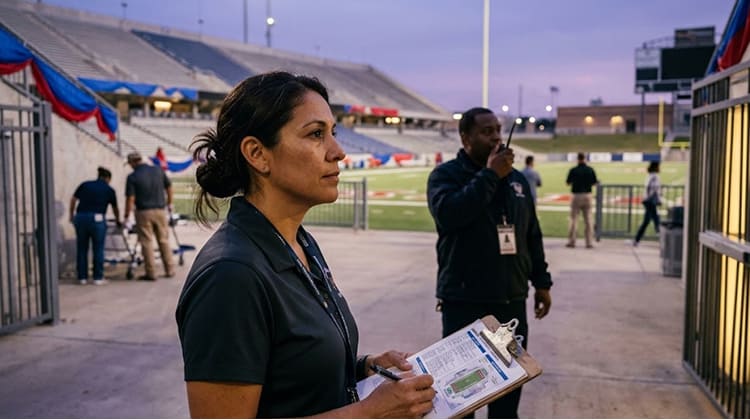
That distinction can become important during playoff games or events held at neutral venues.
A visiting school cannot assume that its own campus emergency plan automatically applies to another stadium. Coaches, administrators and other school personnel need to understand how the facility operates and how emergency communication will work at that location.
The UIL’s designated school administrator guidance already places significant responsibility on school administrators during athletic contests, including crowd management, communication with officials and security responsibilities for home contests. The new state requirements add another layer of formal planning around those existing duties.
The Rules Create New Costs For School Districts
Safety requirements also have a financial dimension.
Hiring uniformed peace officers, preparing event-specific plans, maintaining medical equipment and coordinating emergency personnel can increase the cost of hosting major school events. That issue becomes more significant for districts that regularly operate large stadiums or host playoff contests.
The final Texas rule acknowledged that local financial effects will vary because extracurricular activities are voluntary and decisions about hosting events are made locally. However, the state also noted that approximately $500 million was added to school safety allotment funding during the 89th legislative session to help offset district costs associated with safety and security initiatives.
That funding does not mean every district will have the same resources available for every event. A large suburban district with its own police department may have different options from a smaller rural district that relies on a county sheriff’s office or municipal law enforcement agency.
The difference could influence how districts schedule events, determine appropriate venues and coordinate personnel.
What The New Rules Mean For Students And Families
For students, the most visible impact may be relatively subtle. Families may see more uniformed officers at large games, additional entry procedures, clearer emergency announcements or more formal crowd-management practices.
The broader effect is that security planning is becoming part of the infrastructure of school activities rather than something added only after a problem occurs.
That matters because school events serve a larger role in youth life than competition alone. Football games, marching band performances, basketball tournaments, graduations and other gatherings are major community events where students spend time with peers and families.
The state rule treats those environments as places that require coordinated preparation.
For parents, that can mean asking more practical questions before attending a large event: Where are the emergency exits? How will weather alerts be communicated? Where is medical assistance located? Who is responsible for the venue during an emergency?
Those questions may become more familiar as districts implement the requirements.
Security Rules Could Change The High School Event Experience
Texas has historically placed substantial responsibility for school-event safety at the district and campus level. The new standards establish a clearer statewide baseline while still leaving districts room to assess the individual circumstances of an event.
The balance is important. A 300-person school gathering and a 3,000-person football game do not present identical operational challenges. Neither does a routine football game present the same potential risk as a rivalry contest with a long history of confrontation.
The adopted rules therefore combine mandatory standards with risk-based considerations. Large events have a defined peace-officer requirement, while rivalry events and higher-risk contests require districts to determine appropriate additional coverage.
That approach also places greater emphasis on preparation. Crowd control, emergency communication, evacuation, medical response and weather planning now have to fit together as part of the same event-safety structure.
For Texas students participating in UIL athletics, the immediate objective remains familiar: getting athletes onto the field, court or competition area safely and allowing them to compete. But as the 2026–27 school year continues, the experience surrounding those competitions will increasingly reflect a statewide system that expects schools to plan for emergencies before thousands of students and spectators arrive.
The result could be a more consistent safety standard across Texas high school events, while also forcing districts to weigh the staffing, planning and financial demands that come with hosting large gatherings.