
Austin Mayor Kirk Watson is asking families at two struggling middle schools to consider an extraordinary option: closing their campuses as a way to prevent the state from taking control of the entire Austin Independent School District.
Watson’s proposal, released September 9, focuses on Burnet Middle School and Webb Middle School, both of which received their fifth consecutive failing accountability rating from the Texas Education Agency for the 2025–26 school year. Those ratings triggered a state intervention requirement under Texas law and put Austin ISD in an unusual position as the only Texas district currently facing a potential takeover based on the 2026 accountability results.
The proposal does not mean either school is already scheduled to close. Instead, Watson is pointing families toward a provision in state law that could give parents a direct role in determining what happens next. If parents representing a majority of students at each affected campus petition for closure, the Texas education commissioner could be required to order the requested action rather than impose a broader district intervention.
For students and families, that creates a difficult choice. Closing two schools could disrupt established communities, transportation patterns and student relationships. At the same time, a district-wide state takeover could affect elected trustees, district leadership and decision-making across a much larger portion of Austin’s public-school system.
The stakes are therefore much larger than the future of two middle-school buildings.
Why Burnet And Webb Triggered State Intervention
The immediate problem began with the 2026 accountability ratings released by TEA on August 14.
Burnet Middle School and Webb Middle School each received their fifth consecutive F rating. Under Texas law, five consecutive unacceptable ratings at a campus can trigger mandatory state action. The potential intervention can range from targeted action affecting the failing schools to a much broader move involving the district’s elected leadership.
The situation is especially significant because Austin ISD itself did not receive an F rating.
The district earned an overall B, improving from a C the previous year. Superintendent Matias Segura has pointed to that improvement as evidence that the district is moving in the right direction, even though individual campuses continue to face serious academic challenges. Austin ISD also reported a 42% increase in A- and B-rated campuses since 2024.
That creates a tension at the heart of the debate.
Austin ISD can point to districtwide improvement while the state accountability system focuses attention on campuses that have repeatedly failed to meet standards. For families, both facts can be true at the same time: a district can improve overall while specific schools remain in serious trouble.
The Texas Education Agency accountability data provides the statewide framework behind these ratings and shows how consecutive unacceptable performance is tracked for individual campuses and districts.
What Mayor Kirk Watson Is Proposing
Watson’s plan is based on a relatively little-known provision in Texas education law involving parent petitions.
Under the approach described by the mayor, parents representing a majority of students enrolled at each of the two failing campuses could petition for the schools to be closed rather than allowing the situation to progress toward a broader district takeover.
The proposal is significant because it places some of the decision-making power directly in the hands of families whose children attend the affected schools.
Watson said the parents at Burnet and Webb have a powerful voice under Texas law and argued that the process gives communities an opportunity to act rather than simply wait for the state to determine what happens.
The required timeline is already approaching.
Parents would need to submit their petitions to Superintendent Matias Segura for validation by October 15. If validated, Segura would then be required to send them to Education Commissioner Mike Morath by December 1. Under the provision Watson cited, Morath would generally be required to order the action requested by the parents.
That does not make the process automatic, however. If the Austin ISD Board of Trustees submits a written request opposing the petition, the commissioner could choose to side with the board.
Closing Two Schools Could Be An Alternative To A Larger Takeover
The most important part of Watson’s proposal is its relationship to the potential state takeover.
Texas law gives the commissioner significant authority after a district reaches the statutory threshold for intervention. One possible outcome is action focused on the failing campuses. Another could involve replacing locally elected leadership with a state-appointed board of managers.
The latter would represent a fundamental change in who controls Austin ISD.
A state-appointed board of managers would replace the district’s elected trustees for at least the period established under state law. The commissioner could also make changes involving district leadership and campus operations depending on the intervention selected.
That makes the mayor’s proposal a strategic attempt to contain the consequences of the two failing campuses.
Instead of allowing the problems at Burnet and Webb to potentially trigger action affecting the entire district, Watson is asking whether the communities at those schools would prefer to accept the immediate disruption of closure.
For parents, that is hardly an easy trade.
What Closure Could Mean For Students
Closing a middle school affects much more than a building.
Students would have to move to other campuses, potentially changing their daily transportation routes, class schedules, extracurricular activities and peer groups. Teachers and staff could also face reassignment or employment changes depending on how Austin ISD structures the transition.
Middle schools also serve as community anchors. Families often develop relationships with teachers, counselors, coaches and administrators over several years. A closure can therefore produce effects that do not appear in an accountability spreadsheet.
This is particularly important for students who already rely on established support networks.
A student receiving specialized academic services, participating in athletics or depending on a particular transportation arrangement could experience the transition differently from another student. The district would need to consider those differences when planning any closure.
For families following Austin education developments, the question is therefore not simply whether Burnet and Webb have low ratings. It is how the consequences of a closure would be distributed among the students who currently attend them.
Austin ISD Has Already Tried Another Strategy
The current proposal also comes after Austin ISD attempted to find an alternative to state intervention.
Earlier in 2026, the district proposed surrendering control of three struggling campuses to an external operator as part of an effort to avoid a state takeover. TEA rejected that plan.
That rejection narrowed the district’s options.
The latest ratings then confirmed that Burnet and Webb had reached the five-year threshold, while Dobie Middle School avoided the same fate after receiving a D rather than a fifth consecutive F. Austin ISD also has nine additional campuses with four consecutive failing ratings, according to reporting from The Texas Tribune.
That means the current situation could have implications beyond Burnet and Webb.
If additional campuses receive another unacceptable rating in the future, the district could face another round of state intervention concerns.
The District Is Improving While Some Campuses Continue To Struggle
Austin ISD’s overall B rating makes the situation more complicated than a simple story about a district failing academically.
TEA’s statewide 2026 results show that 1,202 districts and 9,105 campuses received A-F ratings. Overall, 85% of rated campuses achieved a C or higher. Austin’s district-level improvement therefore fits into a broader statewide picture in which many schools improved while others continued to struggle.
For Austin ISD, the districtwide B rating provides evidence that some academic measures are improving.
But the state intervention rules are designed to identify persistent campus-level problems. That means district averages cannot erase the consequences of five consecutive failing ratings at individual schools.
The result is a conflict between two ways of evaluating educational performance.
One asks whether the district is improving overall.
The other asks whether particular campuses have improved enough to escape repeated unacceptable ratings.
Both measurements matter, but state intervention law places significant weight on the second.
A New School Could Eventually Rise At Burnet’s Site
Watson’s proposal also contains an element of rebuilding rather than simply shutting down a neighborhood.
He said he trusts Segura and the Austin ISD Board of Trustees to create a new school in the $158 million building currently being constructed at the Burnet Middle School site.
That possibility changes the meaning of the proposed closure.
Instead of treating the decision as simply removing a campus from the community, the mayor is presenting it as a potential reset. The existing school could close while the community eventually receives a new campus serving students from the same general area.
The details, however, remain unresolved.
There is no finalized plan in the mayor’s proposal establishing exactly what the new school would look like, how enrollment would work or how students from Burnet and Webb would be served during any transition.
Those decisions would require cooperation among Austin ISD, the city, families and potentially TEA.
Parents Now Have A Critical Role
The most unusual aspect of the proposal is the role assigned to parents.
The petition process means the families of students currently attending Burnet and Webb could have a direct influence over whether the schools close.
But obtaining signatures from a majority of enrolled students’ parents is a significant organizational challenge.
Parents would need to understand the consequences of both options before deciding whether to support closure. They would also need clear information about where students would attend school, transportation, staffing, extracurricular programs, special education services and the long-term plan for the campuses.
That makes communication one of the most important parts of the process.
A petition cannot simply be viewed as a vote on whether a school is performing well. Families are effectively being asked to compare two uncertain futures.
One involves the possibility of closing their school.
The other involves allowing the state to determine an intervention that could reach beyond their campus.
The September 11 Deadline Comes First
Before any parent petition becomes the central issue, Austin ISD still has an immediate deadline.
The district has until September 11, 2026, to appeal the preliminary accountability ratings. TEA’s published accountability materials identify September 11 as the deadline for the current appeal process.
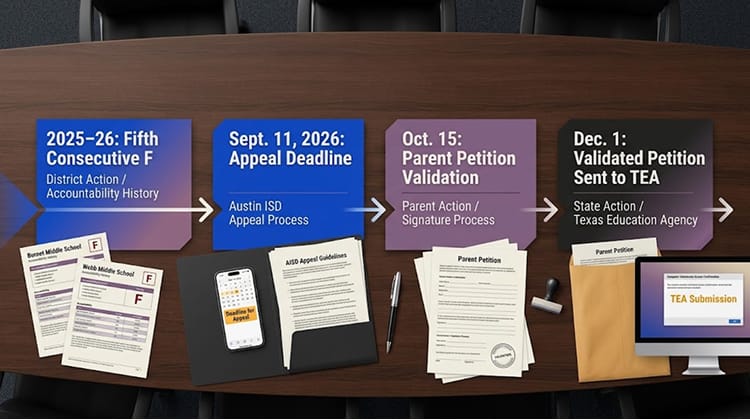
An appeal could potentially change the status of one or both campuses if the state’s review results in a different rating.
That means families should not assume that the current preliminary ratings are necessarily the final word.
The situation could therefore develop in stages:
- Austin ISD appeals the preliminary ratings by September 11.
- TEA reviews the appeals and determines the final campus ratings.
- If the fifth consecutive F ratings remain, the state intervention requirement continues.
- Parents could then pursue the petition process described by Watson.
- TEA Commissioner Mike Morath would ultimately determine the intervention required under state law.
Each stage could alter the choices facing families.
Austin’s School Takeover Fight Extends Beyond Two Campuses
Austin’s situation is part of a broader Texas debate about how the state should respond when campuses repeatedly fail to meet accountability standards.
At least 14 Texas districts were identified as being at risk of school takeovers or other serious state intervention in the future, with Austin among the districts facing immediate consequences because of two campuses reaching five consecutive unacceptable ratings.
The policy question is difficult.
State intervention is intended to address persistent academic problems and protect students from being trapped in schools that repeatedly fail to meet state standards. But replacing local leadership can also remove decision-making power from communities that elect their own school boards.
Austin’s case adds another possible solution: allow parents at chronically struggling schools to choose closure rather than expose the broader district to a potential takeover.
Whether that approach produces better outcomes for students will depend on what happens after the decision.
What Austin Families Should Watch Next
The next several months will be critical for Burnet, Webb and Austin ISD.
Families should pay attention to the September 11 appeal deadline, any final TEA decisions, communication from Austin ISD leadership and the development of any parent petition effort. They should also demand specific information about where students would attend school if either campus closes.
The central questions include:
- Whether Burnet and Webb retain their fifth consecutive F ratings after the appeal process.
- Whether parents at each campus support petitions for closure.
- Whether the Austin ISD Board of Trustees supports or opposes any validated petition.
- What intervention Commissioner Mike Morath ultimately selects.
- How Austin ISD would protect student transportation, academic programs and support services during a transition.
The situation is moving quickly, but the outcome is still unsettled.
Austin Mayor Kirk Watson’s proposal does not eliminate the consequences of the accountability ratings. Instead, it introduces a new choice into an already difficult situation: whether two school communities should accept the disruption of closure in order to preserve greater local control over the rest of Austin ISD.
For Burnet and Webb families, that decision could determine far more than the future of two middle-school buildings. It could influence where thousands of students learn, how neighborhoods maintain their school communities and whether Austin’s public education system remains under local control or enters a new chapter of state intervention.