

Texas public schools are preparing for one of the most significant curriculum changes in years after the State Board of Education approved a required literary works list that includes Bible stories and adopted a sweeping rewrite of social studies standards.
The changes were approved after months of debate over how Texas students should learn about religion, American history, race, culture and the development of the state and nation. The Republican-led board approved the required reading list on a 9-4 vote in June, while high school social studies standards received additional final action in September. Nearly 500 people addressed the board during the intense June discussions, with the debate extending late into the night.
The changes will not immediately replace what students are learning this school year. The Texas Education Agency says the adopted literary works rules have an effective date of July 1, 2027, while the new required literary works are scheduled for phased classroom implementation beginning in the 2030–31 school year.
That timeline gives school districts several years to prepare, but the debate over what Texas students should read and learn has already become one of the state’s most consequential education policy discussions.
What The Texas Board Approved
The new curriculum package involves two connected areas: required literary works and revised social studies standards.
Under the reading-list changes, Texas schools will be required to teach selected literary works at specific grade levels. The list includes biblical stories and passages, alongside works from the broader literary canon.
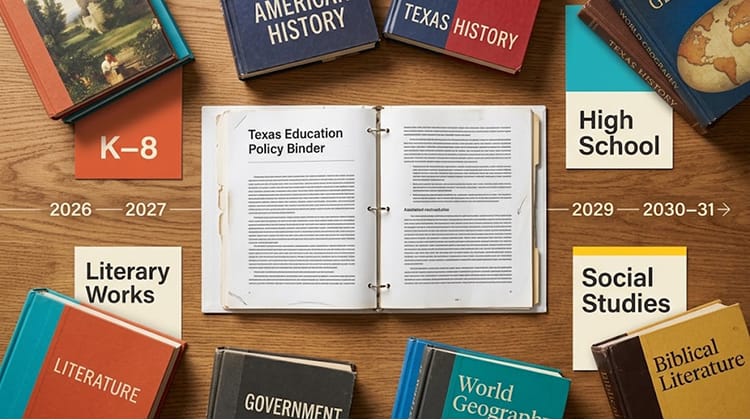
Among the Bible-related selections are stories involving Adam and Eve, Noah’s Ark, David and Goliath, Daniel and the Lion’s Den, the Beatitudes and the Parable of the Prodigal Son. Some selections are intended for students as young as elementary school age.
The Texas Education Agency’s official rules show that the reading lists were adopted under legislation requiring the State Board of Education to establish literary works for different grade levels. The rules cover Kindergarten through Grade 12, including separate lists for English and Spanish language arts programs.
At the same time, the board has been replacing the state’s existing social studies Texas Essential Knowledge and Skills, commonly known as TEKS.
The Texas Education Agency curriculum framework shows that the revision process has involved multiple rounds of public hearings, work groups and board amendments dating back several years.
The Changes Go Beyond The Bible
The reading list has received much of the public attention, but the social studies revisions could affect an even larger portion of the school day.
In June, the board approved new K–8 social studies standards. The state’s official description says the revised framework uses a more chronological approach to history, emphasizing connections among people, events and institutions over time. It also places a stronger emphasis on American founding principles and Texas history.
One major component is an eighth-grade Texas history capstone, which is intended to provide students with a more comprehensive study of Texas history through the present day. The official State Board description says the course will emphasize how Enlightenment principles influenced the Texas Constitution and the state’s founding ideals.
The changes also extend into high school.
On September 4, 2026, the State Board of Education considered and finalized new standards for high school United States history, United States government, world history and world geography. Those standards implement legislation approved during the 2025 Texas legislative session, including House Bill 824 and Senate Bill 24.
This means the curriculum overhaul is not simply an elementary-school reading initiative. It represents a broader restructuring of how Texas intends to organize social studies instruction from elementary grades through high school.
A New Approach To Teaching History
The State Board has described the revised social studies standards as a move toward chronological instruction.
Under that approach, students are expected to see historical developments as connected events rather than isolated facts. The state says students should examine why particular people, ideas and institutions mattered and how they influenced later developments.
That approach can have practical advantages for students.
History becomes easier to follow when students can connect one event to another. The American Revolution, for example, can be studied alongside Enlightenment political ideas, colonial government, economic conditions and the constitutional system that followed.
The challenge is deciding which events, perspectives and historical interpretations receive the greatest emphasis.
That is where the Texas curriculum debate becomes more complicated. Selecting what students study inevitably means deciding what receives classroom time and what receives less attention.
English teachers also raised concerns during the reading-list debate about the number of required works and the amount of instructional time available. With a school year containing a finite number of instructional weeks, adding required material can affect the flexibility teachers have to select additional texts.
The Role Of Race, Culture And Religious Diversity
One of the strongest criticisms of the curriculum revisions involves representation.
Opponents argue that some of the new social studies standards reduce attention to racial, geographic and cultural diversity. Supporters counter that the revised standards provide students with a clearer historical framework and restore material they believe was previously underemphasized.
The issue became even more contentious during the board’s August-September discussions of high school social studies.
The Texas Tribune reported that the board approved language concerning Islam and the September revisions despite testimony from Muslim Texans who argued that the material presented their religion in an overly negative manner. A number of experts also raised concerns about the historical framing of some of the proposed material.
Among those who testified was Habiiba Quresh, a 15-year-old student, who told board members she felt that the proposed language portrayed her religion as though it did not belong in Texas classrooms.
That testimony illustrates why curriculum decisions can have consequences beyond textbooks.
For students, the content of a history lesson can influence whether they see their families, communities and cultural backgrounds represented fairly in the story being taught.
Why Bible Stories Are Part Of The Debate
The inclusion of biblical material has attracted particular attention because Texas public schools serve students from many religious and cultural backgrounds.
Supporters of the reading list argue that biblical texts have played a major role in Western literature, American history and political thought. From that perspective, teaching stories from the Bible can provide students with cultural and historical references that appear throughout literature, art, politics and historical documents.

Critics have focused on a different question: whether requiring Bible stories in public-school instruction gives Christianity a preferred position compared with other religious traditions.
The debate became especially intense during the June board meetings. Students, teachers and advocacy organizations questioned the representation of racial, ethnic and religious groups in the proposed materials. The Texas Tribune reported that nearly 500 people spoke during the board’s discussions.
Rachel Laser, president and CEO of Americans United for Separation of Church and State, opposed the policy and argued that public schools should not impose a particular religious perspective on students. Other speakers defended the inclusion of biblical literature as an important part of classical education.
The dispute therefore goes beyond whether students should read the Bible. It raises a larger educational question about how public schools can teach religious texts as literature and history while maintaining a distinction between academic study and religious instruction.
What Students Will Actually See In Class
The changes will not appear overnight.
The State Board approved the new rules in 2026, but implementation is scheduled across multiple years. The official Texas Register shows that the new literary works rules have an administrative effective date of July 1, 2027. However, the instructional implementation of the elementary and secondary literary works lists is tied to later school years.
For the literary works list, the state is preparing schools for a transition beginning in 2030–31. The high school literary works provisions extend further into the implementation schedule, with certain Spanish-language high school provisions beginning in 2033–34.
That distinction matters for families.
A parent with a child entering Texas public school in 2026 will not suddenly see the entire new curriculum appear in the classroom this fall. Districts will have time to prepare materials, train teachers and adjust course planning before the new instructional requirements take effect.
The Texas State Board of Education’s adopted rules provide the state’s current implementation information and grade-level literary lists.
What The New Reading List Includes
The reading list is broader than the Bible passages that have dominated headlines.
The board adopted required works across grade levels, creating a statewide framework for literary instruction rather than leaving every selection entirely to individual districts and teachers.
| Grade Level | Examples Of The New Structure |
|---|---|
| Elementary | Classical literature and selected biblical stories introduced at age-appropriate levels |
| Middle School | Required literary works combined with existing language-arts instruction |
| High School | Required works connected to English courses and broader historical and literary themes |
The Texas Education Agency’s rules specify that required works are to be included in instruction at or before the designated grade level. The state also allows districts to use additional literary works that meet the applicable standards and maintain comparable rigor.
That means the state is establishing a required foundation rather than necessarily eliminating every local decision about what students read.
How Teachers And Districts May Be Affected
For teachers, the biggest practical issue may be time.
English language arts courses already have state standards covering reading, writing, vocabulary, research and communication. Adding required works means educators will have to determine how those texts fit into existing units.
The same issue applies to social studies.
Teachers will have to align lessons with revised TEKS while still covering the required material within the available school calendar. District curriculum departments will also need to update pacing guides, instructional materials and professional-development plans.
The state began preparing for these changes years ago. TEA’s social studies review documents show that the revision process included public hearings, focus groups and work groups before the board’s final votes.
For students, the practical result will eventually be a more standardized curriculum across Texas public schools.
That consistency can make it easier for students who move between districts to encounter similar material. But it also reduces some of the flexibility individual districts and teachers previously had in determining which texts and historical examples received the greatest emphasis.
The Political Debate Is Likely To Continue
The State Board’s votes settle the formal adoption process for these portions of the curriculum, but they are unlikely to end the political debate.
The board’s 9-4 vote on the required reading list reflected a sharply divided political environment. Two board members were absent during that vote, according to reporting from the Texas Tribune.
The high school social studies changes have generated their own controversy, particularly around the treatment of religion and cultural groups.
At the center of the disagreement are two competing ideas about public education.
One side argues that Texas schools should give students a strong shared foundation in Western civilization, American history, constitutional principles and classic literature.
The other argues that a shared curriculum can still be academically rigorous while presenting a broader range of religious, racial, cultural and historical perspectives.
Those arguments will continue as districts prepare to put the new requirements into practice.
What Texas Families Should Watch Next
Parents and students have several years before the full literary works requirements are implemented, but the preparation process will become increasingly visible.
Families should pay attention to:
- When districts begin adopting new textbooks and instructional materials aligned with the revised TEKS.
- How individual school systems interpret the required literary works and provide context around religious texts.
- Which additional books and historical perspectives teachers continue to include beyond the state-required material.
- How the revised standards affect course planning, assessments and instructional time.
The state has also established a process for dealing with required works that become unavailable or too expensive to obtain at the scale needed for statewide implementation. Under the adopted rules, the commissioner can report such circumstances to the State Board, which can then consider removing a work through the formal rulemaking process.
That gives the system some flexibility while keeping the core requirements in place.
The Bigger Question Is What Texas Students Should Know
Texas’ curriculum overhaul ultimately raises a question larger than the inclusion of any individual Bible story or history standard: What knowledge should every Texas student share by the time they graduate?
The State Board has answered that question by emphasizing chronological history, classical literature, American founding principles, Texas history and selected religious texts.
Critics believe the new framework places too much emphasis on Christianity and particular interpretations of history while giving insufficient attention to some communities and perspectives.
The effects will take years to measure because the most significant changes have not yet reached classrooms statewide. The required literary works are scheduled for phased implementation beginning in the 2030–31 school year, giving today’s younger students a different curriculum path from students who graduate before the new standards fully take effect.
For Texas students, the most important part of the debate will eventually move from the State Board meeting room in Austin to their actual classrooms. The question will be whether the new curriculum gives students a stronger grasp of history and literature while allowing them to examine competing perspectives, understand the state’s religious and cultural diversity, and distinguish historical study from religious instruction.
That classroom experience—not the intensity of the board debates—will ultimately determine how Texas’ new curriculum is judged by the students and families who live with it.