
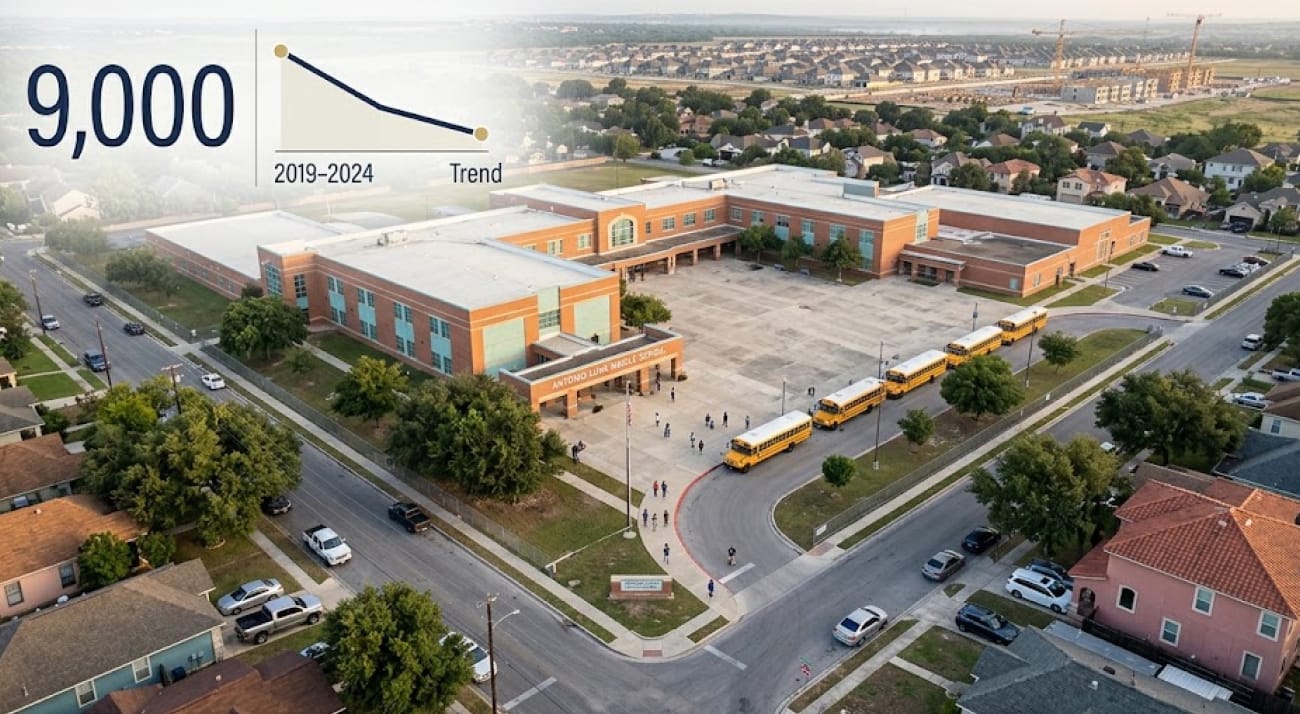
San Antonio’s public education system is beginning the 2026-27 school year with a major enrollment challenge. Across 18 school districts that shared current enrollment figures with the San Antonio Express-News, roughly 9,000 fewer students have registered compared with the previous school year. The decline is affecting districts across Bexar County, although the scale varies considerably from one community to another. San Antonio school enrollment data show that the shift is becoming more than a short-term post-pandemic fluctuation, with demographic changes, school choice and changing family decisions all contributing to a smaller traditional public-school population.
The numbers matter because enrollment is directly connected to how districts plan staffing, operate campuses, maintain facilities and prepare budgets. A school system that loses thousands of students cannot simply continue operating the same number of classrooms and campuses indefinitely. At the same time, a declining enrollment count does not automatically mean fewer children are living in the region. San Antonio’s current situation is more complicated: some students are moving to charter schools or private schools, some families are choosing homeschooling or other educational arrangements, and demographic trends are reducing the number of children entering the school system.
San Antonio’s Enrollment Decline Is Happening Across Multiple Districts
The combined loss of approximately 9,000 students across 18 districts provides the clearest indication of how broad the change has become. The Express-News reported that shrinking enrollment is occurring across the city and state, with only a limited number of local systems bucking the trend. South San Antonio ISD illustrates the pressure particularly clearly, with the district losing about 700 students and now sitting nearly 25% below its pre-pandemic enrollment level.
Northside Independent School District, one of the largest districts in the San Antonio region, has also been dealing with sustained enrollment pressure. The district has lost around 10,000 students since 2020, according to recent reporting, even as parts of the surrounding region continue to grow. That creates a particularly difficult planning problem because population growth in the broader metropolitan area does not necessarily translate into enrollment growth for a particular traditional school district.
The contrast is especially visible when comparing Northside with Comal ISD. Comal continues to add approximately 1,000 students a year and expects its enrollment to reach roughly 40,000 by 2035. The district is planning new campuses and infrastructure to accommodate that growth, while districts closer to central San Antonio are confronting excess capacity and considering how many campuses they can realistically operate.
This creates two very different education landscapes within the same metropolitan region. Some communities need additional classrooms, while others have more buildings and seats than their student populations require.
Birth Rates Are Only Part Of The Story
One of the easiest explanations for declining enrollment is a reduction in the number of children being born. That factor is real, but the San Antonio data suggest it cannot explain the entire change.
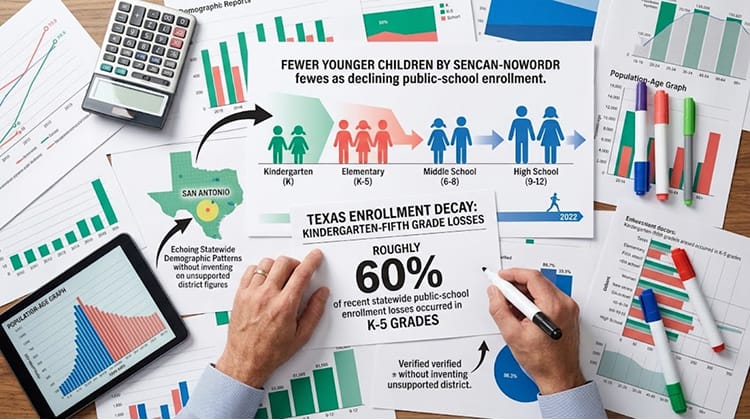
Texas experienced a major public-school enrollment decline during the 2025-26 school year. Research from Texas 2036 found that statewide public-school enrollment fell by approximately 76,000 students in a single year, representing the largest non-pandemic annual decline in nearly four decades. Hispanic students accounted for about four out of every five students lost, while nearly 60% of the decline occurred in kindergarten through fifth grade.
That elementary-school pattern is particularly significant. When fewer children enter kindergarten and the early grades, the effect does not stop there. Smaller elementary cohorts eventually become smaller middle-school classes and then smaller high-school populations.
Texas 2036 projects that public-school enrollment could decline by approximately another 100,000 students by 2030. Its projections also warn that the effect of the state’s new education savings account program is not fully incorporated into those estimates, meaning actual enrollment could fall below some projections depending on how families respond to school-choice options. Texas public-school enrollment projections show how demographic trends are becoming a long-term planning issue rather than a single-year problem.
For San Antonio, that means district leaders have to plan for both the students who are already leaving and the possibility that fewer children will enter the system in future years.
Texas Vouchers Add Another Layer To The Enrollment Shift
San Antonio’s enrollment picture is also unfolding during the first year of Texas’ statewide private-school voucher program.
The Texas Education Freedom Accounts program has already placed significant public funding behind private-school choices. In August, Texas Comptroller Don Huffines announced that more than 100,000 students statewide had received TEFA funding for the 2026-27 school year. The program allows participating families to use funds for approved educational expenses, including private-school tuition, tutoring, curriculum and certain special-education services.
San Antonio has a substantial number of students participating. Earlier this year, the Comptroller’s office reported that at least 8,405 students living within San Antonio school-district boundaries would use the new program. Statewide, the initial program was funded at $1 billion for the 2026-27 school year.
The relationship between vouchers and the city’s enrollment decline needs to be handled carefully. The 9,000-student reduction cannot be attributed entirely to vouchers. Some participating students may already have been attending private schools or homeschooling before receiving state assistance. Lower birth rates and other demographic factors are also influencing the numbers.
Still, the timing is important. Traditional public schools are losing students at the same time Texas is expanding the amount of public funding available for families choosing alternatives.
That creates a new competitive environment for San Antonio school districts.
The Financial Impact Goes Beyond Empty Classrooms
A smaller student population creates financial challenges because many school costs do not decline at the same rate as enrollment.
A district cannot immediately eliminate a school building because 100 fewer students are enrolled. It still has to maintain the property, pay utilities, provide transportation, operate administrative systems and employ enough staff to serve the students who remain.
Over time, however, persistent enrollment declines make those costs harder to justify.
San Antonio ISD has already experienced this pressure. The district previously voted to close 15 campuses and has continued examining additional reductions as enrollment falls. District officials have considered a future model that could reduce the number of campuses by more than 40%.
That creates a difficult choice for school boards. Closing campuses can reduce operating costs, but it can also force students to travel farther, disrupt established school communities and create strong opposition from parents and neighborhood residents.
The enrollment decline therefore becomes a facilities issue as much as a demographic statistic.
Fewer Students Could Reshape San Antonio Neighborhood Schools
For families, the most visible consequence may eventually be changes to the schools closest to home.
When districts have substantially more classroom capacity than students, administrators have to determine which campuses remain viable. Decisions can involve enrollment projections, building conditions, transportation routes, academic performance and the geographic distribution of students.
San Antonio’s previous campus closures demonstrate how contentious those decisions can become. The issue is especially sensitive in neighborhoods where a school functions as more than a place for classes. It may also serve as an athletics center, community gathering point, polling location or one of the most recognizable public institutions in the area.
The decline could also alter the experience inside schools that remain open.
Smaller enrollment can create opportunities for smaller class sizes or more individualized attention if staffing is adjusted appropriately. But if staffing and resources are reduced faster than student needs decline, families could experience fewer programs, reduced extracurricular opportunities or less access to specialized services.
The outcome will depend heavily on how individual districts manage the transition.
School Choice Is Changing Where San Antonio Students Go
Another major factor is competition between traditional school districts and alternative education providers.
San Antonio has one of the most diverse education markets in Texas, with traditional independent school districts operating alongside charter networks, magnet programs, private schools, homeschooling and online education options. Families increasingly have opportunities to choose a school outside the neighborhood assigned to them.
Northside ISD, for example, began an open-enrollment approach this school year in an effort to attract students who live outside its traditional boundaries. The district reportedly attracted approximately 420 students through the program. San Antonio ISD has taken an even broader approach, bringing in thousands of students from outside its boundaries, with more than half attending in-district charter campuses.
That competition means enrollment is becoming a measure of family choice as much as population.
Charter schools themselves are now preparing for the possibility of slower growth. In September, two San Antonio charter operators—the School of Science and Technology and Compass Rose Public Schools—combined central-office resources in an effort to move more money into classrooms while protecting their budgets against potential enrollment declines. Compass Rose serves roughly 4,000 students across schools in San Antonio and Austin, while the School of Science and Technology operates nine local campuses.
The move demonstrates that enrollment pressure is not limited to traditional ISDs. Every type of education provider has an incentive to attract and retain students.
Comal’s Growth Shows Why San Antonio’s Story Is Not Uniform
The regional contrast between declining urban districts and growing suburban systems is one of the most important parts of the story.
Comal ISD is planning for growth along the Interstate 35 corridor, including new elementary campuses and additional infrastructure. Its expected enrollment trajectory is dramatically different from that of districts that have been losing students for years.
That difference suggests that San Antonio’s education challenge is partly about where families live and where they choose to attend school, not simply whether the region has children.
Housing development, migration patterns, school reputation, transportation, academic programs and school-choice policies can all influence where students eventually appear in enrollment counts.
For San Antonio youth education, that makes enrollment more than a budget statistic. It is a signal of how families are responding to the region’s changing communities and educational options.
Elementary Enrollment Could Determine The Next Decade
The strongest warning sign may be the age of the students disappearing from public-school enrollment.
Texas 2036 found that roughly 60% of the state’s recent enrollment decline occurred in kindergarten through fifth grade. That matters because those children form the pipeline for future middle and high schools.
If San Antonio districts continue seeing fewer children enter elementary schools, today’s enrollment challenge will eventually move into middle schools and high schools.
That could affect everything from athletic programs to advanced courses.
A high school that once supported multiple football teams, extensive elective offerings and large numbers of advanced courses may eventually have to reconsider how those programs are structured if its enrollment falls substantially. Smaller schools could gain advantages in some areas, but maintaining specialized courses becomes more difficult when there are fewer students to support them.
The effect could also extend to the local workforce. Texas 2036 has warned that enrollment trends influence school funding, staffing and long-term workforce planning.
District Leaders Face A New Kind Of Competition
San Antonio’s school districts are now competing in an environment that looks very different from the one that existed a decade ago.
Parents have more choices, charter operators are actively recruiting students, private schools are receiving new state-backed funding, and some districts are opening their boundaries to attract families. At the same time, demographic trends are reducing the number of children entering public schools.
The response is already visible.
Districts are reviewing campus footprints, experimenting with open enrollment, promoting specialized academic programs and reconsidering how they allocate resources. Charter operators are consolidating administrative operations to protect classroom spending. Families are weighing traditional neighborhood schools against an increasingly broad menu of alternatives.
The question for San Antonio is therefore no longer simply how to reverse a 9,000-student decline.
The larger question is whether traditional public school districts can adapt quickly enough to a system where student enrollment is becoming more mobile, more competitive and more sensitive to family choice.
For students, that shift could determine where they attend school, what programs are available to them and how their communities invest in education for years to come.