
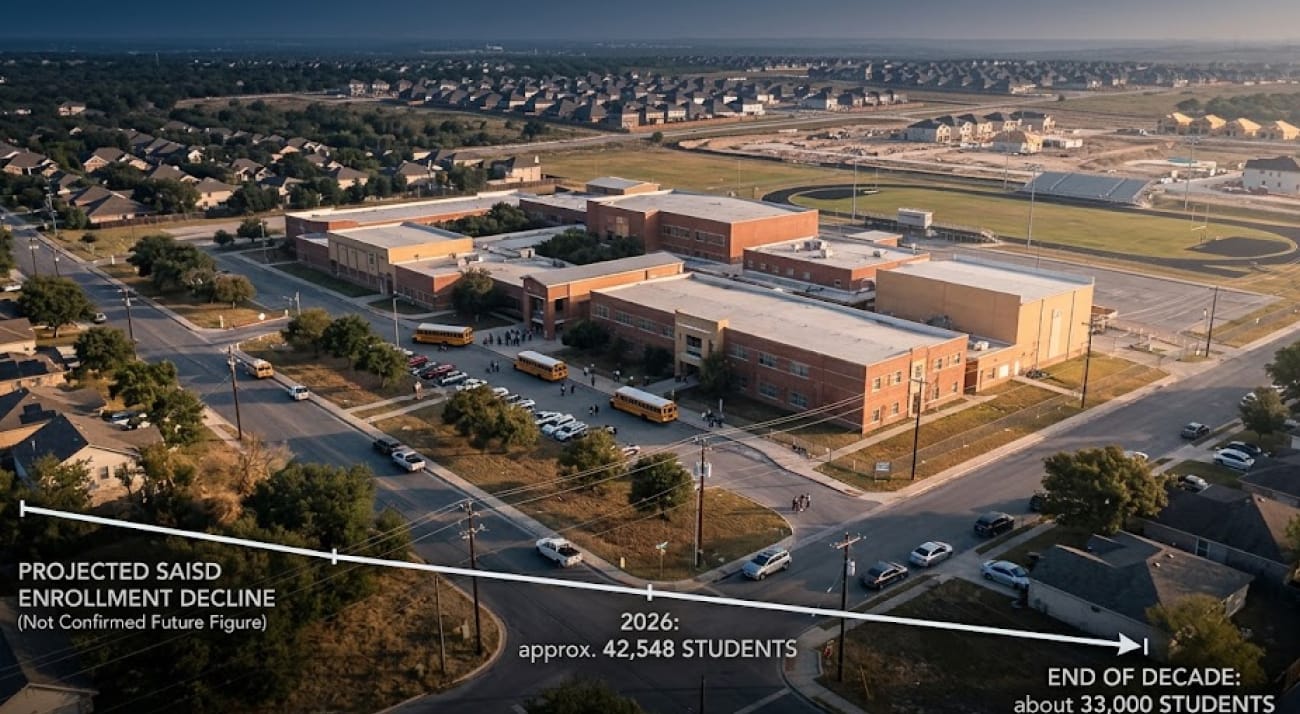
San Antonio Independent School District is facing a major change in the size of the student population it serves. The district currently enrolls about 42,548 students across 83 campuses, but officials expect that number could fall to approximately 33,000 students by the end of the decade. That would represent a decline of roughly 9,500 students from the current enrollment level and would reshape how the district staffs schools, maintains buildings, allocates funding and decides which campuses remain open.
The projection comes at a particularly consequential moment for SAISD. Trustees are preparing for a November election involving a proposed $600 million bond package and a property-tax rate increase, while the district is simultaneously dealing with money from its previous bond program that has not yet been spent. The combination creates a difficult planning problem: SAISD needs to address aging infrastructure and campus needs while also preparing for a student population that could be thousands smaller within only a few years.
The issue is therefore bigger than enrollment alone. It raises questions about what a smaller urban school district should look like, how many campuses it can reasonably operate and how much taxpayers should invest in facilities when fewer students are expected to use them.
SAISD Has Already Lost A Significant Share Of Its Enrollment
The projected decline to 33,000 students would extend a trend that has already been underway for years.
According to the Texas Tribune’s Schools Explorer, SAISD had 42,548 students in 2026, representing a 19.8% decline from 2016. The district currently operates 83 campuses, including 51 elementary schools, 12 middle schools and 14 high schools, along with several specialized and multi-level campuses.

That means SAISD is not starting its planning process from a stable enrollment base. It has already experienced years of contraction, and administrators have previously responded by closing and consolidating schools.
The scale of the change becomes clearer when looking at the district’s recent history. SAISD closed 15 campuses at the end of the 2023-24 school year as part of an effort to match its facilities with declining enrollment and financial constraints. Earlier this year, the district was also considering the closure of Carvajal Elementary on San Antonio’s West Side because of enrollment and academic concerns.
The district’s challenge is therefore becoming structural rather than temporary. If enrollment eventually reaches 33,000, SAISD would be serving a student population considerably smaller than the system that existed when many of its current facilities were planned and built.
A 33,000-Student District Would Need A Different Campus Strategy
Enrollment determines much more than the number of students sitting in classrooms.
District leaders use enrollment projections when determining teacher staffing, transportation routes, academic programs, maintenance needs and whether existing facilities have enough students to justify their operating costs. The Texas Tribune notes that enrollment trends can directly influence decisions about school closures and facility expansion.
SAISD has already acknowledged that its existing campus footprint may be too large for its future student population.
The district has referred to this process as “rightsizing,” which involves considering whether the number and size of campuses align with the number of students being served. A previous facilities assessment identified more than $580 million in mechanical, electrical and plumbing upgrades, while the district projected another $781 million in capital life-cycle needs by 2028.
Those figures illustrate the central problem.
SAISD is responsible for a large inventory of aging buildings, but declining enrollment means fewer students are available to spread the cost of maintaining those facilities. Closing campuses can reduce some operating expenses, but it can also require students to travel farther and can disrupt long-established neighborhood schools.
The district must therefore decide whether to invest heavily in existing buildings, replace some facilities, consolidate campuses or pursue a combination of those strategies.
The Financial Pressure Is Growing At The Same Time
SAISD’s enrollment projection comes alongside a difficult financial situation.
Recent reporting indicates the district is facing a budget deficit while dealing with rising operating costs and relatively limited growth in state funding. The district has also been reviewing how to use existing bond resources while considering another large bond package for voters.
That creates a particularly complicated situation for district trustees.
A district with declining enrollment may have less recurring revenue tied to student counts, yet its buildings still require major repairs. Heating and cooling systems, electrical infrastructure, security equipment, technology networks and other capital needs do not disappear when enrollment falls.
At the same time, borrowing hundreds of millions of dollars for facilities becomes harder to evaluate when officials expect the student population to decline substantially.
The issue is not simply whether SAISD needs money for its schools. The more specific question is how much infrastructure the district should maintain for the number of students it expects to serve.
SAISD Is Asking Voters To Consider $600 Million In Bonds
SAISD trustees voted to put a $600 million bond package before voters in November, along with a proposed property-tax rate increase. The package is intended to address several categories of district needs, including aging heating and cooling systems, campus security, technology and improvements to Alamo Stadium and the Convocation Center.
The proposal comes after the district’s previous $1.3 billion bond approved in 2020, which was the largest bond measure ever approved in Bexar County at the time. Yet roughly $420 million of that previous bond remains unspent, according to recent reporting. Trustees have questioned the pace and status of projects as construction costs have increased and some plans have changed.
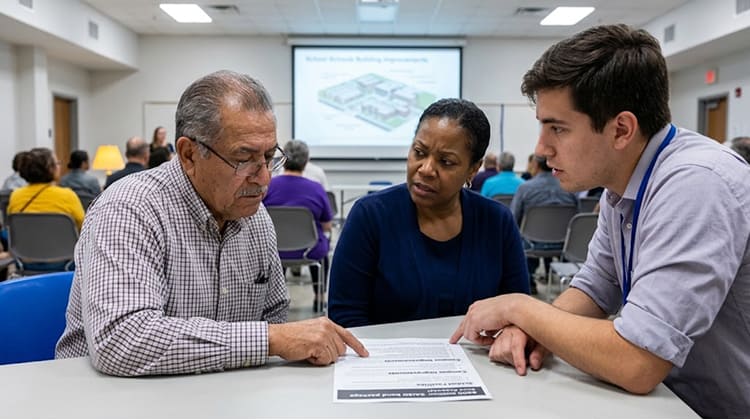
That unfinished work is now part of the public discussion surrounding the new proposal.
A recent board meeting highlighted the tension. Trustees debated the district’s enrollment decline, previous bond spending and whether certain projects still made sense given the changing student population. A proposed $65.8 million renovation project involving two campuses was tabled amid concerns related to enrollment and accountability.
For families, the debate could have consequences well beyond November’s ballot. The decisions made now could determine which campuses receive major upgrades, which facilities are consolidated and where future students attend school.
What Happens To The Previous Bond Matters
The remaining money from the 2020 bond is one of the most significant factors in the current debate.
SAISD has completed dozens of projects under the previous program, while other projects remain in various stages of construction, design or planning. In 2025, the district reported 96 projects completed, 13 under construction, 15 in design and 11 in programming.
But inflation, supply-chain problems, labor shortages and changes in campus plans have affected the original assumptions behind some projects.
That makes long-term facilities planning especially important now.
If the district eventually has about 33,000 students, a facility plan developed around today’s 42,548 students could quickly become outdated. A school designed for a larger population may have substantially more classroom capacity than the district needs several years later.
This is why SAISD’s enrollment forecast is directly connected to the bond conversation.
The district is effectively trying to solve two problems at once: address immediate infrastructure deficiencies while avoiding investments that could become difficult to justify if enrollment continues falling.
The New Way Forward Could Reshape The District
SAISD is also developing a strategic plan known as “New Way Forward.” The effort is expected to examine how the district should operate as its student population changes, including potential campus closures and adjustments to academic programming.
The plan matters because simply closing schools one at a time may not provide a complete response to a long-term enrollment decline.
A smaller district could require a different distribution of campuses, fewer administrative costs, revised transportation patterns and a different approach to specialized programs.
For example, SAISD operates a mix of traditional neighborhood schools, early-college campuses, Montessori programs, college-preparatory schools and other specialized options. The district’s current campus inventory includes programs such as Advanced Learning Academy, Travis Early College High School, Young Women’s Leadership Academy and several specialized academies.
Those programs complicate the rightsizing discussion because enrollment cannot be evaluated solely by looking at the number of students in a building.
A small specialized campus may serve a different educational purpose than a larger neighborhood school. Closing it could reduce facility costs while also eliminating a program that attracts families from across the district.
San Antonio’s School Enrollment Trends Are Not Uniform
SAISD’s projected decline also has to be understood within the broader San Antonio metropolitan area.
Some districts are losing students while others are growing rapidly. East Central ISD, for example, has projected substantial enrollment growth as residential development expands in its boundaries. The district previously projected its enrollment could rise from 11,622 students to 25,617 by the 2033-34 school year, demonstrating how dramatically enrollment patterns can differ within the same metropolitan region.
That distinction is important for families.
San Antonio’s overall population can grow while individual school districts lose students. New housing developments may be built outside the boundaries of an older urban district, while families already living in established neighborhoods may choose charter schools, private schools, homeschooling or other educational options.
The result is a regional education map that is increasingly uneven.
For San Antonio education news, the SAISD projection is significant because it shows how demographic and enrollment changes can eventually affect the schools students see every day, from classroom availability to campus locations and extracurricular opportunities.
Students Could Experience The Effects Before 2030
A projection of 33,000 students may seem like a distant planning issue, but students and families could experience the consequences much earlier.
Campus consolidation can affect transportation times. Changes in enrollment can influence whether schools continue offering particular electives or extracurricular activities. Staffing adjustments can alter the availability of counselors, teachers and specialized support.
Even the physical condition of a campus can be affected by the district’s financial choices.
SAISD has identified major needs involving air conditioning, electrical systems, security and technology. Those improvements directly affect students because San Antonio’s climate makes reliable cooling especially important during the school year. Modern security infrastructure can also affect how students and staff enter and move through campuses.
The challenge is making those investments strategically.
A district cannot reasonably postpone every major improvement simply because enrollment is declining. Students currently attending SAISD still require safe, functional classrooms and access to educational resources.
But spending decisions also need to account for the district’s future size.
The November Election Will Add Another Layer To The Debate
The November ballot will give San Antonio voters a direct role in one part of SAISD’s financial planning.
The district’s proposed $600 million bond package is accompanied by a proposed 3.17-cent tax-rate increase, which officials estimate would generate approximately $5.5 million in additional annual revenue. The bond package would finance capital projects, while the tax-rate increase would provide additional operating revenue.
The election is scheduled for November 3, 2026, with early voting beginning October 19 and voter registration closing October 5.
The timing makes the 33,000-student projection especially relevant to the public discussion.
The district is asking residents to consider major investments at the same time trustees are acknowledging that the number of students using the system could fall substantially.
That does not automatically determine whether individual projects are necessary or unnecessary. It does mean that future enrollment is one of the key facts residents can examine when evaluating the district’s long-term facilities strategy.
What 33,000 Students Could Mean For SAISD’s Future
If the projection becomes reality, SAISD would be operating with approximately 9,500 fewer students than it has today. That is equivalent to losing a student population larger than many individual school districts serve.
The resulting changes could touch nearly every part of the organization.
| Area | Potential Planning Pressure |
|---|---|
| Campuses | Fewer students could accelerate consolidation or closure discussions |
| Staffing | Teacher and administrative positions may need to adjust with enrollment |
| Facilities | Aging buildings could require investment even as some campuses become underused |
| Transportation | Consolidated campuses could create longer routes for some students |
| Programs | Specialized and extracurricular offerings could be reassessed based on participation |
| Budget | Lower enrollment and fixed facility costs could increase pressure on recurring finances |
The district’s task is to make those adjustments without reducing educational opportunities for the students who remain.
That will require decisions based on enrollment data, campus conditions, academic outcomes, transportation needs and the location of future housing—not simply the number of buildings SAISD currently operates.
The district has already demonstrated that closures are possible. Fifteen campuses were closed after the 2023-24 school year, and additional rightsizing decisions remain under consideration.
The projected move toward 33,000 students would make those conversations even more consequential.
The Next Few Years Will Define San Antonio ISD’s Shape
SAISD’s projected enrollment decline is ultimately a test of long-term planning.
The district has to maintain schools for today’s students while preparing for a smaller student population. It has to address hundreds of millions of dollars in infrastructure needs while explaining how new investments fit into a changing campus footprint. And it has to determine which schools and programs should remain available as the number of students continues to change.
The 42,548 students enrolled in 2026 provide the immediate starting point. The projected 33,000 students by the end of the decade provide the warning about what could come next.