
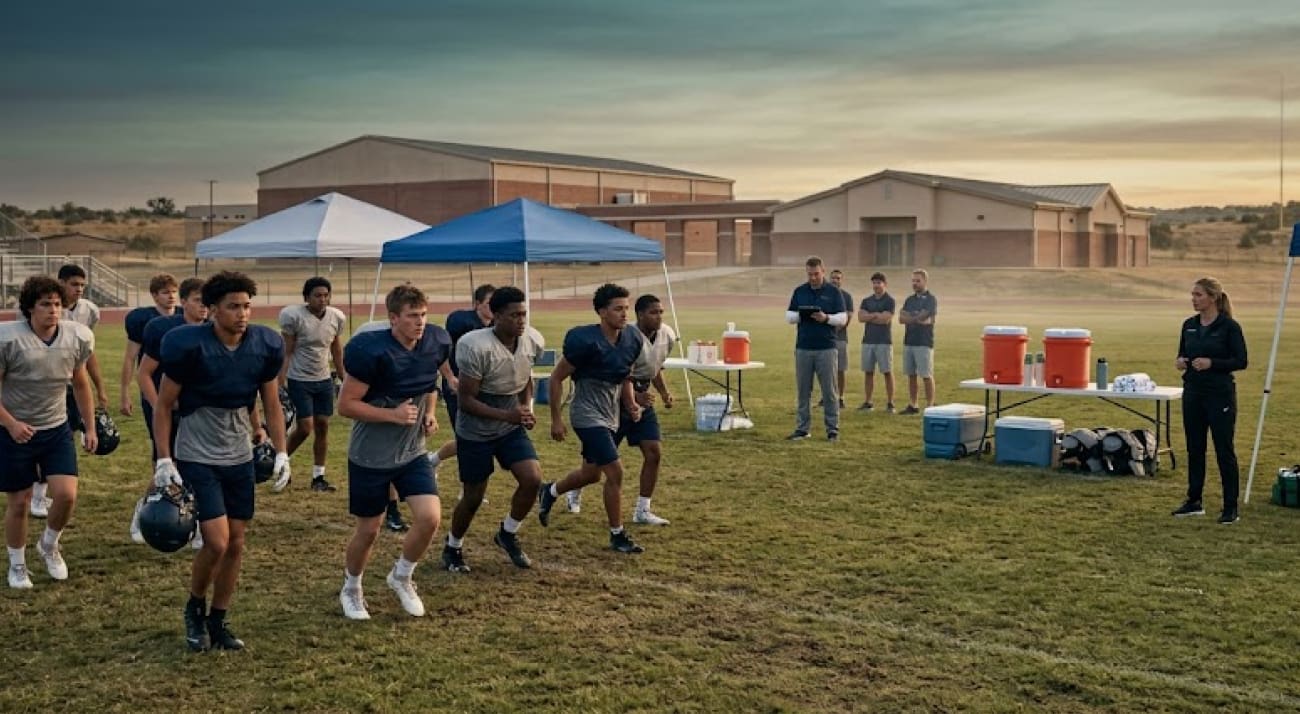
Texas high school athletics entered the 2026–27 school year under a significant change in how schools manage extreme heat. Beginning August 1, 2026, the University Interscholastic League (UIL) made its heat-stress protocols mandatory for outdoor athletic and marching band activities, replacing several years of recommended guidance with statewide requirements. The rules require schools to use Wet Bulb Globe Temperature (WBGT) readings to determine when practices must be modified, shortened or stopped.
The change affects thousands of student-athletes across Texas, from football players practicing in the Rio Grande Valley to marching band members preparing in Houston, San Antonio and Dallas. It also changes the daily responsibilities of coaches, athletic trainers and school administrators. For families following Texas youth sports news, the new policy represents a major shift in how the state balances competitive preparation with student safety during increasingly demanding summer conditions.
Why UIL Made Heat Safety Mandatory
UIL did not introduce the WBGT system overnight.
The organization approved WBGT as a recommended forecast measurement in 2023, giving schools several years to incorporate the system into outdoor athletics. After evaluating implementation and consulting its Medical Advisory Committee, UIL moved to make the protocols mandatory beginning with the 2026–27 school year. The UIL Legislative Council approved the change in June 2026.
The underlying issue is that ordinary air temperature does not tell the entire story of heat exposure.
A 95°F afternoon with relatively low humidity can place a different level of stress on the body than a 95°F afternoon with high humidity and direct sunlight. WBGT attempts to capture those conditions by accounting for air temperature, relative humidity, wind speed and solar radiation.
That makes the measurement particularly relevant to Texas athletics.
A football field covered in direct sunlight can create significantly different conditions from a shaded sideline. A humid coastal community can present different risks from a dry West Texas location, even when both locations report similar air temperatures.
The new system gives schools a standardized way to account for those differences.
How The New WBGT System Works
Under the 2026–27 requirements, UIL member schools conducting outdoor athletic and marching band activities must monitor WBGT and adjust activities according to the reading.
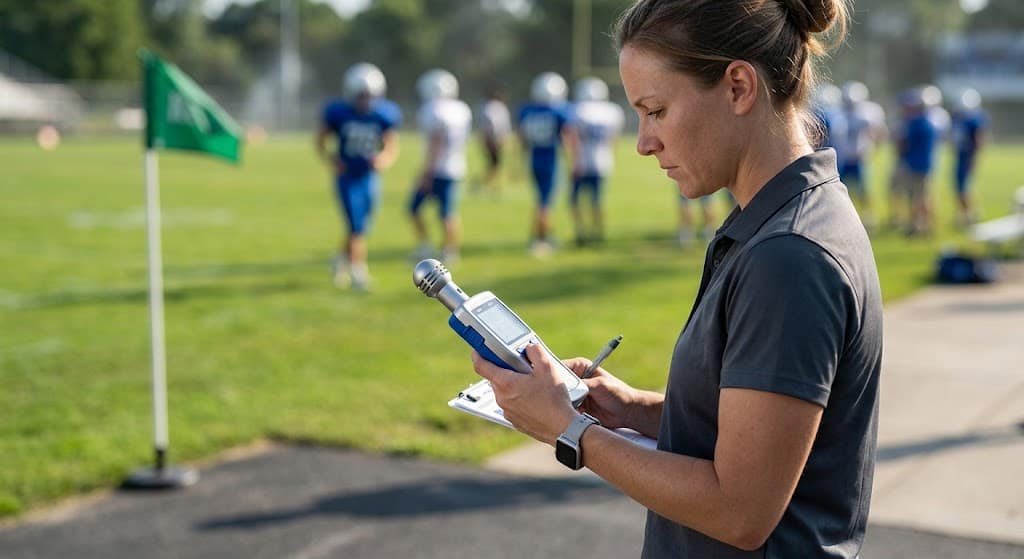
Schools must take a WBGT reading within 15 minutes before practice begins and then continue monitoring conditions every 30 minutes during the practice period. UIL also recommends that, when possible, the same person take the readings throughout a practice window to maintain consistency.
The system creates escalating safety requirements as heat stress increases.
| WBGT Condition | General UIL Response |
|---|---|
| Lower-risk conditions | Normal activity with regular monitoring |
| Elevated WBGT | Rapid cooling zone and additional precautions required |
| High WBGT | Reduced practice duration, equipment restrictions and additional rest/hydration |
| Extreme WBGT | Practice duration sharply limited or outdoor activity stopped |
The exact requirements depend on the UIL classification and the applicable WBGT range, so coaches cannot simply rely on the day’s air-temperature forecast.
That is one of the biggest practical changes.
Instead of asking, “How hot will it be today?” athletic staffs must ask, “What will the measured heat stress be at this particular location and time?”
Practice Schedules Could Change Across Texas
The new policy could influence when teams practice.
A football team that traditionally begins a two-hour afternoon session may need to move its work earlier in the morning when WBGT conditions are more manageable. Another school might shift conditioning indoors or reduce the amount of equipment worn during the hottest portion of the practice.
UIL’s rules allow modifications based on environmental conditions, including changes to practice duration, work-to-rest ratios, hydration opportunities and equipment.
For schools, that creates a scheduling challenge.
Coaches have to prepare athletes for competition while also working within conditions that can change significantly during a single afternoon.
A practice beginning at 4 p.m. may have a substantially different WBGT reading at 5 p.m. The requirement to check conditions every 30 minutes means the decision-making process continues throughout the session rather than occurring once before players step onto the field.
That creates a more dynamic approach to athletic preparation.
The UIL heat-safety requirements now provide the statewide framework coaches and athletic departments must follow.
Why Football Is At The Center Of The Discussion
Football has become the most visible testing ground for the new rules because preseason practices occur during some of the hottest weeks of the Texas calendar.
The 2026 football calendar began conditioning for many schools on August 3, with full-contact practices permitted beginning August 8. The first scrimmages were scheduled for August 13, putting teams into an intensive preparation period while temperatures across the state remained high.
That timing creates a difficult balance.
Football players need time to learn systems, develop conditioning and prepare for contact. Coaches need enough practice opportunities to establish depth charts and team strategies. At the same time, athletes cannot safely train as though every August afternoon were environmentally identical.
The new rules force those competing priorities into the same decision-making framework.
Safety does not eliminate competitive preparation.
Instead, it changes how preparation has to be organized.
The Recent Lake Travis Tragedy Adds Weight To The Debate
The new rules are being discussed during a particularly emotional period for Texas high school football following the death of 17-year-old Odin Hensley, a Lake Travis High School senior and football player.
Hensley suffered a medical emergency during football practice on August 10, 2026, and was transported to Dell Children’s Medical Center. He died several days later on August 13. Local reporting said the emergency involved cardiac arrest, while the circumstances of the incident remain distinct from any assumption that heat caused his death.
That distinction is critical.
There is no basis for concluding that Hensley’s death was caused by the new heat-rule issue or that heat was the cause of his medical emergency. His death occurred as UIL’s mandatory protocols were taking effect, but correlation should not be presented as causation.
What the tragedy does demonstrate is the seriousness with which Texas communities view medical emergencies involving young athletes.
The Lake Travis community has mourned Hensley, who had been part of the school community since elementary school and participated in both football and wrestling. A memorial service was scheduled for August 22 at Austin Ridge Bible Church.
For coaches and families, the event reinforces why emergency preparedness matters even when an incident cannot be attributed to heat.
Rapid Cooling Is Now A Required Part Of The Plan
One of the most consequential elements of the UIL policy is the requirement for rapid cooling capability during higher-risk conditions.
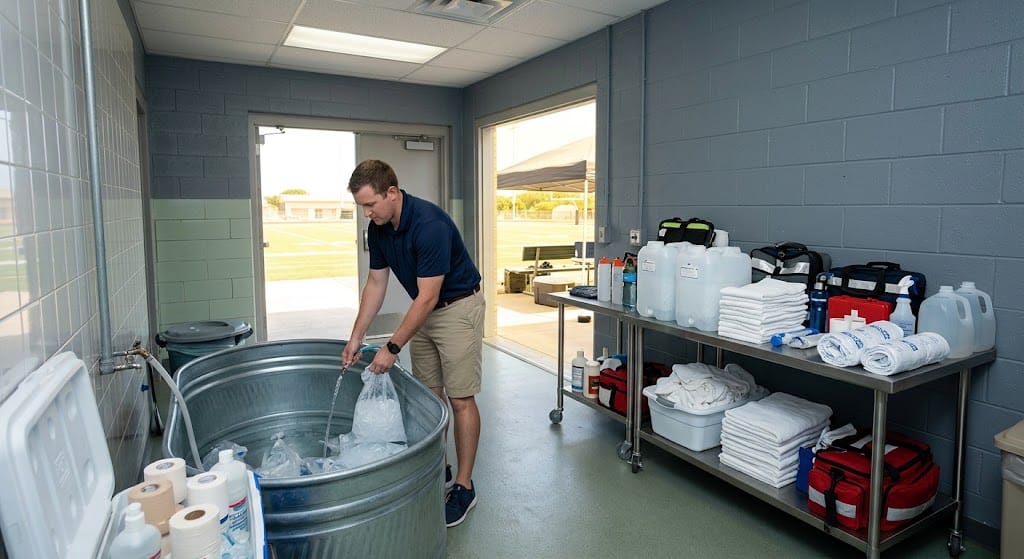
UIL requires schools to have equipment capable of full-body immersion in ice water for athletes experiencing heat illness and distress. Rapid cooling zones must be available for outdoor activities when the WBGT reaches specified thresholds, with options including cold-water immersion tubs or tarp-assisted cooling methods.
This represents a shift from simply recognizing heat illness to preparing for immediate treatment.
That difference can matter in an emergency.
UIL identifies exertional heat stroke as a leading preventable cause of death in high school athletics and provides schools with resources for emergency response.
The policy also requires unrestricted access to water during practices. Rest periods must include opportunities for hydration and recovery rather than simply replacing one physical activity with another.
The National Federation of State High School Associations’ heat-illness resources similarly emphasize prevention, acclimatization and rapid recognition of heat-related emergencies.
The Rules Apply Beyond Football
Football may dominate the conversation, but the UIL policy reaches much further.
The mandatory heat protocols cover outdoor athletics and marching band activities. That means cross-country runners, soccer players, tennis players, track athletes and marching band members can all be affected by environmental conditions.
Marching band is particularly important because students may spend extended periods outdoors while carrying instruments and wearing uniforms that can increase physical demands.
A student participating in an afternoon rehearsal could therefore face many of the same environmental challenges as an athlete.
The policy recognizes that heat stress is not limited to traditional sports.
This broader application is one reason the new system is significant for youth development. School activities provide opportunities for teamwork, discipline, leadership and physical activity, but those benefits depend on students being able to participate safely.
Regional Differences Make A Statewide Rule Complicated
Texas is geographically enormous, and heat conditions vary considerably.
A school in Laredo does not experience exactly the same combination of humidity, solar radiation and wind as a school in the Panhandle. Coastal communities can face significant humidity, while West Texas can experience intense sunlight and different atmospheric conditions.
UIL addresses these differences through separate classifications for heat protocols.
The official system identifies Class 2 and Class 3 areas with different thresholds. For example, the UIL plan identifies WBGT levels of 79.7°F for Class 2 and 82°F for Class 3 as thresholds at which the applicable activity guidelines begin requiring additional measures.
That means a statewide rule does not necessarily impose an identical response everywhere.
Instead, it creates a standardized measurement system while allowing the environmental classification to determine the appropriate restrictions.
This is particularly relevant in South Texas, where heat can remain intense well into the evening.
Houston Shows Why Timing Matters
Recent weather conditions in Houston and Southeast Texas demonstrate why fixed assumptions about practice schedules can become problematic.
A heat advisory issued for the region called for heat-index values between approximately 106°F and 110°F, with the most dangerous conditions expected during afternoon and early evening hours. Local weather reporting specifically noted that high school sports and marching band practices would need to account for the elevated WBGT readings.
The practical implication is straightforward.
A team may be able to conduct a safer practice early in the morning that would be considerably more difficult several hours later.
That does not mean morning practices are automatically safe. WBGT must still be measured because humidity, sunlight and other environmental conditions can change.
The rule therefore encourages schools to treat weather as a real-time operational variable.
Coaches Face A New Decision-Making Responsibility
The new requirements also change the role of coaches.
Previously, heat protocols were recommendations. Starting in 2026–27, they are required standards.
Coaches and athletic directors must now ensure that someone is properly monitoring environmental conditions, recording readings and implementing the appropriate modifications.
That requires organization.
It also requires communication between athletic trainers, coaches and school administrators.
A coach cannot treat the WBGT reading as a box to check before practice. If the measurement moves into a different activity zone, the practice itself must change.
This could mean removing equipment, increasing rest periods, reducing the practice window or ending outdoor activity.
The American College of Sports Medicine’s heat-safety guidance has long supported the use of environmental conditions to guide work-to-rest ratios and exercise modifications, concepts reflected in UIL’s updated system.
Competition Rules Are Different From Practice Rules
One important detail could easily be overlooked: UIL’s WBGT practice restrictions do not automatically apply in the same way to competitions.
UIL recommends that schools monitor WBGT before and during contests and consider appropriate modifications when conditions are severe. Schools can consider changes such as altered start times, additional official timeouts, expanded halftime periods, shaded areas and cooling resources.
That distinction matters because the competitive calendar cannot always be adjusted as easily as a practice.
Two schools may have traveled significant distances for a game, with fans already in the stands and officials scheduled.
Nevertheless, UIL requires a rapid cooling zone to be available for contests conducted at specified elevated WBGT levels.
The policy therefore attempts to preserve competition while strengthening the emergency infrastructure surrounding it.
What This Means For Texas Families
For parents and student-athletes, the new rules provide something that previous recommendations could not: a statewide mandatory framework.
Families can reasonably expect schools to monitor environmental conditions rather than relying solely on how hot the weather feels.
They can also ask practical questions:
- How is the school’s WBGT being measured?
- Who is responsible for monitoring it?
- Where is the rapid cooling equipment located?
- What happens if conditions cross into a more restrictive zone?
- How will families be notified if practice schedules change?
Those questions are not challenges to competitive athletics.
They are part of participating responsibly in youth sports.
A well-managed heat policy should allow students to train hard while recognizing that training intensity and environmental risk are not independent variables.
The Bigger Shift In Texas Youth Sports
The UIL’s 2026–27 policy represents a broader change in how Texas approaches high school athletics.
For decades, extreme heat was often treated as an unavoidable part of late-summer football culture. Coaches and athletes developed informal strategies around hydration, shade and scheduling.
The new system formalizes those practices.
It turns heat monitoring into an institutional responsibility.
It also creates a common language. A coach in Laredo, an athletic trainer in Houston and a band director in Austin can discuss conditions using the same WBGT framework rather than relying on subjective descriptions such as “really hot” or “too humid.”
That standardization is valuable because it makes safety decisions more measurable.
Student Safety Now Has A Formal Place In Practice Planning
The most important change may be cultural rather than technical.
UIL is effectively telling Texas schools that heat management belongs inside the athletic planning process rather than outside it.
Practice schedules, equipment decisions, hydration breaks, emergency preparedness and weather monitoring are now connected.
That does not eliminate risk.
No policy can guarantee that a young athlete will never experience a medical emergency.
But the new framework gives schools more tools to identify environmental risk and respond before conditions become more dangerous.
The UIL’s decision followed three years of recommended WBGT use and a review by its Medical Advisory Committee before the Legislative Council approved mandatory implementation.
For Texas student-athletes, that evolution means the 2026–27 season begins with a different definition of preparation.
Being ready for Friday night now includes more than playbooks, conditioning and equipment.
It also means knowing when the environment requires a different approach.
As Texas high school sports move deeper into the 2026 season, the effectiveness of the new rules will ultimately be measured by how consistently schools implement them across very different communities and climates. The competitive intensity of Texas athletics is unlikely to change, but the expectation surrounding how young athletes are protected while competing has clearly changed.