
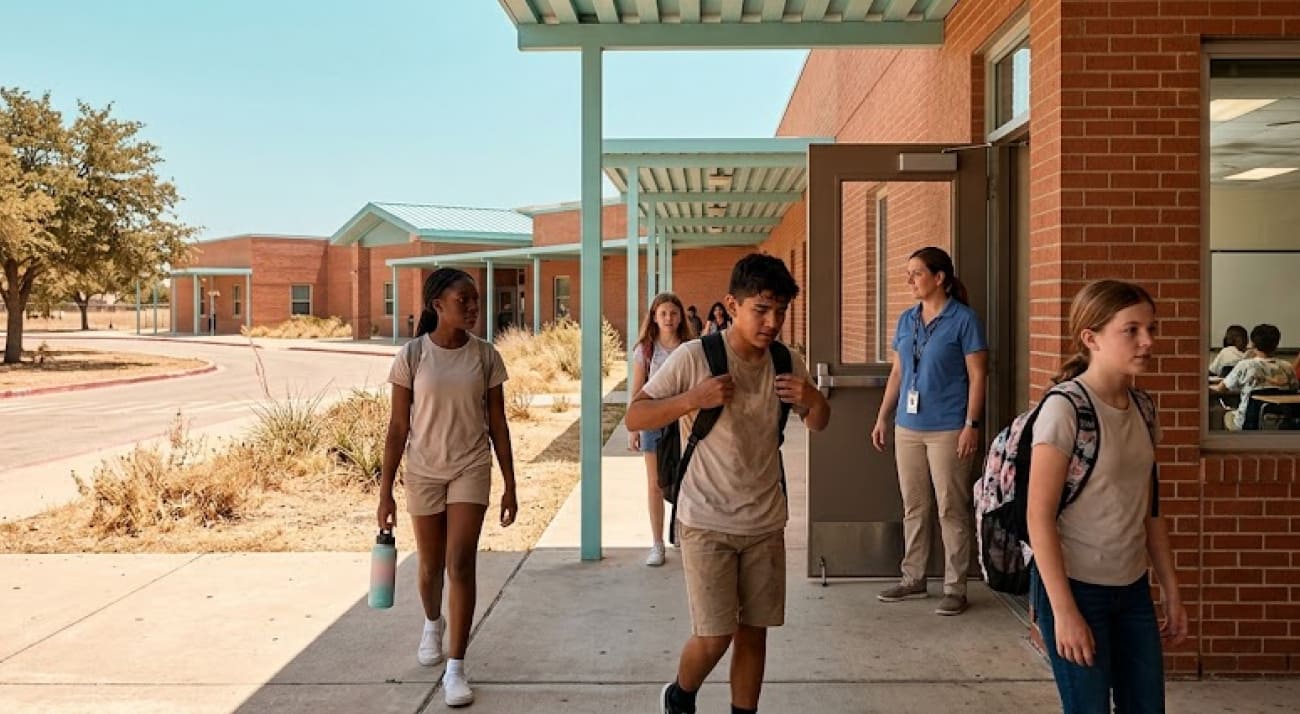
As San Antonio begins the 2026–27 school year, Northside Independent School District (NISD) is addressing reports of air-conditioning problems at several campuses while the region experiences another stretch of triple-digit temperatures. The issue has drawn attention because classroom conditions can directly affect students’ ability to concentrate, participate and remain comfortable during long school days. NISD has emphasized that the problems are limited rather than districtwide, but reports from Pat M. Neff Middle School and Hector P. Garcia Middle School have raised broader questions about school infrastructure and heat preparedness. For families following Texas youth education news, the situation illustrates how student success depends on conditions extending well beyond academic programs.
A Difficult Start To The 2026–27 School Year
Northside ISD began its 2026–27 school year on August 10, according to the district’s official calendar and campus information. Neff Middle School, located at 5227 Evers Road in San Antonio, also welcomed students that day.
The timing has made the HVAC concerns particularly significant.
San Antonio has entered another period of extreme summer heat, with forecasts calling for temperatures around or above 100°F on multiple days. Recent forecasts have placed heat-index values between approximately 102°F and 107°F, depending on the day and location. A persistent high-pressure system over Texas has contributed to the hot and mostly dry conditions.
For a school district, extreme heat creates a different challenge from an ordinary hot day. Students may spend seven or eight hours inside classrooms, while teachers and staff must maintain an environment suitable for sustained learning.
The National Weather Service heat safety guidance emphasizes the importance of hydration, cooling and recognizing symptoms of heat-related illness when temperatures and heat indexes become dangerous.
The HVAC reports therefore arrive at a particularly sensitive point in the school calendar. Students have only recently returned, teachers are establishing classroom routines and extracurricular activities are beginning, while outdoor temperatures remain unusually high.
What Northside ISD Says About The HVAC Problems
NISD has pushed back against descriptions suggesting that its campuses are broadly experiencing failed air-conditioning systems.
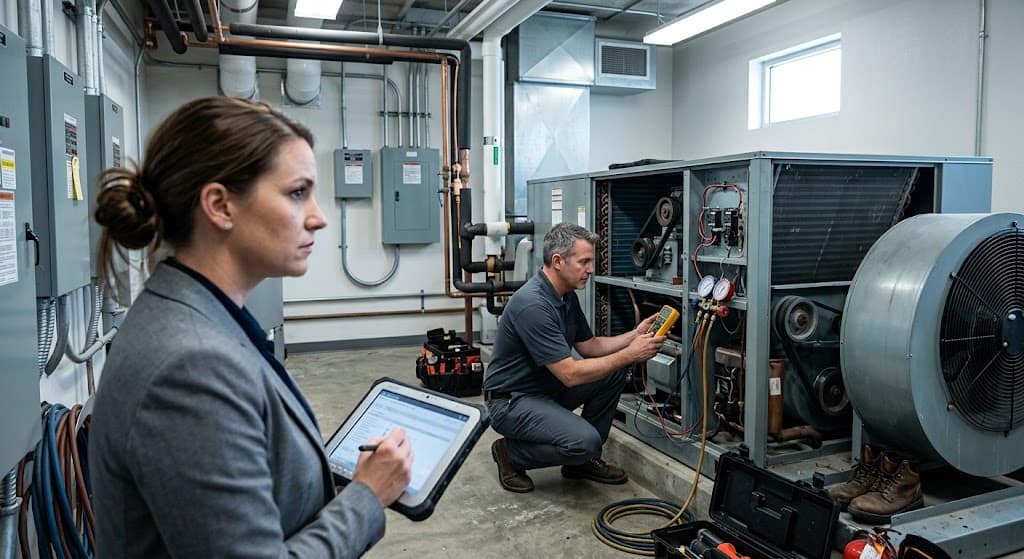
District officials told local media that the problem at Pat Neff Middle School was limited to a small number of classrooms rather than the entire campus. At least one class was temporarily relocated while maintenance crews worked to address the problem and obtain necessary replacement parts.
The distinction is important.
Northside ISD operates a very large school system, and a handful of HVAC failures does not establish that the district as a whole is unable to cool its classrooms. The district has said its teams monitor air-conditioning systems and work to maintain appropriate classroom temperatures.
At the same time, reports from parents and teachers show why even isolated failures can become significant during a heat wave.
One recent report involved a parent at Hector P. Garcia Middle School, where the parent said a student spent a week in a classroom without functioning air conditioning and used a personal fan. Local reporting also described additional concerns about cooling conditions at other classrooms.
The conflicting perspectives create a more complicated picture than simply labeling the situation an “AC crisis.”
The district says the problem is limited.
Families experiencing excessive classroom heat understandably see the problem from the student’s perspective.
Both realities can exist simultaneously.
NISD Has More Than 130 Campuses To Maintain
The scale of Northside ISD makes the maintenance challenge particularly important.
Local reporting indicates that the district has approximately 130 campuses, meaning its facilities teams are responsible for an extensive network of classrooms, administrative spaces, athletic facilities and specialized learning environments.
That scale changes how HVAC problems should be interpreted.
A mechanical failure at one campus does not necessarily indicate systemic failure. Large school systems routinely experience equipment breakdowns, particularly when aging mechanical systems are placed under heavy demand during extreme weather.
The more important question is how quickly those failures are detected, communicated and repaired.
NISD says its staff inspects HVAC equipment before the school year begins. District officials have also explained that some problems only become apparent once systems are operating continuously under real classroom conditions.
That distinction is technically important.
An air-conditioning unit can appear operational during a short inspection but fail once it faces prolonged high temperatures and sustained demand.
In San Antonio’s current conditions, that demand is substantial.
San Antonio’s Triple-Digit Heat Raises The Stakes
San Antonio has experienced several 100-degree days this year, although 2026 had been relatively mild earlier in the summer compared with the city’s historical pattern. Recent reporting indicates that the city had recorded four days reaching 100°F by mid-August, including one in July and three in August.
The immediate forecast, however, has been considerably hotter.
Temperatures have been expected to reach roughly 99°F to 102°F, while humidity can push the heat index above the actual air temperature. Recent forecasts placed the heat index around 102°F to 104°F, with some South Texas areas approaching 107°F.
That difference matters because heat index measures how hot conditions feel to the human body when humidity is considered.
For children and teenagers, the risk is particularly relevant during outdoor physical activity.
Physical education classes, athletics, marching band practices and other activities can expose students to heat even when their primary classrooms remain adequately cooled.
The CDC’s heat and health resources identify children and adolescents among groups requiring attention during periods of excessive heat, particularly when physical activity increases exposure.
Athletics Create Another Layer Of Heat Risk
The classroom is only one part of the school day.
Northside ISD has a large athletics and extracurricular program, meaning students can transition from air-conditioned buildings into outdoor environments where temperatures and heat indexes are substantially higher.
Football practices, soccer sessions, marching band rehearsals and other activities can require students to remain outdoors for extended periods.
This creates a two-part heat-management responsibility.
| School Environment | Primary Heat Concern |
|---|---|
| Classrooms | Indoor temperature, ventilation, student concentration and comfort |
| Athletic fields | Direct heat exposure, hydration, exertion and heat illness |
The National Athletic Trainers’ Association heat illness resources emphasize preparation, acclimatization, hydration and appropriate monitoring for athletes exercising in hot conditions.
For school administrators, that means HVAC repairs and outdoor heat policies should be viewed as connected parts of a larger student-safety strategy.
A student may spend the morning in a classroom and the afternoon on an athletic field. The risks change throughout the day, but the responsibility for managing them remains with the adults overseeing the activity.
Why Classroom Temperature Matters For Students
The question is not simply whether a classroom feels uncomfortable.
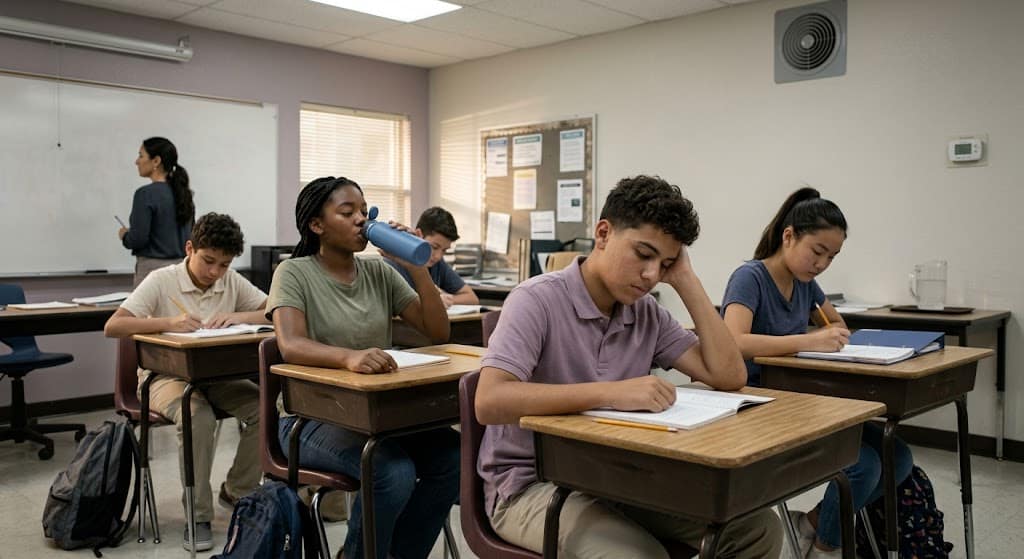
Heat can affect concentration, fatigue, hydration and physical well-being. For students who already face challenges with attention or learning, uncomfortable environmental conditions can add another barrier to classroom engagement.
The U.S. Environmental Protection Agency’s school indoor-air guidance identifies indoor environmental quality as an important component of healthy school environments. Temperature, ventilation and other building conditions can influence students and staff throughout the school day.
This makes HVAC maintenance part of the educational infrastructure rather than merely a facilities issue.
A school can have strong teachers, effective curriculum and sophisticated technology, but those resources operate inside a physical environment.
If students are distracted by heat, teachers have to devote attention to classroom comfort instead of instruction. If a classroom becomes unsuitable, administrators may need to relocate students. If repairs take several days, the disruption can extend across multiple lessons.
These effects may be invisible in traditional academic performance measurements, but they still matter to student success.
Why HVAC Maintenance Is An Education Issue
School infrastructure is often discussed separately from academic achievement.
That separation can be misleading.
A reliable physical environment supports the instructional environment. When classrooms are comfortable, teachers can concentrate on instruction. When buildings require emergency repairs, school personnel must divert time and resources toward logistics.
The issue also has a financial dimension.
HVAC systems are expensive pieces of infrastructure. Large districts must balance routine maintenance, emergency repairs, energy costs and long-term capital replacement.
The most effective approach is generally not waiting for every system to fail.
Preventive maintenance can identify aging components before they become emergencies, while replacement planning can prevent districts from repeatedly spending on increasingly unreliable equipment.
NISD’s own resource-planning operation includes responsibility for allocating district resources, classrooms and staffing while maintaining enrollment and campus-capacity information. The district also publishes projected enrollment data for 2026–27.
That planning infrastructure matters because facilities have to support the number of students actually attending each campus.
Student Experience Should Remain Part Of The Measurement
One challenge with infrastructure problems is that they can be difficult to quantify using traditional school accountability systems.
A campus might receive strong academic results while still having classrooms that periodically experience uncomfortable temperatures.
Likewise, a school could have excellent facilities while students struggle academically.
The two measurements should therefore be considered separately.
Academic accountability tells communities about educational outcomes.
Facility conditions tell communities about the environment in which those outcomes are being produced.
For Youth Rise Texas readers, that distinction is particularly relevant. Youth development is influenced by academic instruction, physical health, extracurricular participation, family engagement and the quality of the environments surrounding young people.
A well-maintained classroom does not guarantee academic success.
But a poorly functioning learning environment can create an unnecessary obstacle.
Communication With Families Can Reduce Uncertainty
Another important element of the current situation is communication.
Parents understandably want to know whether a reported HVAC problem affects one classroom, one building or an entire campus. They also need to know what temporary measures are available while repairs are underway.
NISD’s response has emphasized that its HVAC issues are limited and that maintenance teams are actively working on repairs.
That communication can be strengthened when districts provide clear information about:
- Which classrooms or areas are affected.
- Whether students have been relocated.
- What temporary cooling measures are being used.
- Whether repairs require replacement parts.
- When families can expect another update.
Clear communication does not eliminate the underlying mechanical problem, but it helps families understand the scope and response.
It also prevents an isolated incident from being interpreted automatically as a districtwide failure.
The Bigger Challenge For San Antonio Schools
Northside ISD is not the only San Antonio school system dealing with infrastructure questions.
The city’s broader education landscape is also facing major facility and financial discussions. San Antonio ISD, for example, is seeking voter approval for a proposed $600 million bond package that would fund school modernization, safety and technology improvements, alongside a proposed property-tax-rate increase.
That broader discussion highlights why school infrastructure has become increasingly relevant to education policy.
Buildings age.
Mechanical systems wear out.
Energy costs fluctuate.
Enrollment changes.
Climate conditions create new demands.
At the same time, districts have finite resources and must decide which investments should receive priority.
For families, these decisions eventually become very tangible. They determine whether a child studies in a modernized classroom, rides an updated bus, participates in a renovated athletic facility or attends a school where administrators are still trying to repair aging infrastructure.
Preparing Students For A Hotter School Environment
The current San Antonio heat wave is a short-term event, but the planning challenge extends beyond one week.
Schools can prepare through a combination of facility maintenance, heat policies, hydration access, activity adjustments and communication.
The objective should not be to eliminate every mechanical failure. That is unrealistic for a district operating more than a hundred campuses.
The objective is to make sure that when something fails, students are protected and learning can continue with as little disruption as possible.
That requires identifying vulnerable equipment, prioritizing repairs, monitoring classroom conditions and having contingency plans available.
It also means recognizing that extreme heat can affect students differently.
Younger children, athletes, students with certain disabilities and young people participating in extended outdoor activities may require additional precautions.
The Texas Department of State Health Services heat illness guidance provides additional information for recognizing and preventing heat-related illness in Texas communities.
What Happens Next For Northside ISD
The immediate priority for NISD is straightforward: restore affected cooling systems and maintain safe, comfortable learning environments as San Antonio moves through the hottest part of the summer.
The district’s response will likely remain under scrutiny because the issue emerged at the beginning of the school year, when families are particularly attentive to campus conditions.
But the available evidence does not support describing the situation as a districtwide air-conditioning failure.
Instead, the current picture is one of localized HVAC problems occurring during an unusually demanding period of extreme heat.
That distinction should remain central to how the story develops.
The challenge for Northside ISD is to demonstrate that its maintenance systems can identify and resolve those problems quickly while keeping students in suitable learning environments.
For families, the broader lesson is equally important. Student success is shaped by more than grades, test scores and instructional programs. It also depends on whether schools provide the physical conditions necessary for young people to learn, participate and remain healthy.
As San Antonio’s temperatures push beyond 100°F, that basic requirement has become impossible to ignore.