
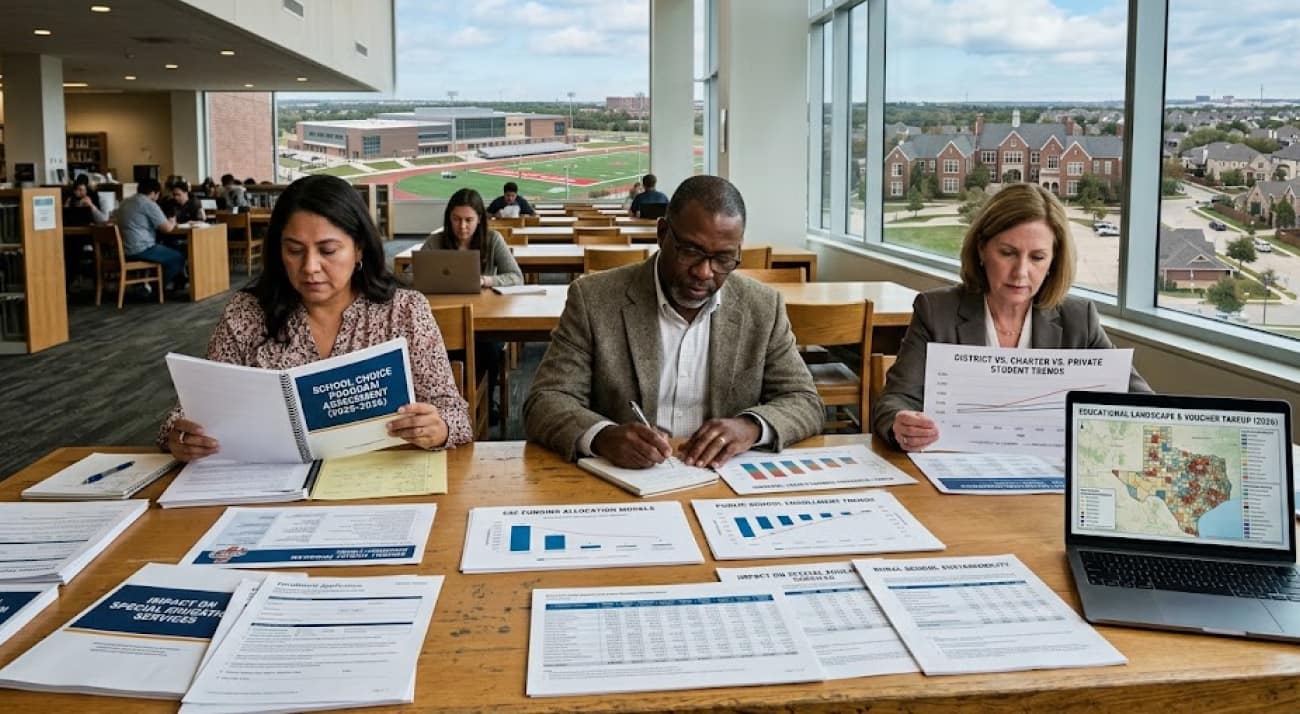
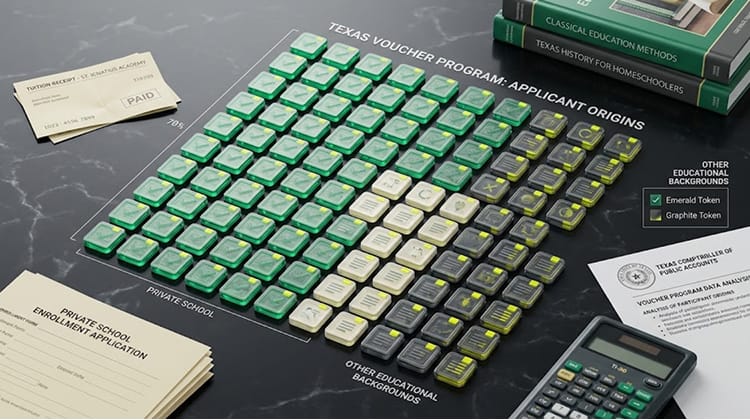
Texas’ new school voucher program has reached more than 100,000 participating students in its first year, but new data is raising questions about whether the state’s $1 billion education choice initiative is primarily helping families leave public schools or providing financial assistance to families who had already chosen private education or homeschooling. At least 70% of families who have joined the Texas Education Freedom Accounts program or have pending invitations had children who were already attending private school or being homeschooled, according to data obtained by Axios through the Texas Public Information Act.
The figure matters because the policy debate surrounding Texas vouchers has centered heavily on educational choice for families dissatisfied with their local public schools. Supporters argue that state-funded education accounts give parents greater control over how and where their children learn. Critics counter that the program can subsidize educational arrangements families were already paying for, raising questions about whether taxpayer dollars are producing the public-school enrollment changes supporters anticipated.
The debate is becoming particularly relevant as the program enters its first full school year and state officials prepare to determine how much money will be needed to maintain and potentially expand it.
Texas Has Created One Of The Nation’s Largest Voucher Programs
The Texas Education Freedom Accounts, or TEFA, were established through Senate Bill 2, passed by the Texas Legislature in 2025. The program began accepting applications on February 4, 2026, and was designed to allow eligible families to use state funds for approved educational expenses.
Governor Greg Abbott promoted the program as a major expansion of parental choice. When applications opened, Abbott described TEFA as a way for parents to choose the educational environment that best fits their children. The program received more than 100,000 applications within its first two weeks.
The scale of the initial demand was significant. Texas ultimately received 274,183 applications before the March deadline, according to final applicant data reported by The Texas Tribune. Nearly 25,000 applications were found ineligible.
The application pool also revealed an important demographic pattern: 75% of applicants had attended private school or homeschool during the 2024–25 academic year. That earlier figure applied to applicants, while the newer 70% figure applies to families who have joined or have pending invitations. The two numbers are therefore related but should not be treated as identical measurements.
For Texas families, the distinction is important because the program is now moving from application demand to actual participation.
The Texas Education Freedom Accounts program is administered by the Texas Comptroller of Public Accounts rather than by the Texas Education Agency. That structure gives the Comptroller responsibility for distributing funds, managing applications and confirming participation.
More Than 100,000 Students Are Already Participating
By August 13, Texas Comptroller Don Huffines announced that funding had been delivered to 101,600 students participating in TEFA.
That milestone came as students returned to school for the 2026–27 academic year. The Comptroller’s office said the number was expected to increase as additional awards were processed. More than 100,000 students remained on the waitlist at the time of the announcement.
The scale of the program makes the 70% figure especially consequential.
If a large majority of participating families had already selected private school or homeschooling before the voucher program existed, the immediate effect may be less about moving students out of public schools and more about changing who pays for an educational arrangement that was already in place.
That does not necessarily mean those families do not benefit.
A household paying private tuition could receive meaningful financial relief from a state-funded account. A homeschooling family can use the program for approved educational expenses. Families with children who have disabilities may also qualify for substantially larger amounts.
But those benefits represent a different policy outcome from the one often emphasized by voucher supporters: using public funding to give families a realistic opportunity to leave a public school they consider unsuitable.
The question is therefore less whether families value the accounts and more what the accounts are changing.
What The 70% Figure Actually Tells Us
The new data requires careful interpretation.
The 70% figure does not establish that 70% of Texas public school students are abandoning public schools because of vouchers. It indicates that among families who had joined the program or had pending invitations, at least 70% were already using private school or homeschooling before receiving the benefit.
That distinction is critical.
A family already paying private tuition may have applied because the voucher lowers its educational expenses. A homeschooling family may use the account to offset curriculum, tutoring or other eligible costs. Neither situation necessarily represents a student transferring out of a traditional public school.
The program’s early applicant data reinforces that concern. The Texas Tribune reported in April that 75% of applicants had attended private school or homeschool during the 2024–25 school year. At that point, the Comptroller had not provided data showing how many applicants were currently enrolled in private school or being homeschooled.
The newer information provides a clearer picture of the families actually entering or waiting to enter the program.
That makes the 70% statistic an important early indicator, but it is not yet a complete measurement of the program’s long-term effect on public-school enrollment.
Low-Income Families And Students With Disabilities Remain Central To The Debate
Income and disability status add another layer to the discussion.
The program was structured with priority tiers intended to favor students with disabilities and families with lower incomes. Texas officials have repeatedly emphasized that the program is intended to make private educational options available to families who might otherwise struggle to afford them.
The Comptroller’s office reported in August that nearly one in four participants had a documented disability.
The program also gives children with qualifying disabilities access to potentially much larger awards than the standard homeschool amount. Under the state’s rules, some students with disabilities can qualify for as much as $30,000 annually, depending on their individualized education program and circumstances. Homeschool participants are generally limited to $2,000 annually.
That creates an important distinction within the 70% figure.
A student who was already in private school and has a disability may have had substantial educational costs before receiving an account. The voucher can change the financial burden on that family even if the student’s school placement does not change.
For public-school districts, however, the question is whether the program eventually reduces enrollment enough to affect district finances and operations.
That answer will require more years of enrollment data.
Houston, Dallas And San Antonio Are Major Areas Of Participation
The voucher debate is particularly relevant in Texas’ largest metropolitan areas.
Early participation data shows significant numbers of families living within the boundaries of major public school districts. Houston, Dallas and Northside Independent School District in San Antonio were among the districts with the largest numbers of participating families.
Northside ISD alone had approximately 2,300 students using the new voucher program, according to Axios reporting published in August.
That number is large enough to attract attention in a district serving tens of thousands of students, but it also demonstrates why local enrollment effects need to be measured carefully.
If a substantial share of those students were already enrolled in private schools or being homeschooled, their participation in TEFA would not necessarily represent a new loss of public-school enrollment.
This distinction could become increasingly important as districts prepare budgets based on projected student counts.
Texas public schools receive funding based partly on enrollment, meaning sustained shifts in where students are educated can affect district revenue. But if voucher-funded students were already outside public schools, the immediate financial effect on districts could be much smaller than the headline number of voucher participants suggests.
Supporters Point To Parental Choice
Supporters of the program view the same numbers differently.
Comptroller Don Huffines has argued that the demand for TEFA demonstrates that Texas families want greater control over education funding. In August, he announced that more than 100,000 students were receiving accounts and described the milestone as evidence of demand for educational choice.
The program also has a broader definition of educational choice than simply transferring students from public schools to private campuses.
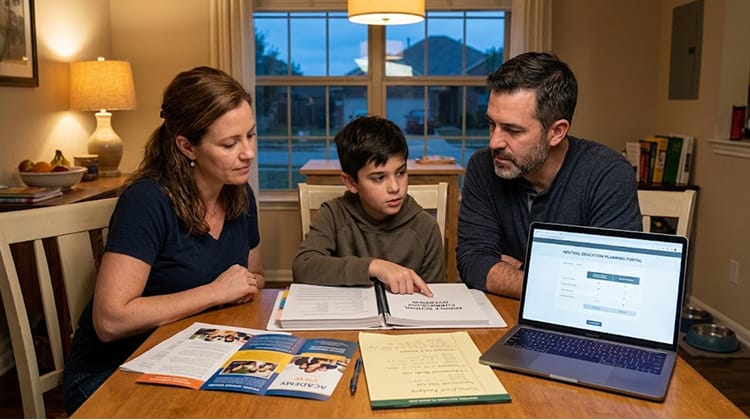
Families can use TEFA funds for approved expenses including private school tuition, homeschool curriculum, tutoring, special education services, school supplies and uniforms. The state has therefore structured the program as an education spending account rather than simply a tuition voucher.
The Texas Comptroller’s TEFA information provides the state’s official framework for how those accounts are administered.
From the supporters’ perspective, a family that was already enrolled in private school can still benefit from receiving assistance. They argue that parental choice should not be limited to families who first enroll their children in public school.
That argument also helps explain why the program attracted such substantial demand from families already using alternative forms of education.
The disagreement is ultimately about what taxpayers should expect in return.
Supporters emphasize freedom, flexibility and the ability to direct education funding according to family preferences. Critics emphasize whether the spending produces new educational opportunities for students who otherwise would have remained in public schools.
The State Is Requesting More Money As Demand Continues
The financial stakes are growing.
The Texas Comptroller’s office is seeking approximately $2.3 billion in the state’s next two-year budget to operate the voucher program, according to reporting published September 3. That would represent a major increase over the initial $1 billion allocation for the 2026–27 school year.
The request comes while more than 100,000 students remain on the waitlist.
That combination—large participation, a substantial waitlist and a multibillion-dollar budget request—means the debate over the program is moving beyond whether Texas should offer school choice.
The next question is how much the state should spend on it.
Lawmakers will have to weigh the cost of expanding TEFA against other education priorities, including funding for traditional public schools, teacher compensation, special education, school facilities and other student services.
For families, meanwhile, the debate is more personal.
A $10,000-plus private-school award can represent a substantial change in a household education budget. For a family with a child who qualifies for additional disability-related funding, the potential value can be considerably greater.
But the same expenditure may look different from the perspective of a public-school district trying to maintain staffing and services with limited resources.
Texas Will Need Better Enrollment Data To Measure The Program
The first year of TEFA provides strong participation numbers, but participation alone does not answer the most important questions.
State officials, school districts and lawmakers will need to track where participating students came from, whether they remain in their selected educational setting, whether public-school enrollment changes in affected districts and whether students who previously attended public schools experience measurable academic benefits.
That information will also be important for evaluating whether the program is expanding access or primarily reducing costs for families already using private education.
The state’s own implementation requirements show how complicated the system can become.
The Texas Education Agency has established procedures for school districts to provide special education information for eligible children seeking Education Freedom Accounts, including situations involving children already attending private schools or being homeschooled.
That means traditional public-school systems can remain involved even when students are not enrolled in their classrooms.
For YouthRiseTX readers, this is where the policy becomes more than a political debate. Texas is creating a new pathway for families to finance education, and the consequences will affect students, parents, private schools, homeschool providers and public districts simultaneously.
The Voucher Debate Is Now About Results, Not Just Demand
Texas has already demonstrated that families are willing to apply for education accounts.
More than 274,000 students applied, more than 100,000 students have received funding, and more than 100,000 remained on the waitlist as the first school year got underway. Those numbers establish substantial demand.
But demand and impact are different measurements.
The new 70% figure makes that distinction especially clear. If most participating families were already using private schools or homeschooling, the program’s first-year impact may be less about creating new alternatives for public-school students and more about providing financial assistance to families already outside the public system.
That does not automatically make the program successful or unsuccessful.
It does, however, change the question Texas policymakers should be asking.
The central issue for the next phase of TEFA will be whether the program produces measurable educational gains, expands access for families who could not previously afford private options, supports students with disabilities effectively and changes public-school enrollment in meaningful ways.
Those answers will require more than application totals.
They will require longitudinal enrollment data, student outcomes, family income information, school participation figures and transparent accounting of how billions of taxpayer dollars are being spent.
For Texas students and families, the first year of school vouchers has established the scale of the experiment. The next several years will determine whether that investment primarily opens new educational doors—or largely pays for doors that many families had already chosen to walk through.