
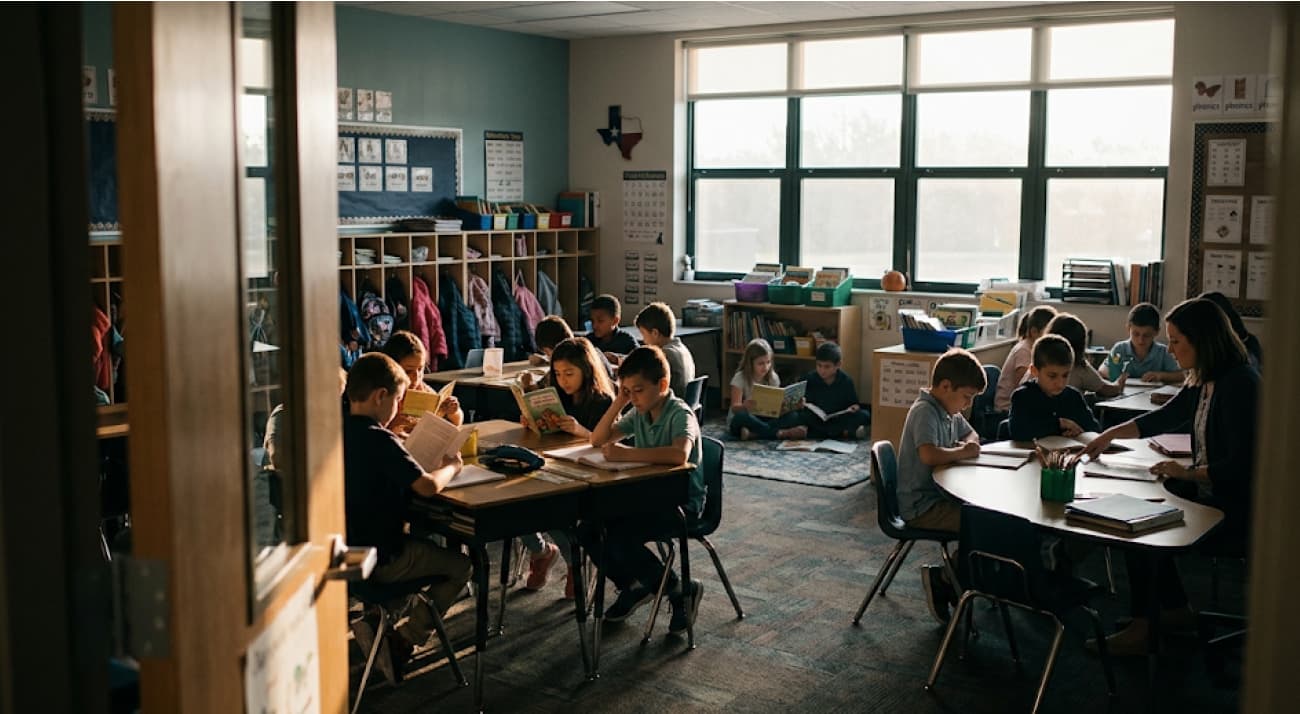
Nearly half of Texas third graders are still failing to reach the state’s grade-level standard in reading, putting elementary literacy back at the center of the state’s education debate. Texas Education Commissioner Mike Morath highlighted the problem during the annual txEDCON conference in Houston, where he told school board members that roughly half of Texas students are falling short of grade-level reading expectations by third grade. The warning comes after the state’s Spring 2026 STAAR results showed Grade 3 Reading Language Arts performance declined by one percentage point from the previous year.
The timing is significant. Texas has spent several years changing how schools teach early reading, requiring additional teacher training, emphasizing phonics and expanding the use of approved instructional materials. The state has also developed its own Bluebonnet Learning curriculum, which was used by hundreds of districts during the 2025–26 school year.
Morath’s message in Houston was that those changes need to continue and that local school boards have a major role in ensuring schools use effective reading instruction. For families, however, the statistic represents something more immediate: thousands of Texas children are reaching the end of third grade without demonstrating the reading skills the state considers necessary for success in the next stage of school.
Third Grade Is A Critical Point In Texas Reading Education
Third grade is an especially important year for literacy because students are increasingly expected to use reading as a tool for learning other subjects.
In the early elementary years, children spend substantial time learning how to decode words, build vocabulary and develop comprehension. By third grade, reading becomes increasingly connected to science, social studies, mathematics word problems and independent classroom work.
Texas’ STAAR system measures Grade 3 Reading Language Arts as one of the state’s key early indicators of academic performance.
The state’s performance standards define Meets Grade Level as performance indicating that a student has a high likelihood of success in the next grade or course, although some students may still need short-term targeted intervention. Students below that level can still demonstrate partial mastery, but the state expects additional support to help them progress.
That distinction matters when looking at the latest numbers.
A child who does not meet the STAAR standard is not necessarily unable to read. The results indicate that the student’s demonstrated performance did not reach the state’s defined threshold for the Meets Grade Level category.
That creates a much more precise picture of the challenge facing Texas schools.
The 2026 STAAR Results Show Little Movement In Early Reading
The latest statewide assessment results provide the statistical foundation behind Morath’s October warning.
The Texas Education Agency released the Spring 2026 STAAR results on June 16, 2026. TEA reported that Reading Language Arts performance was stable or improved across most grades, with Grade 8 gaining three percentage points and Grade 7 gaining two.

Grades 4, 5 and 6 remained at their 2025 levels.
Grade 3, however, declined by one percentage point.
That decline is small in percentage terms, but it matters because third grade is already one of the areas where Texas has struggled to move a large majority of students into the state’s top performance categories.
The 2026 results therefore did not produce the kind of broad early-literacy improvement that would allow state officials to declare the problem solved.
Instead, the numbers show a mixed picture: older students made gains in reading, while the state’s youngest tested elementary cohort moved slightly backward.
For parents, that raises an obvious question: why are improvements in some grades not translating into stronger third-grade results?
Poverty Remains Closely Connected To Reading Performance
Morath’s comments in Houston also emphasized the relationship between literacy and poverty.
Students in high-poverty school districts are generally more likely to struggle with reading, creating a challenge for Texas schools that goes beyond the choice of curriculum.
Children enter kindergarten with very different experiences. Some have attended preschool or received extensive early literacy exposure at home. Others may have limited access to books, tutoring, preschool programs or stable learning environments before entering elementary school.
Schools are then expected to narrow those differences while teaching all students to the same state standards.
That makes early literacy one of the clearest tests of whether public education can provide students with comparable opportunities regardless of family income.
Morath has argued that weak reading performance threatens that goal because students who struggle early can face academic problems later. The Houston Chronicle reported that he connected third-grade reading performance to longer-term risks involving high-school completion and workforce outcomes.
The implication for Texas school boards is significant. Literacy cannot be treated simply as a problem for third-grade teachers. It begins well before third grade and depends on what happens in kindergarten, first grade and second grade.
Texas Has Changed How Early Reading Is Taught
Texas has spent years moving toward a more evidence-based approach to literacy instruction.
The state has required reading academies for teachers, expanded phonics requirements and introduced systems designed to monitor student reading progress.
The broader strategy is frequently described as the science of reading, a term used for instructional approaches emphasizing areas such as phonemic awareness, phonics, fluency, vocabulary and comprehension.
Morath told school board members that districts need to remain committed to this approach rather than repeatedly shifting instructional strategies.
That message comes after Texas invested heavily in developing and distributing its own instructional materials.
The Texas Education Agency’s Bluebonnet Learning program provides state-developed materials aligned with the Texas Essential Knowledge and Skills. Grade 3 Bluebonnet Reading Language Arts materials have received State Board of Education approval and cover the state’s reviewed expectations for the subject.
The state is therefore trying to address the literacy problem at several levels: teacher training, instructional standards, curriculum materials and student progress monitoring.
The remaining question is whether those reforms can produce sustained gains in the classrooms where students are still struggling.
Bluebonnet Learning Is Expanding Across Texas
The latest evidence on Bluebonnet Learning adds another layer to the discussion.
On September 30, 2026, TEA released its first-year usage and outcomes data for the state-developed curriculum. During the 2025–26 school year, 619 districts opted to implement at least one of the three Bluebonnet Learning programs district-wide.
TEA reported that districts using Bluebonnet Learning saw stronger average year-over-year achievement changes in reading and math than districts that did not use the materials.
That does not mean Bluebonnet caused the improvement.
Districts that adopted the curriculum may differ from other districts in staffing, leadership, demographics, teacher training or other factors. TEA’s first-year comparison is therefore useful evidence, but it does not establish that the curriculum alone produced the gains.
Still, the results give state officials an argument for continuing to promote the materials.

About one-third of Texas districts have adopted Bluebonnet in some form, according to recent reporting. Morath told school board members that wider use of high-quality instructional materials should be part of the response to low literacy rates.
Parents Can Now Receive Additional Reading Support
Texas has also created a new financial support mechanism specifically for families whose third graders struggle on the Grade 3 RLA assessment.
The Parent Access to Supplemental Supports, or PASS, program was established by the Legislature to help eligible families pay for literacy tutoring.
Under the program, families of students who received a Did Not Meet Grade Level result on the Grade 3 RLA STAAR assessment can receive up to $400 for qualifying literacy tutoring services.
TEA says that beginning in fall 2026, eligible families can use PASS funds with parent-selected tutoring providers, including in-person tutoring companies, virtual tutoring providers and designated Teacher Incentive Allotment tutors.
This is an important shift because it places some of the intervention decision directly in parents’ hands.
Instead of relying exclusively on what a school can provide during the regular school day, eligible families can select additional tutoring support.
The program also reflects how seriously Texas officials are treating the third-grade reading gap. The state is effectively creating an additional layer of intervention for children who have already demonstrated that they need more help.
Schools Face Different Challenges From One Community To Another
The statewide statistic can obscure major differences among Texas communities.
A large urban district may serve thousands of students learning English as a second language, while a small rural district may face teacher shortages and limited access to specialized reading intervention.
Texas also has significant differences in household income, population growth and access to early-childhood education.
For an elementary school serving a large number of economically disadvantaged students, improving literacy can require much more than adopting a new textbook.
Schools may need reading specialists, interventionists, trained classroom teachers, tutoring programs, family outreach and additional time for students who are behind.
That creates a funding question as well as an instructional one.
A curriculum can give teachers better materials, but schools still need people who can use those materials effectively and provide individual assistance when students fall behind.
The state’s push for consistent instructional materials therefore has to coexist with local decisions about staffing and intervention.
Teachers Remain Central To The Literacy Strategy
The debate over reading instruction can sometimes become a debate about curriculum, but teachers remain at the center of the process.
Texas has invested in mandatory reading academies to give educators more training in evidence-based literacy instruction. The objective is to make sure teachers understand how early reading develops and how to identify students who need additional support.
The challenge is implementation.
A third-grade classroom can contain students reading above grade level, students who are close to the standard and students who need significant intervention. Teachers have to manage those differences while delivering required curriculum and preparing students for state assessments.
High-quality instructional materials can help organize that work, but teachers still have to interpret student responses and determine where additional support is needed.
That makes teacher preparation particularly important as Texas expands its literacy strategy.
If the state wants to see better third-grade results, it will have to measure whether teachers have the training, time and resources necessary to respond to students who enter third grade already behind.
The Reading Gap Can Follow Students Into Later Grades
The concern extends beyond the third-grade classroom.
Students who struggle with reading comprehension may eventually face difficulties in subjects where the primary instruction comes through increasingly complex text.
Middle school science, social studies and mathematics all require students to read directions, interpret information and understand vocabulary.
A student who has difficulty processing grade-level text can therefore face barriers even in classes that are not formally labeled reading courses.
This is one reason Morath’s comments focused on the long-term consequences of early literacy.
Texas does not simply want students to pass a third-grade assessment. The larger objective is to ensure that children develop the skills needed to learn independently as academic demands increase.
The Texas Education Agency’s student assessment resources allow families and educators to examine statewide and individual assessment information, giving schools another tool for identifying where students need help.
That information becomes more useful when it leads to timely intervention rather than simply recording that a student fell behind.
Texas School Boards Now Face A Clear Literacy Test
Morath’s appearance at txEDCON placed school boards directly in the discussion.
The conference, held October 8–11, 2026, at Houston’s George R. Brown Convention Center, brought together school board members, superintendents and administrators from across Texas.
The message from the state’s education commissioner was straightforward: school boards have to support instructional strategies that can improve reading outcomes.
That places pressure on local leaders to evaluate curriculum choices, teacher training and intervention programs using student performance rather than political preferences.
It also means districts will have to show whether their literacy strategies are producing measurable improvement.
For parents, that creates a useful standard for judging education policy. Instead of asking only which curriculum a district uses, families can ask whether more students are actually reaching grade-level reading expectations.
That is the outcome that matters most to students.
Third Graders Cannot Wait For A Future Fix
The latest numbers make one point difficult to avoid: Texas still has a major early-literacy challenge.
The state has introduced reading academies, strengthened phonics instruction, created Bluebonnet Learning, expanded progress monitoring and launched the PASS tutoring program. Yet roughly half of third graders still fall below the state’s Meets Grade Level reading standard.
The challenge now is moving from policy implementation to measurable improvement.
That will require schools to identify struggling readers earlier, provide targeted intervention, support teachers and make sure families know what help is available. It will also require state and local officials to examine which strategies produce lasting results rather than assuming that a new program will solve the problem on its own.
For Texas children, the stakes are straightforward.
Third grade is one year of elementary school, but reading skills developed during those years influence how students approach every subject that follows. A child who leaves third grade struggling to understand grade-level text may need increasingly intensive support as academic demands rise.
Texas has spent years building a statewide literacy strategy. The next few years will show whether that strategy can move the state from having strong reading policies on paper to having substantially more children who can demonstrate grade-level reading skills in the classroom.
For the students currently sitting in Texas third-grade classrooms, that progress cannot come soon enough.