
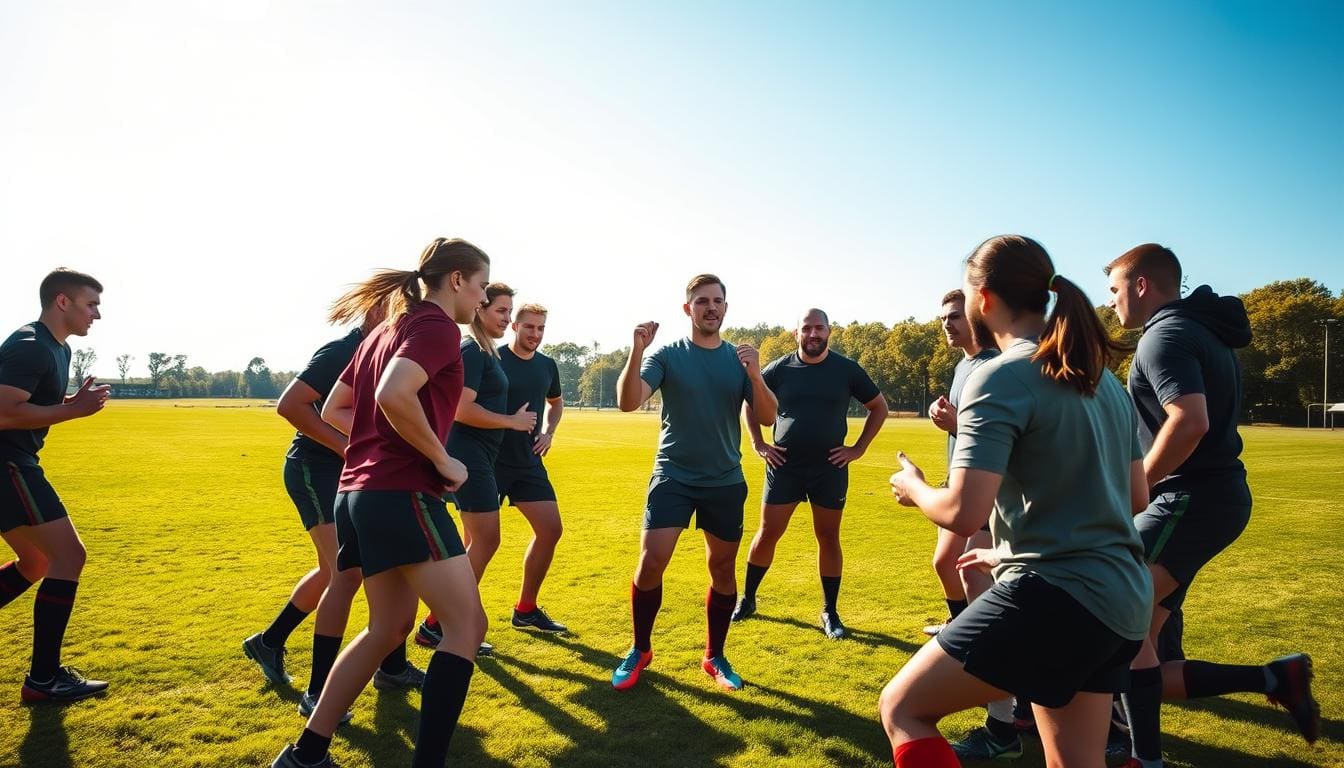
Rugby is more than just a sport. It’s a place where character is built and unshakeable fortitude is earned. It’s a journey to inner strength, not just about winning.
The sport is tough. Players face intense physical contact and must perform under pressure. Every play needs sharp focus and split-second decision-making.
Success comes from staying calm when tackles fly and the game is on the line. These challenges are perfect for building a strong mindset.
What you learn on the field helps in life. It prepares you to handle stress, overcome obstacles, and thrive. You develop a calm that helps you long after the game ends.
Establishing Supportive Athletic Environments
A supportive athletic environment is not created by chance. It’s built with care to foster mental resilience. This strength grows from a mix of strategic support and shared challenges.
Coaches play a big role. They set the tone with a focus on growth, not just winning. This approach helps players view setbacks as learning opportunities. It lays the groundwork for mental resilience to grow.
Training should feel like game-day. Tools like NeuroTracker offer safe, intense simulations. Players sharpen their rugby smarts and learn to stay focused, even when tired.
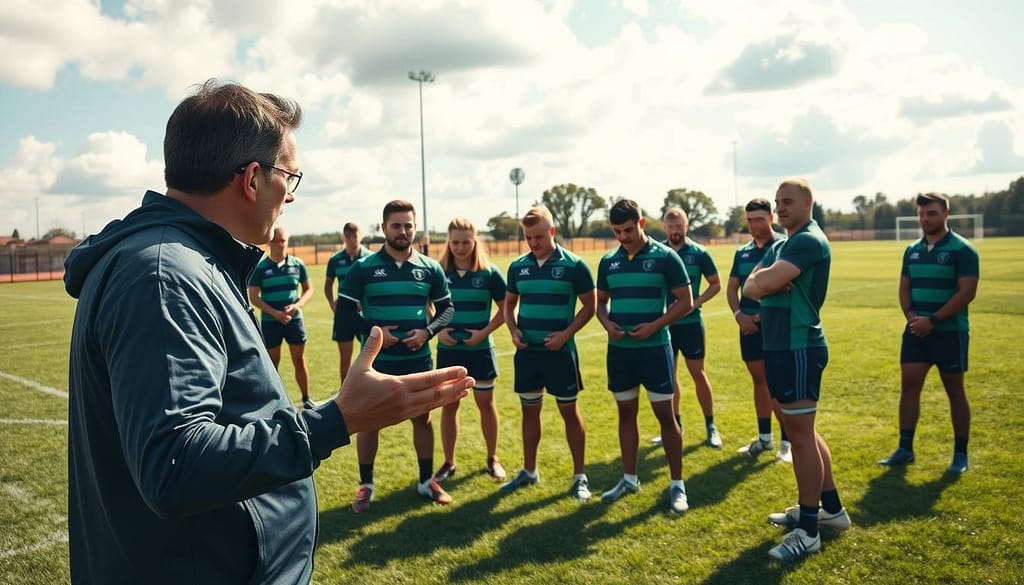
Team culture is essential. Teams that act as one unit have a big advantage. They need positive communication and shared responsibility. Every player must feel valued and accountable for the team’s mood.
Mental performance coaching is vital. It teaches athletes to handle frustration and stay focused. These skills make players reliable, even when plans change. The aim is to perform well under any pressure.
Creating this environment is a choice. It combines challenge with constant support. The result is a team known for its strength, not just wins.
Success Story: Emotional Growth Through Rugby
The true measure of a program’s impact is often found not in the win column, but in the personal victories of its players. Take Alex, a dedicated flanker whose journey on the field became a masterclass in building emotional strength.
Alex’s season started with a string of tough losses. Each game felt like a step backward. Then, during a critical match, a torn ligament took him off the pitch entirely. The physical pain was sharp, but the emotional blow was deeper. He saw the injury as the final failure in a season of them. Frustration and doubt became his constant companions.
This is where the core philosophy of his training intervened. His coach reframed the situation. “Rugby isn’t a game of perfection,” he said. “It’s a game of resilience.” The setback wasn’t an end; it was a forced timeout—a unique chance to learn and rebuild from the ground up. Alex began to see his recovery not as a passive wait, but as active preparation.
Mental training sessions became his new practice field. He learned to shift his mindset away from the frustration of “why me?” to the practical focus of “what now?” He worked on visualization techniques, seeing himself returning stronger. He practiced breath control to manage the anxiety of re-injury. This dedicated mental work taught him how to recover his composure quickly, a skill that would prove invaluable.
The real test came in his first game back. With minutes left on the clock and his team clinging to a narrow lead, the old fears tried to surface. This time, Alex felt different. The months of mental conditioning paid off. He felt a calm focus. His emotional strength allowed him to perform consistently under that intense pressure, making a decisive tackle that secured the win. The victory was sweet, but the greater win was the unshakable self-belief he now carried.
The table below contrasts the mindset shift that defined Alex’s transformation, highlighting how rugby’s principles forge a resilient identity:
| The Old Mindset | The Resilient Mindset | Key Outcome |
|---|---|---|
| Views setbacks as personal failures. | Sees setbacks as opportunities to learn and adapt. | Fosters a growth-oriented attitude. |
| Emotions control reactions (frustration leads to mistakes). | Mindset controls emotions (composure leads to clear decisions). | Enhances performance under pressure. |
| Confidence is tied to immediate results. | Confidence is built on preparation and self-belief. | Creates consistent, reliable players. |
| Gives up when facing adversity. | Digs deeper, using challenge as fuel. | Develops profound mental toughness. |
Alex’s story is a powerful example of how the structure of sport can build life-changing emotional strength. The resilience he forged on the rugby field didn’t just make him a better athlete; it gave him tools for composure and confidence that extended far beyond it. This transformative journey is at the heart of our community programs, where every challenge is treated as a chance to grow stronger from the inside out.
Skills and Techniques for Coping and Growth
What makes great athletes different is their mental game. It’s not just about talent. It’s about using sports psychology to build mental strength. Every drill and every game is a chance to grow.
Your mind needs a strategy just like your body does. Here’s a table with key techniques for mental toughness. Start using these today.
| Technique | Primary Purpose | How to Practice |
|---|---|---|
| Process-Focused Goal Setting | Creates a clear, controllable roadmap for improvement. | Set daily or weekly “how-to” goals (e.g., “I will complete 10 focused passing drills”) instead of just outcome goals (e.g., “I will win”). |
| Cognitive Reframing | Turns obstacles into opportunities and manages negative self-talk. | When a thought like “I always mess this up” arises, consciously reframe it to “This is a chance to learn and adjust my technique.” |
| Success Visualization | Builds neural pathways for perfect execution and boosts confidence. | Spend 5 minutes daily mentally rehearsing a perfect play. Engage all senses—see the field, feel the ball, hear the crowd. |
| Mindfulness & Breath Control | Anchors you in the present moment to manage in-game pressure. | Practice box breathing (4 seconds in, 4 hold, 4 out, 4 hold) during breaks to calm the nervous system and sharpen focus. |
| Cognitive Skill Training | Enhances decision-making speed and accuracy under pressure. | Use tools like NeuroTracker to improve dynamic attention and processing, translating to better split-second choices on the field. |
Goal-setting is key, but the type of goal matters. Focus on the process, not just the outcome. This keeps you in control and avoids frustration.
Your mindset is your coach. Cognitive reframing helps you overcome challenges. It’s a skill for lasting resilience, like developing healthy coping skills.
Visualization is more than daydreaming. It’s mental rehearsal for success. It boosts confidence and reduces anxiety by making success feel familiar.
Mindfulness keeps you in the moment. It’s essential for making quick decisions during intense games. A simple breathing exercise can calm your nerves and improve your focus.
Tools like NeuroTracker are at the forefront of sports psychology. They improve your brain’s ability to focus and make quick decisions. This enhances your game performance.
Building resilience is a daily effort. These techniques are like mental exercises. Start with one, master it, then add another. Your mental strength will grow with each practice.
Involving Families in Resilience Training
A player’s mental strength grows with a strong support network. This includes coaches, teammates, and family. After the game, the work of building resilience goes on at home. This partnership turns coaching into a 24/7 character-building experience.
Words are a family’s most powerful tool. What they say after a game shapes a young athlete’s mind. Moving from praising wins to recognizing effort helps grow a growth mindset. This matches mental performance coaching, keeping athletes focused and adaptable.
Families play a key role in helping athletes deal with setbacks. Instead of focusing on frustration, they guide through analysis. This turns tough losses into learning opportunities.
Here are ways families can boost resilience every day:
- Use Positive, Process-Oriented Language: Emphasize effort, strategy, and teamwork.
- Help Process Setbacks with a Plan: Guide the athlete to improve one area and take a simple step.
- Create a Recovery-Focused Home Environment: Make sure there’s space for rest and emotional healing after games.
- Understand the Emotional Cycle of Sport: Know that excitement, nervousness, fatigue, and reflection are all normal.
When families support the program’s philosophy, athletes get a clear message. This consistency leads to deep growth. The skills learned become life skills, practiced on and off the field. By uniting the support system, we enhance the program’s impact, building strong character.
Measuring Emotional Development Outcomes
True growth in mental resilience is visible. It shows in a player’s calm focus during a high-pressure play. You see it in better team communication and a consistently positive attitude, even after a loss.
Tools like NeuroTracker provide hard data. They measure cognitive resistance to fatigue, spatial awareness, and reaction time. These scores connect directly to a player’s ability to stay composed and recover quickly from mistakes.
Tracking this progress proves the process works. Consistent practice of mental skills builds a stronger, more capable athlete. Research supports this link, showing a positive correlation between emotional intelligence and resilience.
This measurable journey is the heart of building mental resilience. It transforms challenges on the field into proven strength for life.