
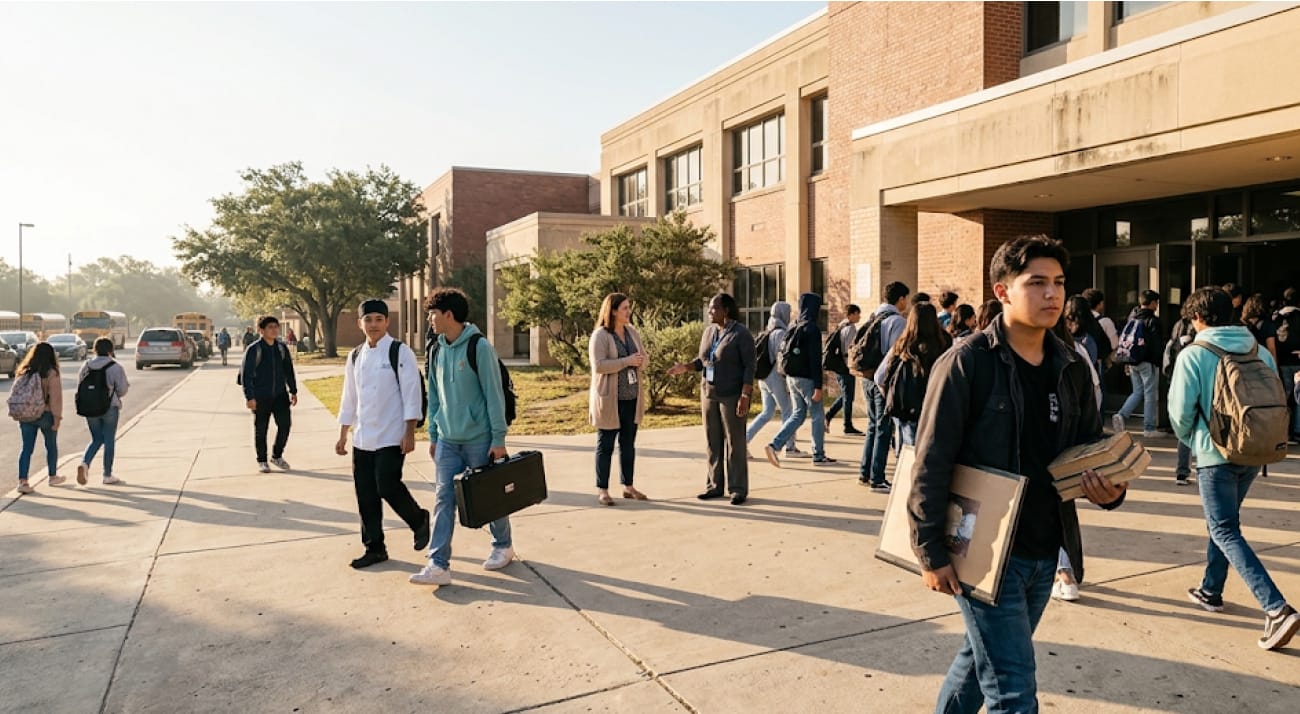
Brackenridge High School has earned an A rating in the Texas Education Agency’s 2026 accountability results, marking a significant achievement for the San Antonio Independent School District as it faces continued questions about academic performance and student outcomes. The campus earned an overall score of 90, up from 82 in the previous rating cited in recent reporting. Under Principal Mandie Holtsford-Suarez, the school has emphasized high expectations, targeted academic support, and career-focused learning opportunities for students.
The result stands out because Brackenridge serves a student population facing substantial economic challenges. According to the Texas Education Agency’s 2026 campus comparison report, the high school enrolled 1,577 students, and 84% were classified as economically disadvantaged. Its performance provides a useful case study in how schools can combine academic expectations, graduation planning, and practical career preparation.
For San Antonio families, the achievement offers encouraging evidence that improvement is possible within the district. It also raises a broader question: how can successful practices at one high school contribute to stronger outcomes across a district with campuses performing at very different levels?
Brackenridge High School Raises Its Accountability Score to 90
The Texas Education Agency released its 2026 accountability ratings in August. Brackenridge received an overall score of 90, placing it in the A category under the state’s accountability system. Recent reporting by the San Antonio Express-News identified it as the first traditional high school in SAISD to reach that rating.

The state’s official Brackenridge accountability summary provides a more detailed picture of the result. The school received a 93 scaled score for College, Career and Military Readiness, an 83 in Student Achievement, an 89 in School Progress, and a 91 in Closing the Gaps. Its reported four-year graduation rate was 95.8%.
These figures measure different aspects of school performance. The overall rating reflects the state’s accountability framework, while the component scores help identify where a campus is performing well and where further improvement may be needed.
Brackenridge’s A rating therefore represents more than a single test result. It reflects a combination of academic progress, readiness for life after high school, and performance among student groups measured under the state system.
A High-Poverty Student Population Makes the Result Significant
Brackenridge’s student demographics are central to the story. With 84% of students classified as economically disadvantaged, the school serves many families who may face financial barriers to tutoring, technology, transportation, college preparation, or other academic resources.
Economic disadvantage does not determine a student’s potential. However, differences in access to resources can affect the support students receive outside the classroom. Schools serving communities with significant financial pressures may need to provide additional academic assistance while helping students prepare for college, technical training, or employment.
Brackenridge’s results challenge the idea that a school’s community circumstances alone dictate its academic outcomes. They also highlight the importance of examining what students can access inside the school, including consistent instruction, academic interventions, career programs, and adults who help them plan their next steps.
The campus’s experience is relevant to the broader mission of youth education in Texas, where student success depends on both classroom performance and meaningful opportunities to develop skills beyond traditional coursework.
The key question for other campuses is whether the approaches associated with Brackenridge’s improvement can be adapted to their own needs. School leaders cannot assume that a strategy producing strong results in one setting will work identically everywhere, but the example provides a basis for examining which practices are transferable.
Career and Technical Education Connects Learning With Employment
Career and technical education is an important part of Brackenridge’s approach. Recent reporting indicates that about 40% of its graduates earn industry certifications, approximately 31% graduate with dual credit, and nearly 11% earn associate degrees.
These pathways give students options beyond a conventional high school diploma. Industry certifications can help graduates demonstrate specific technical skills to employers, while dual-credit courses allow eligible students to earn high school and college credit at the same time. Associate degrees can offer a head start for students continuing their education or entering fields where additional credentials are valued.
The programs also give students opportunities to connect academic subjects with practical work. A student interested in digital media, for example, may find it easier to understand the value of writing, mathematics, and technology when those subjects contribute to a project or a potential career.
Culinary arts instructor Rafael Gonzalez Jr. and digital media teacher Michael Ramirez are among the educators highlighted in reporting on the school’s career-focused instruction. Their programs connect students with skills that have practical applications in workplaces and further training.
The importance of these pathways extends beyond the school’s accountability score. Students need options that reflect different goals, financial circumstances, and interests. A strong school can help students prepare for a four-year university while also respecting the value of technical training, community college, and direct entry into the workforce.

Graduation and College Readiness Offer Additional Signs of Progress
Brackenridge’s reported four-year graduation rate of 95.8% is another important indicator. Graduation rates help show whether students are completing high school within the expected period, although the figure alone does not reveal every challenge students may experience along the way.
The school’s College, Career and Military Readiness scaled score of 93 also points to an emphasis on preparing students for their next stage. Readiness measures in Texas can include several different pathways, so families should look at the detailed indicators rather than interpreting one score as a complete picture of every graduate’s experience.
The reported rates of dual-credit participation, industry certification, and associate-degree completion help make that picture more concrete. They indicate that students are pursuing several forms of postsecondary preparation while still in high school.
For families, the practical questions are whether students can access these programs, receive the guidance needed to select them, and complete the requirements without unnecessary barriers. The availability of a program does not automatically mean every student can participate.
Schools also need to help students understand the costs, admission requirements, scheduling demands, and long-term value associated with different pathways. That work can be especially important for students who are the first in their families to consider college or who need to balance school with family responsibilities or employment.
San Antonio ISD Still Faces Wider Academic Challenges
Brackenridge’s result arrives as SAISD continues to face scrutiny over performance across its schools. A district can include a high-performing campus while other schools struggle with academic achievement, student growth, attendance, or graduation preparation. An individual campus rating should therefore be celebrated without being treated as a substitute for districtwide improvement.
The TEA’s 2026 reports show that performance varies among SAISD campuses. For example, J.T. Brackenridge Elementary School, a separate campus from Brackenridge High School, received an overall D rating with a score of 67. The distinction matters because similarly named schools can have very different results and serve students at different grade levels.
District leaders must examine those differences closely. Elementary students may need stronger foundational reading and mathematics instruction, while middle and high schools may require focused support in subject mastery, attendance, credit completion, and graduation planning. Improvement efforts are more likely to respond to local needs when leaders use campus-level evidence instead of applying a single solution everywhere.
SAISD is also dealing with broader questions about public confidence, finances, and facilities. Recent local reporting has focused on an audit of the district’s 2020 bond program and a proposed new bond package. Those financial issues are separate from Brackenridge’s academic rating, but they contribute to the wider environment in which district leaders must demonstrate transparency and results.
Academic progress and public accountability are related, but they are not interchangeable. Families need evidence that students are learning, while taxpayers also expect clear explanations of how public resources are being used.
Strong School Leadership Can Help Turn Goals Into Daily Practice
Principal Mandie Holtsford-Suarez’s leadership has been central to coverage of Brackenridge’s improvement. School leadership can influence how expectations are communicated, how teachers coordinate instruction, how struggling students receive support, and how career programs fit into the school day.
However, successful school improvement is rarely the work of one administrator alone. Teachers, counselors, students, families, and community partners all affect the environment in which students learn. A principal can establish priorities, but those priorities must translate into consistent classroom practices and useful support for students.
Targeted academic interventions are particularly important when students have different levels of preparation. Some may need additional instruction to master essential concepts, while others need opportunities to pursue advanced coursework or career certifications. A school must be able to respond to both needs without lowering expectations.
Brackenridge’s results give district leaders a reason to examine the campus’s practices in greater detail. That examination should focus on measurable strategies, such as how students are identified for extra support, how teachers monitor progress, and how students learn about college and career pathways.
It should also consider student experience. Strong scores matter, but schools need to ensure that students feel supported, can access the programs they need, and understand the options available after graduation.
What Brackenridge’s Results Could Mean for Other Texas Schools
Brackenridge’s A rating offers a useful example for other Texas high schools working to improve outcomes in communities facing economic challenges. The school’s combination of academic expectations, career preparation, and graduation planning provides several areas for further study.
Other campuses can begin by reviewing their own data and identifying where students face the greatest obstacles. A school with low graduation rates may need better credit monitoring and advising. Another with weak subject scores may need stronger classroom interventions. A campus with limited postsecondary participation may benefit from expanding access to dual credit, industry certifications, or career exploration.
The state’s accountability ratings can help direct attention, but they cannot replace a close examination of the students behind the numbers. Leaders must ask which students are progressing, which groups remain underserved, and whether programs are reaching the young people they are intended to help.
Brackenridge’s results should also encourage families to ask specific questions about their own schools. Parents can review campus report cards, ask counselors about certification and dual-credit options, and discuss graduation requirements and career goals with teachers. Students can take an active role by learning which courses and credentials align with their interests.
No single rating captures every aspect of a school, and one campus’s success does not resolve all of SAISD’s challenges. Still, Brackenridge High School’s 90-point score and range of postsecondary pathways provide a concrete example of the progress a school can make.
The Next Challenge Is Sustaining Improvement
An A rating is a milestone, but maintaining strong performance requires continued attention to student learning. Brackenridge will need to keep monitoring academic growth, graduation outcomes, college readiness, and participation in career programs while responding to the changing needs of its students.
For San Antonio ISD, the broader task is to turn individual campus successes into sustained improvement across the district. That means identifying effective practices, supporting teachers and school leaders, and directing resources toward the specific needs of each campus.
Brackenridge’s achievement gives students, families, and educators a reason for optimism. Its next measure of success will be whether the school can maintain its results while ensuring that students from different backgrounds have access to the instruction, credentials, and guidance they need after graduation.
As SAISD works through wider academic and public-accountability pressures, Brackenridge offers an important lesson: progress is most meaningful when strong performance is paired with practical opportunities for students to build their futures.