A 17-year-old student from Plano, Texas, is using machine learning, environmental research and youth education to address a problem that can be difficult to see from a distance: differences in air quality between neighborhoods.
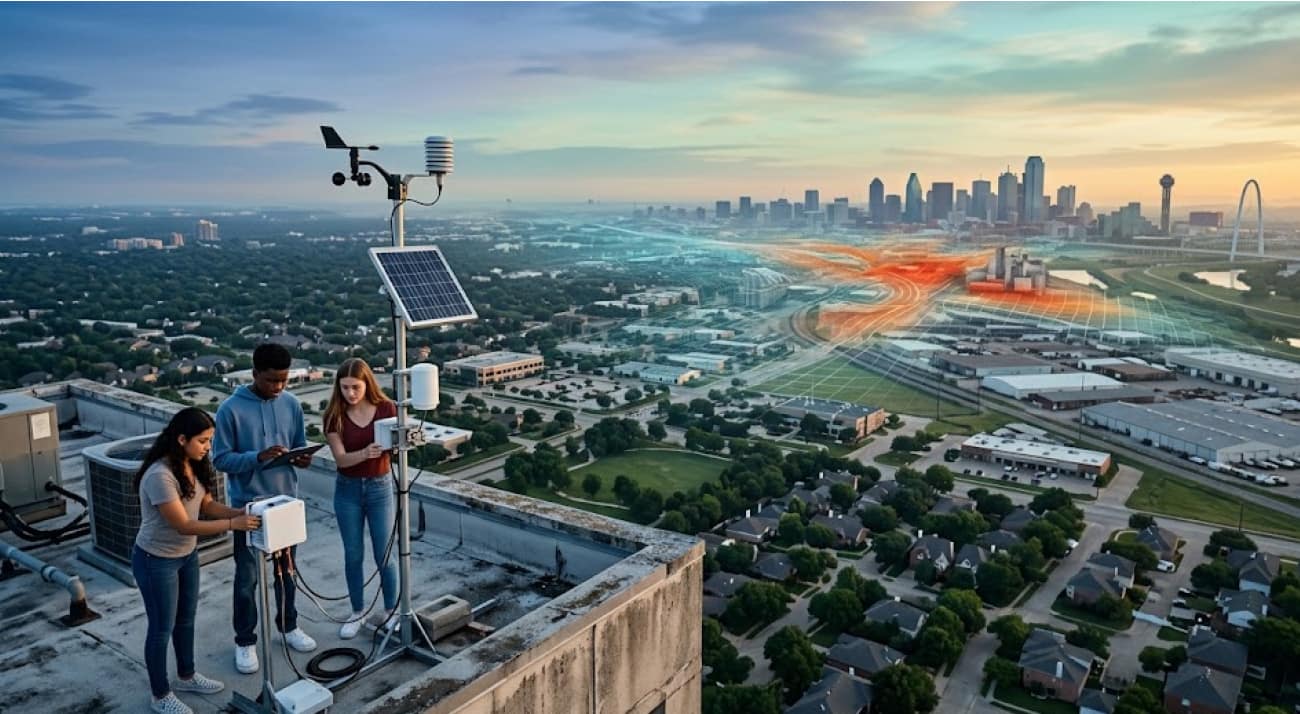
Nathan Tan, a student at St. Mark’s School of Texas, founded the Shared Skies Initiative, a youth-led nonprofit focused on environmental justice and localized air-quality information in Dallas. Tan developed a machine-learning model that estimates particulate matter levels in areas where traditional monitoring stations do not provide enough neighborhood-level coverage. The resulting real-time map is now used by approximately 1,000 Texans, according to recent reporting. (Plano Magazine)
The project has grown beyond technology. Shared Skies has distributed bilingual environmental education materials to more than 60 low-income schools, reaching approximately 30,000 students, and has trained 300 youth ambassadors to interpret air-quality information and communicate it within their communities. The organization has also distributed student-built air filters and thousands of KN95 masks.
Tan’s work recently received national recognition when he was named one of the 2026 Gloria Barron Prize for Young Heroes winners. He is one of two Texas recipients among 25 young people recognized across the United States and Canada this year. (Barron Prize coverage)
A Student Question Started The Shared Skies Initiative
The origins of Tan’s project can be traced to his experience tutoring elementary school students in West Dallas.
According to Shared Skies, the project began after a young student looked at the hazy sky and asked why it appeared that way. Tan did not have a straightforward answer, so he began researching the availability of local air-quality information and the environmental conditions affecting West Dallas neighborhoods. (Shared Skies Initiative)
The question eventually became a research project.
Tan found that parts of West Dallas had limited access to localized monitoring information despite the area’s proximity to highways, industrial activity and other potential sources of pollution. Recent reporting on his work says a single official air-quality monitor covered more than 900 square miles, leaving large areas without the same level of neighborhood-specific information.
That monitoring gap is important because air pollution can vary considerably over relatively short distances.
The U.S. Environmental Protection Agency says air-quality monitors are distributed across the country but that not all counties have air-pollution monitors. Its children’s environmental-health data also shows that, in 2023, 32% of U.S. children lived in counties with no monitoring data for PM2.5. (EPA air-quality data)
Tan’s approach was therefore based on a practical problem: how to provide useful estimates in places where a physical monitoring station cannot be installed on every street.
The AI Model Estimates Neighborhood-Level PM2.5
Shared Skies uses machine learning to estimate concentrations of PM2.5, a category of fine particulate pollution small enough to penetrate deep into the respiratory system.
The organization says its model uses sensor information and other environmental data to predict neighborhood-level PM2.5 concentrations in locations where physical monitors are unavailable. The system is intended to fill gaps rather than replace official monitoring infrastructure. (Shared Skies research)
That distinction is important.
A modeled estimate is different from a direct measurement taken by an official monitoring station. Shared Skies describes its system as a way to expand localized information, while physical sensors are used to provide observational data and help validate the model.
The organization currently says its research has processed more than 319,000 sensor-day records across four Texas metropolitan areas. Its research program combines low-cost sensors with machine-learning analysis to produce localized estimates. (Shared Skies impact data)
For students, the technical aspect of the project creates an unusual STEM learning opportunity.
Instead of treating environmental science as something that exists primarily in textbooks, Tan’s project connects data science, programming, geography, environmental science and public communication to a problem occurring in actual neighborhoods.
The technology is only one part of the model.
Dallas Has A Larger Air-Quality Challenge
The need for localized air-quality information exists within a broader Dallas-Fort Worth pollution problem.
The American Lung Association’s 2026 State of the Air report found that the Dallas-Fort Worth metropolitan area ranked ninth worst in the United States for ozone pollution and received an F grade for ozone. The report examined pollution measurements from 2022 through 2024. (American Lung Association)
The same report found that 5,474,038 children in Texas live in areas affected by unhealthy levels of air pollution under at least one of the measures examined by the report. The national report also found that 46% of Americans under 18 lived in a county receiving a failing grade for at least one pollution measure.
Those statistics provide important context for Tan’s work.
His project is not attempting to solve Dallas’ overall air pollution problem by itself. Instead, it addresses a narrower information problem: helping communities see more clearly how pollution may vary between locations.
That distinction is especially relevant for young people who spend significant portions of their day outdoors.
The EPA says children can be particularly susceptible to air pollution because their lungs are still developing and because they can experience greater exposure through outdoor activity. Fine particulate pollution has been associated with respiratory symptoms, asthma and reduced lung-function development in children. (EPA on particle pollution)
Shared Skies Has Reached More Than 60 Schools
Tan’s initiative has expanded from research into an education program.
Shared Skies created a 50-page environmental justice guide in English and Spanish and distributed it to more than 60 low-income schools, according to recent reporting. The materials have reached an estimated 30,000 students.
The bilingual approach is significant because environmental information is useful only when families can access and interpret it.
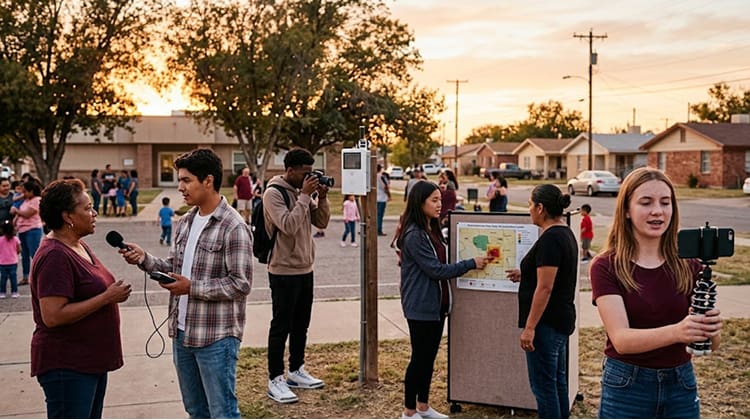
Instead of limiting the project to students already interested in environmental science, Shared Skies has attempted to make air-quality concepts accessible to students and families through classroom materials, workshops and community activities.
The organization says its education work is designed to help students understand environmental justice and interpret local pollution information.
That creates a different role for a student-led environmental organization. Rather than simply collecting data, Tan’s team is trying to build a chain connecting measurement, education and community participation.
The project’s reach can be summarized through several of its reported milestones:
| Shared Skies Initiative | Reported Figure |
|---|---|
| Youth ambassadors trained | 300 |
| Low-income schools reached | 60+ |
| Students reached through educational materials | Approximately 30,000 |
| Texans using the real-time map | Approximately 1,000 |
| Student-built air filters distributed | 50 |
| KN95 masks distributed | 10,000 |
The numbers show how quickly a project that began with one student’s question expanded into a broader youth program.
The Youth Ambassador Program Turns Students Into Communicators
The 300 youth ambassadors represent another important part of Tan’s strategy.
The program trains young people to interpret air-quality information and share it with classmates, families and community members.
That model changes how students participate in environmental education.

A traditional classroom approach might give students information about air pollution and ask them to complete an assignment. The Shared Skies model adds another step by asking students to become communicators of that information.
A student who learns how to interpret PM2.5 data can potentially explain an air-quality reading to parents or classmates. Another student may use the information in a science project. Others can participate in letter-writing campaigns or community discussions.
The organization says youth ambassadors have participated in advocacy activities, including communicating with local officials about environmental concerns. (Shared Skies Initiative)
For Youth Rise Texas readers, the program also illustrates how STEM education can move beyond academic achievement.
Students can use technical skills to identify a local problem, collect information, build a model and then communicate the results to people outside the classroom.
Student-Built Air Filters Add A Practical Layer
Shared Skies has also combined research and education with physical interventions.
The organization reports distributing 50 student-built air filters to families and schools. Recent reporting says the filters are designed to reduce indoor particulate pollution by as much as 95% under the project’s stated testing conditions.
The project has also distributed 10,000 KN95 masks to students and families in West Dallas.
These efforts illustrate another characteristic of the initiative: Tan’s team is not treating data as the final product.
The information is intended to help communities make decisions about exposure, while physical resources provide additional ways to reduce exposure when pollution levels are elevated.
The approach combines three distinct activities: research, education and advocacy. Shared Skies formally describes those as its three core areas of work.
Nathan Tan Has Taken The Research Beyond Classrooms
Tan’s work has also moved into civic spaces.
He has participated in local advocacy and spoken about air-quality issues at city council meetings. A June 2026 Plano City Council recording shows Tan addressing the council as a 17-year-old resident and founder of Shared Skies. He explained that his project grew from a young student’s question about hazy skies and the lack of information available to measure what that student was experiencing.
That appearance demonstrates how youth STEM projects can develop into civic engagement.
Tan’s organization has also focused on industrial sites and environmental conditions in West Dallas. Its advocacy work has included letter-writing campaigns and efforts to bring local air-quality concerns to policymakers.
For students, this creates a pathway from scientific observation to public discussion.
A young person does not need to wait until adulthood to participate in that process. Tan’s project demonstrates how research can become a tool for community conversations when students can translate technical information into language families and policymakers can use.
The Project Has Received National Recognition
The growth of Shared Skies has now brought Tan national recognition.
In September 2026, Tan was named one of the winners of the 2026 Gloria Barron Prize for Young Heroes, an annual award recognizing young people ages 8 to 18 in the United States and Canada for significant contributions to their communities or the environment. He is one of 25 recipients this year and one of two Texas recipients. Fifteen of this year’s winners receive $10,000 to support their service work or higher education.
The recognition puts Tan’s work within a larger national group of young people working on community and environmental issues.
It also reflects the unusual combination of disciplines represented by Shared Skies.
Tan’s project includes machine learning, environmental monitoring, public health education, youth leadership and civic advocacy. None of those areas operates independently within the initiative.
The data provides the evidence. The educational materials translate the evidence. The youth ambassador program distributes the information. Advocacy creates a path for the information to reach decision-makers.
AI Gives Students A New Way To Approach Environmental Problems
Tan’s project also demonstrates how artificial intelligence and machine learning are changing the kinds of projects high school students can undertake.
Environmental monitoring has traditionally depended heavily on physical infrastructure. Sensors need to be purchased, installed, maintained and calibrated. Expanding a monitoring network across every neighborhood can be expensive and technically difficult.
A predictive model offers another approach.
By combining available sensor data with other information, a machine-learning system can estimate conditions between monitoring points. Shared Skies says its model is designed specifically to predict neighborhood-level PM2.5 concentrations and fill gaps where physical monitors are unavailable.
The model still depends on reliable data and validation, which is why Shared Skies maintains physical sensors alongside the predictive system.
That distinction offers an important lesson for students interested in AI.
The most useful applications are often not about replacing people or existing systems. They can involve combining technology with physical measurements, domain knowledge and community needs.
Tan’s project is an example of that approach in practice.
Plano’s Youth STEM Community Is Growing Beyond Traditional Competitions
Tan’s work also places Plano within a broader North Texas environment where young people are developing projects that connect technology with community issues.
Shared Skies has participated in student competitions and educational programs, including the 2026 SXSW EDU Student Impact Challenge, where the initiative was selected as one of six finalists.
The project has also involved other young people. Shared Skies lists Saketh Chebrolu, Avi Aggarwal, Angela Xue and Amari Sims among its youth team members in a Carnegie Young Leaders program.
This collaborative structure matters because youth innovation rarely develops through one person working completely alone.
Students need teachers, mentors, community organizations, access to equipment and opportunities to present their work. Tan’s experience demonstrates how a school project can grow when those connections continue beyond a classroom assignment.
For families interested in broader Texas youth STEM programs, projects like Shared Skies offer a useful example of how science and technology can connect with real community needs.
The Next Challenge Is Scaling Local Environmental Data
Shared Skies now faces a different question from the one Tan confronted when he started the project.
The initial problem was how to make air-quality information available in neighborhoods that lacked sufficient monitoring.
The next challenge is how to scale that information while maintaining accuracy, transparency and usefulness.
The organization’s website says its machine-learning system is designed to predict PM2.5 across Texas, while its research program has already processed hundreds of thousands of sensor-day records across four Texas metropolitan areas.
Scaling a predictive environmental model requires careful validation because modeled estimates are not equivalent to direct measurements.
That makes the continued combination of sensors and machine learning particularly important.
It also creates opportunities for students to learn about the limitations of technology. Understanding uncertainty, data quality and model validation is part of responsible STEM education.
Tan’s project can therefore serve as both an environmental initiative and a real-world case study in how young people can use technology without treating technology itself as the solution.
A Plano Student Has Built A Youth-Led Environmental Model
Nathan Tan’s work began with a question about a hazy sky in West Dallas. At 17, that question has developed into a nonprofit using machine learning, sensors, bilingual education and youth leadership to address gaps in local air-quality information.
The scale is now measurable: approximately 1,000 Texans using the project’s real-time map, more than 60 schools reached, approximately 30,000 students exposed to educational materials and 300 youth ambassadors trained.
The broader environmental context also remains significant. The American Lung Association’s 2026 report gave the Dallas-Fort Worth metropolitan area an F for ozone pollution and ranked it ninth worst nationally for ozone pollution.
Tan’s project does not eliminate that pollution, and its predictive map does not replace official monitoring. Its contribution is different: it attempts to make information more localized and accessible while giving students a direct role in researching and communicating an environmental issue.
That combination is what makes Shared Skies relevant to youth education.
The project shows how a high school student can move from asking a question to collecting data, developing a machine-learning model, creating educational materials, training other young people and participating in civic discussions.
For students across Texas, the broader lesson is practical. A community problem can become a STEM project, and a STEM project can become a platform for other students to participate.
Tan’s recognition with the 2026 Gloria Barron Prize adds another milestone, but the more lasting measure of the initiative will be whether its data, educational resources and youth network continue expanding access to localized environmental information across North Texas and beyond.