
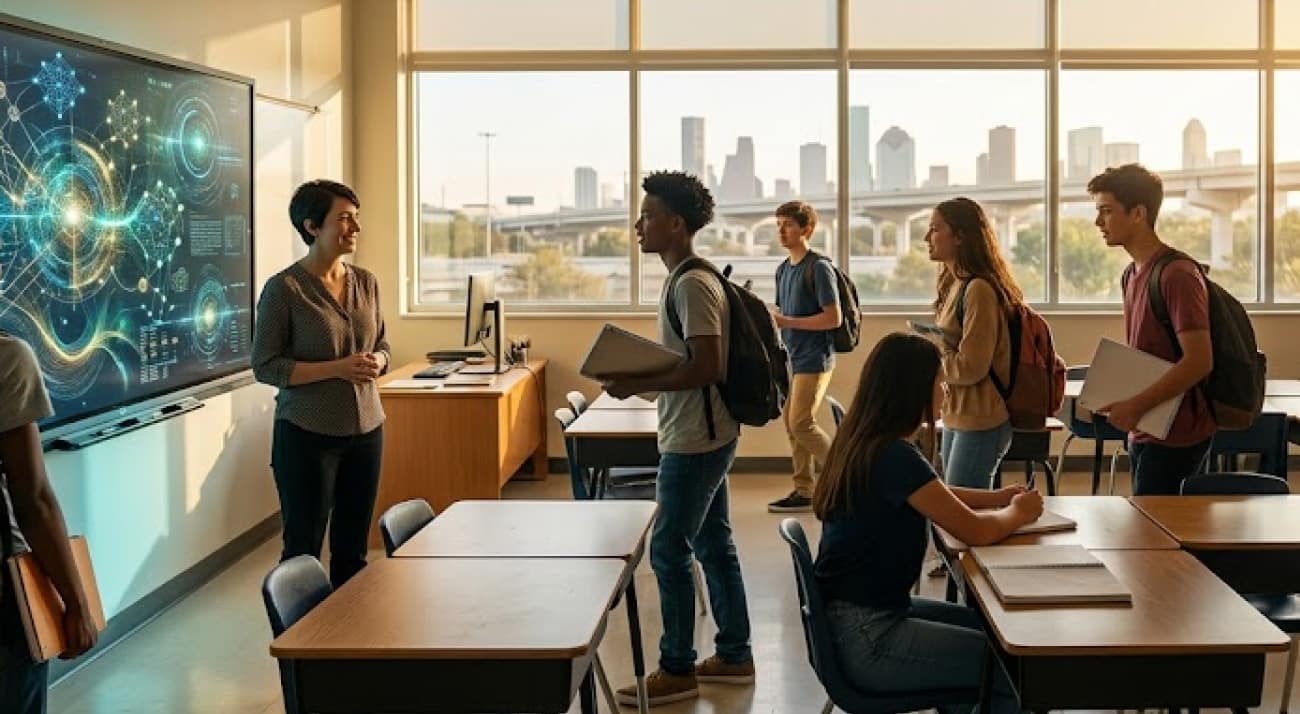
Houston Independent School District has begun the 2026–27 school year with an education experiment that could become one of the most closely watched AI initiatives in a major Texas school district. On August 10, more than 160,000 HISD students returned to campuses as the district launched its expanded Future 2 model at nine schools, combining traditional academic instruction with artificial intelligence, design thinking, hands-on experiences, and skills intended to prepare students for a changing workforce.
For young people, the significance extends beyond learning how to use artificial intelligence. The district is attempting to redesign how students spend their school day and how they develop skills such as problem-solving, collaboration, leadership, creativity, and practical decision-making. That makes the initiative particularly relevant to organizations focused on Houston youth education and long-term student development.
What Future 2 Means For Houston Students
Future 2 is not simply an AI class added to an existing school schedule.
HISD describes the program as a broader instructional model designed around the premise that students need both strong academic foundations and skills that remain valuable as artificial intelligence becomes more common in the workplace.
The district initially announced two Future 2 schools in February: C. Martinez Elementary and Gregg Elementary. Both are being converted into pre-K–8 campuses under the new model. HISD subsequently expanded the 2026–27 pilot to nine campuses.
The nine schools participating in the expanded model include:
| Campus | School Level |
|---|---|
| C. Martinez Elementary | Pre-K–8 Future 2 campus |
| Gregg Elementary | Pre-K–8 Future 2 campus |
| Bonham Elementary | Elementary |
| Shadydale Elementary | Elementary |
| Southmayd Elementary | Elementary |
| Deady Middle School | Middle |
| Forest Brook Middle School | Middle |
| Hartman Middle School | Middle |
| Sugar Grove Academy | Middle |
The expansion represents a substantial increase from the district’s original plan. In April, HISD announced that three additional elementary schools and four middle schools would join the two previously announced Future 2 campuses.
That means the 2026–27 school year is functioning as a real-world test of whether an AI-oriented instructional philosophy can operate across different grade levels and student populations.
The School Day Looks Different Under Future 2
One of the most significant changes is the structure of the school day.
HISD’s original Future 2 framework divides learning into distinct components rather than relying exclusively on conventional classroom instruction. Students receive core academic instruction before moving into experiences and workshops designed around practical application.
The district describes a schedule that can run from 7:30 a.m. to 4 p.m., with optional programming extending to 6 p.m. The model includes coursework, hands-on experiences, and workshops that can involve activities ranging from music and sports to specialized skills.
The concept changes the role of the school from a place primarily focused on academic content into a broader learning environment.
Students can encounter traditional subjects such as reading, writing, mathematics and science while also working on projects that require them to apply knowledge.
That distinction matters because AI can make information easier to obtain. The more difficult educational question is whether students know what to do with that information.
AI Is Being Paired With Human-Centered Skills
HISD Superintendent Mike Miles has presented Future 2 as a response to a labor market in which artificial intelligence is expected to become increasingly common.
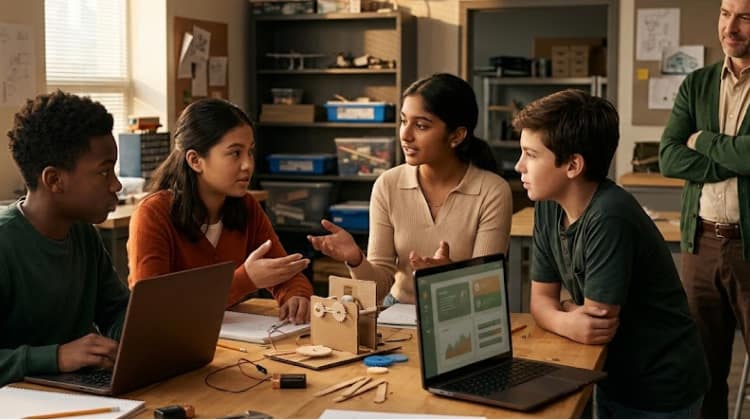
The district’s stated philosophy is that schools should place greater emphasis on skills that technology cannot easily replace, including judgment, empathy, collaboration, leadership and problem-solving.
This creates an important distinction between AI literacy and simply teaching students how to operate AI software.
A student may know how to generate an answer using an AI system without understanding whether the answer is accurate. Another student may use AI to accelerate research but still need to evaluate sources, identify bias and explain the reasoning behind a conclusion.
Those skills become increasingly important when technology can produce information almost instantly.
The U.S. Department of Education’s AI guidance similarly places emphasis on responsible implementation, human oversight and ensuring that technology supports educational goals rather than becoming an objective by itself.
For Youth Rise Texas readers, this aspect of Future 2 may be more significant than the technology itself. The strongest youth programs increasingly focus on helping students become capable decision-makers rather than simply providing access to new devices.
Advanced Students Can Follow An AI-Driven Learning Track
Future 2 also introduces a differentiated academic pathway.
According to HISD, students performing in the top percentile on the Measurement of Academic Progress (MAP) assessment can have the option of following an accelerated AI-driven platform for reading and mathematics.
The district says the advanced coursework is voluntary and is designed to provide additional challenge to students who are ready for it.
That creates a potentially important opportunity for students who might otherwise move through standard coursework without being sufficiently challenged.
At the same time, differentiated instruction requires careful implementation.
Technology can make it easier to provide different learning materials to students at different levels, but academic acceleration still depends on accurate assessment and effective teacher guidance.
The goal should not simply be to move high-performing students faster. It should be to ensure that each student receives an appropriate level of challenge while maintaining access to strong foundational instruction.
Hands-On Experiences Move Learning Beyond Screens
Perhaps the most distinctive part of Future 2 is that the model is not designed around more screen time alone.
HISD’s framework includes 110-minute experience blocks and 90-minute workshops intended to expose students to practical activities and specialized skills. Workshops can include areas such as musical instruments, physical skills and team sports.
The district has also described experiences involving local, domestic and international travel, along with projects that require students to demonstrate problem-solving, collaboration and ethical reasoning.
That creates a useful counterbalance to the growing presence of technology in education.
If students spend part of their day interacting with AI-powered platforms but another part building something, performing, competing, traveling, conducting research or working with community professionals, technology becomes one component of a broader education rather than the entire educational experience.
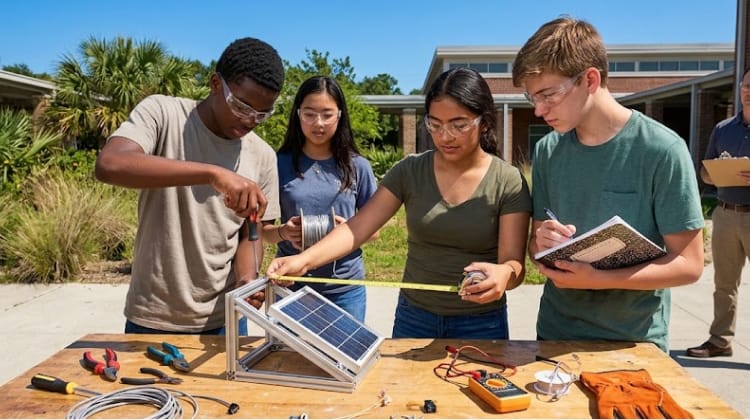
For young people, that distinction can influence confidence and career awareness.
A student who participates in an engineering project may discover an interest in STEM. Another who works with a community professional may develop an interest in entrepreneurship, healthcare, media or skilled trades.
Community Professionals Have A Larger Role
Future 2 also expands the definition of who can contribute to student learning.
HISD says workshops can be taught by community professionals with specialized knowledge outside traditional teaching expertise. Teachers remain responsible for academic instruction, while outside professionals can introduce students to skills and experiences connected to real-world environments.
That model creates a direct connection between schools and the broader Houston community.
Houston has major industries in energy, healthcare, aerospace, technology, manufacturing and logistics. Giving students opportunities to interact with professionals in those fields can make career possibilities more concrete.
This is particularly important for younger students.
Career readiness does not have to begin with choosing a profession. It can begin with discovering what different professions actually look like.
A student who meets an engineer, entrepreneur, scientist, designer or healthcare professional can begin connecting school subjects to real work.
Future 2 Fits Into A Much Larger HISD Transformation
The AI initiative is only one part of a much larger transformation taking place across Houston ISD.
The district began the 2026–27 school year under significant structural changes, including campus closures and mergers, expansion of the New Education System, a major special-education restructuring and changes to teacher compensation. Approximately 5,000 students receiving special-education services were reassigned to different campuses as part of the district’s restructuring.
That context matters when evaluating Future 2.
The district is not introducing AI in isolation. It is simultaneously changing curriculum, staffing structures, campus operations and the way student services are organized.
HISD’s own transformation reporting says reading performance improved across every tested grade in 2026 compared with the previous year, with particularly notable gains since 2023 in grades including fourth, sixth and eighth.
Those results provide an important benchmark.
Future 2 will ultimately have to demonstrate that innovation can coexist with measurable academic progress.
The District Is Investing $4.5 Million In Future 2
The financial commitment behind the pilot is also significant.
HISD budget documents call for an additional $4.5 million for the nine Future 2 schools during the 2026–27 school year, or approximately $500,000 per campus.
That funding is being deployed as the district manages broader financial pressures and significant operational changes.
The investment raises an important question for public education: what does an AI-centered school model need to deliver to justify the additional resources?
A successful program could eventually provide a framework that other campuses can adopt.
A less successful result would provide equally important information by showing which elements of AI-centered instruction do not produce meaningful gains.
Either way, the nine-school pilot gives HISD an opportunity to collect evidence before expanding the concept more widely.
HISD Has Bigger Plans For Future 2
The nine campuses launching the model this year are only the beginning of the district’s stated ambitions.
HISD has previously outlined plans for 25 Future 2 schools during the 2027–28 school year, with Superintendent Mike Miles envisioning the possibility of eventually converting as many as 100 schools by July 2031.
That potential scale makes the 2026–27 pilot particularly important.
What happens at the nine initial campuses could influence decisions affecting thousands of additional students.
The district will need to examine several measures simultaneously: academic performance, student engagement, attendance, teacher retention, family satisfaction, access to advanced coursework and the effectiveness of the hands-on experiences.
A successful AI program cannot be judged solely by whether students can use new technology.
It should demonstrate that students are learning more effectively and developing capabilities that will remain valuable after graduation.
Houston Students Are Entering A Different Educational Era
The beginning of the 2026–27 school year marks an important transition for HISD.
Artificial intelligence is no longer being treated exclusively as a subject students might encounter in college or in a specialized technology course. At the nine Future 2 campuses, it is becoming part of the philosophy governing how students learn.
The larger experiment is whether an AI-era school can combine technology with the qualities that have always mattered in youth development: curiosity, leadership, teamwork, creativity, communication and judgment.
That balance will be critical.
The most useful outcome of Future 2 may ultimately have little to do with whether students become proficient with a particular AI platform. Technology will continue changing too quickly for that to be the central measure.
The stronger test will be whether Houston students leave these programs better prepared to ask good questions, evaluate information, solve unfamiliar problems, work with other people and apply what they know in situations that cannot be solved by a screen alone.
For a district serving more than 160,000 students, the nine-campus experiment now underway could become one of the most consequential education tests in Texas. The 2026–27 school year will provide the first substantial evidence of whether HISD’s vision for AI-centered education can translate from an ambitious policy concept into measurable opportunities for young people.