
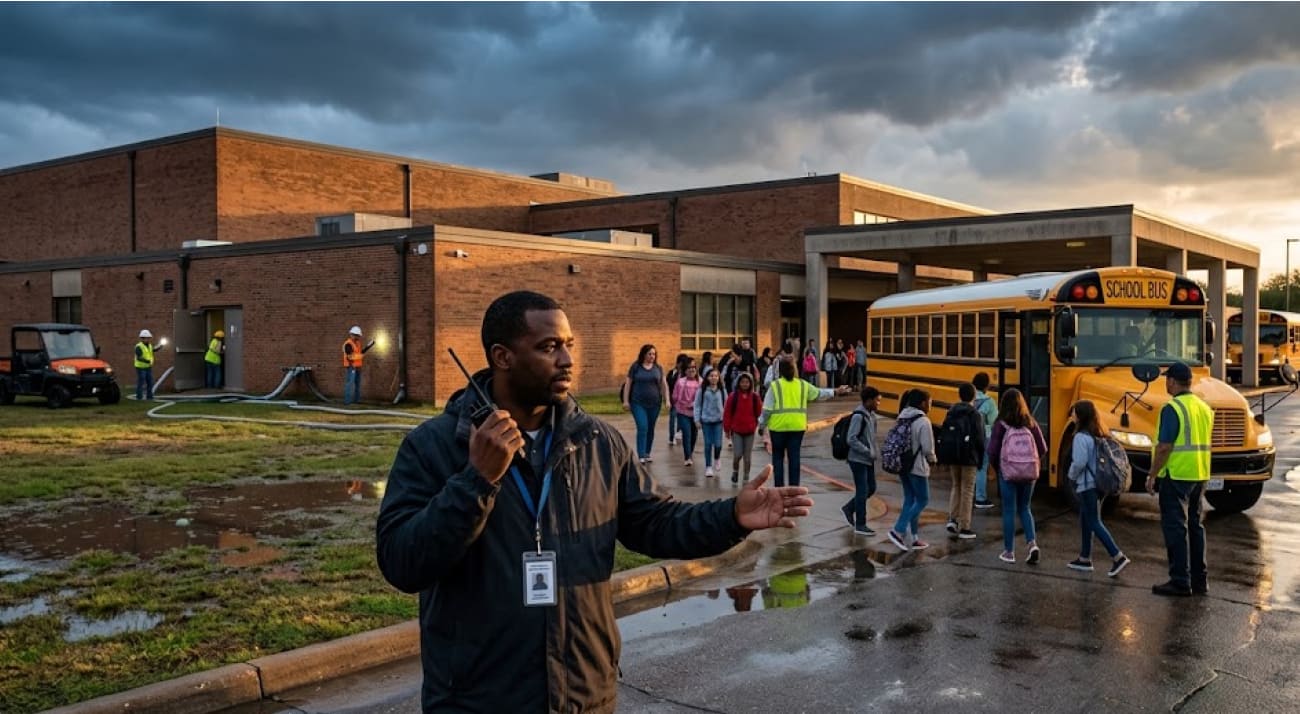
Heavy rainfall has forced Fort Worth ISD to temporarily relocate students from Meacham Middle School after water entered portions of the campus and district officials determined that parts of the building were unsafe for occupancy.
The decision came after severe weather affected North Texas on October 1, 2026. Fort Worth ISD initially closed Meacham Middle School because of water intrusion, canceling school activities and events while officials assessed the building. By October 2, Superintendent Peter Licata told families that repairs were expected to take several weeks and that students would temporarily attend the former Edward J. Briscoe Elementary School building. Fort Worth ISD’s weather update confirms that water intrusion from severe weather prompted the initial closure.
The relocation creates a significant logistical challenge for a middle school community, but the district says its objective is to keep the disruption to students as limited as possible. Students will retain their current teachers, courses, programs, bell schedule, counselors and administrators while classes are moved to the temporary campus.
Heavy Rain Made Parts Of Meacham Unsafe
The immediate cause of the disruption was water intrusion associated with the heavy rainfall that moved across North Texas.
On Thursday, October 1, Fort Worth ISD reported that Meacham Middle School was closed because severe weather had caused water to enter the building. The district canceled school activities and events at the campus while additional information was gathered.

The timing was significant because the National Weather Service office in Fort Worth was issuing multiple flood and flash-flood alerts across North Texas that morning. One flash-flood warning covering Tarrant County, along with parts of Dallas and Denton counties, reported that thunderstorms were producing heavy rainfall and that as much as 4 inches of rain had fallen in parts of the warned area.
The weather was therefore broader than a localized school facility problem. Heavy thunderstorms were affecting transportation routes, roads and other infrastructure across the region at the same time district officials were evaluating Meacham.
For a school building, water intrusion can create several problems beyond visible leaks. District officials must determine whether affected spaces are safe for students and employees, whether electrical or mechanical systems have been compromised, whether classrooms can be cleaned and dried properly, and whether repairs can be completed without exposing students to ongoing hazards.
That assessment explains why Fort Worth ISD did not simply reopen the building once the rain moved away.
Meacham Students Will Temporarily Attend Briscoe
Fort Worth ISD announced that Meacham students would begin attending classes at the former Briscoe Elementary School building on Tuesday following the initial Monday closure.
Superintendent Peter Licata said facilities personnel, contractors and safety teams determined that repairs at Meacham would require several weeks. The district therefore chose a temporary relocation rather than keeping students out of school while the work continued.
Briscoe provides the district with an unusual logistical advantage because the campus was unoccupied after Fort Worth ISD’s broader campus consolidation plan. The district’s facilities plan shows that Edward J. Briscoe Elementary School closed in June 2026, with students reassigned to other campuses for the 2026–27 school year. FWISD’s campus plan identifies Briscoe among the campuses closed as part of the district’s consolidation program.
That means Fort Worth ISD can use an existing school facility rather than immediately attempting to place Meacham students into already occupied classrooms at another middle school.
The temporary move still requires substantial preparation. The district said it was working on classrooms, transportation, technology, food service and student-support systems before students arrived.
Those details matter because relocating a school is considerably more complicated than moving classes from one building to another.
Students need working classrooms, internet access, instructional materials, meals, transportation arrangements and safe arrival and dismissal procedures. Teachers and administrators also need access to the systems they normally use throughout the school day.
Students Are Keeping Their Teachers And Programs
One of the most important aspects of Fort Worth ISD’s response is the decision to preserve as much of the normal academic structure as possible.
According to the district, Meacham students will keep their current teachers, courses, programs and bell schedule during the temporary relocation. The same principal, assistant principals, counselors and support staff will continue working with the students. Support services, interventions and accommodations are also expected to continue.
That approach reduces one of the biggest risks associated with an emergency campus move: creating an academic disruption on top of the physical disruption.
A student who suddenly loses access to a familiar teacher, counselor or class schedule may have to adjust to multiple changes simultaneously. Keeping the existing school team together gives students a more recognizable structure even though the physical environment has changed.
The district also said extracurricular and athletic activities would continue.
For middle school students, those activities can be an important part of daily school life. Sports, clubs and other programs provide social connections and routines that can become especially valuable when students are dealing with an unexpected change to their campus.

The challenge will be making sure that these programs can operate safely and consistently while the temporary site is being prepared and while repairs continue at Meacham.
The Temporary Move Requires A Full School Operation
The decision to relocate Meacham students illustrates how many systems have to move alongside the classroom.
| Area | Temporary Relocation Need |
|---|---|
| Instruction | Classrooms, teachers and course schedules |
| Transportation | New arrival and dismissal logistics |
| Technology | Internet, devices and instructional systems |
| Food Service | Meals and cafeteria operations |
| Student Support | Counselors, interventions and accommodations |
| Athletics | Practice, competition and activity arrangements |
| Administration | Principal, assistant principals and campus operations |
Transportation may be among the most visible challenges for families.
A campus relocation changes where students need to arrive and leave each day. Bus routes may have to be adjusted, parents need updated instructions, and staff have to manage traffic patterns around a facility that may not have been designed to receive the same student population at the same time.
Fort Worth ISD said additional information about transportation, arrival and dismissal procedures, campus maps and other logistics would be provided to families.
That communication becomes particularly important because temporary arrangements can change as construction and facility assessments continue.
Families need to know where students should go, when they should arrive, where buses will operate and which entrances or procedures apply at the temporary location.
Repairs Could Take Several Weeks
The district has not described the temporary relocation as a one- or two-day weather closure.
Instead, officials expect repairs at Meacham to take several weeks.
That timeframe makes the situation different from a conventional weather-related school closure. A short closure primarily involves waiting for roads or weather conditions to improve. A multiweek relocation requires the district to establish an alternative operating environment and maintain it until the original campus is ready.
The distinction is important for students because temporary learning arrangements can become part of their routine.
Fort Worth ISD must therefore balance speed with safety. Moving students back to Meacham before the building is fully ready could create additional problems, while keeping students at Briscoe longer than necessary would extend the logistical burden.
The district’s official position is that Meacham will not reopen until officials are confident the campus is safe and operational.
That approach is consistent with the district’s broader weather-closure procedures, which state that school cancellation decisions are made after officials evaluate weather information, road conditions and impacts on district operations and safety.
North Texas Weather Created A Larger Infrastructure Test
Meacham’s water intrusion occurred during a period of significant rainfall across North Texas.
The National Weather Service reported multiple areas of heavy rainfall and flooding on October 1. A flood advisory for parts of North Texas reported 1 to 3 inches of rain in a short period, while another warning covering Tarrant County reported rainfall totals of up to 4 inches in the affected area.
Those conditions can test buildings that may otherwise operate normally.
Schools are particularly sensitive to water-related damage because they combine large numbers of people with electrical systems, technology equipment, food-service operations, HVAC infrastructure and extensive interior spaces.
The disruption at Meacham therefore raises a broader facilities question for school districts: how prepared are aging or actively renovated campuses to handle intense rainfall events?
That question is especially relevant at Meacham because the campus is already undergoing a major renovation and expansion, according to Fort Worth ISD’s announcement about the relocation.
The fact that the school was already part of a significant construction project adds another layer to the repair process. District officials must coordinate facility assessments and repairs while construction activity is already occurring.
Safety Comes Before A Fast Return
The temptation during a school disruption is to focus on how quickly students can return to their normal campus.
For Fort Worth ISD, however, the immediate priority is determining when the building is safe.
Water damage can produce problems that are not always visible immediately. A classroom may appear usable while underlying moisture, damaged materials or affected building systems still require attention.
That is why the district’s decision to use another campus for several weeks gives facilities teams more time to inspect, repair and prepare Meacham rather than forcing a premature reopening.
The district has also emphasized that the temporary relocation is intended to preserve educational continuity while the work takes place.
For families, that creates a different measure of success. The temporary campus does not need to replicate every physical feature of Meacham. It needs to provide a safe, functional environment in which students can continue learning while repairs are completed.
Meacham’s Community Has To Adapt Quickly
A school is more than its classrooms, and Fort Worth ISD acknowledged that reality in its message to families.
Students and parents may feel anxious about an unexpected campus move, particularly when the change occurs in the middle of the school year and follows a weather event that disrupted the physical school environment.
The district said it intends to provide support during the transition while keeping the existing Meacham leadership and student-support structure in place.
Meacham Middle School is located at 3600 Weber Street in Fort Worth, and the school’s official website continues to provide information about its academic programs, staff and campus services. Meacham Middle School information gives families access to those school resources as the temporary arrangement develops.
Keeping communication centralized can help reduce confusion as transportation, schedules and activities are adjusted.
It also gives families a way to distinguish confirmed district information from speculation circulating through social media or informal parent networks.
The Temporary Campus Is A Test Of Continuity
The relocation of Meacham Middle School students is ultimately a test of how quickly a large school district can preserve educational services after a facility becomes unusable.
The initial weather event created the physical problem, but the district’s response now involves transportation, technology, food service, staffing, student support and facility management.
| Immediate Issue | District Response |
|---|---|
| Water intrusion | Meacham closed for assessment and repairs |
| Building safety | Facilities, contractors and safety teams evaluating the campus |
| Student instruction | Classes moved temporarily to Briscoe |
| Teachers and administrators | Existing Meacham staff retained |
| Courses and programs | Students keep current academic programs |
| Student activities | Athletics and extracurriculars continue |
| Repairs | Expected to take several weeks |
The most important element is that students are not being asked to wait indefinitely for their campus to become usable. Instead, Fort Worth ISD has identified an existing facility and is attempting to recreate the core functions of the school there.
That approach gives students a path to continue their education while the physical problem is addressed.
For families following Fort Worth ISD school operations, the Meacham situation also illustrates why school facilities and student safety are closely connected. A building problem can quickly become an academic, transportation and community issue when hundreds of students depend on that facility every weekday.
The next measure of the district’s response will be whether Meacham’s repairs progress as expected and whether students can return to a campus that is fully safe and operational.
Until then, the temporary move to Briscoe represents a practical attempt to protect students without allowing a weather-related building failure to become a prolonged interruption to their education.