

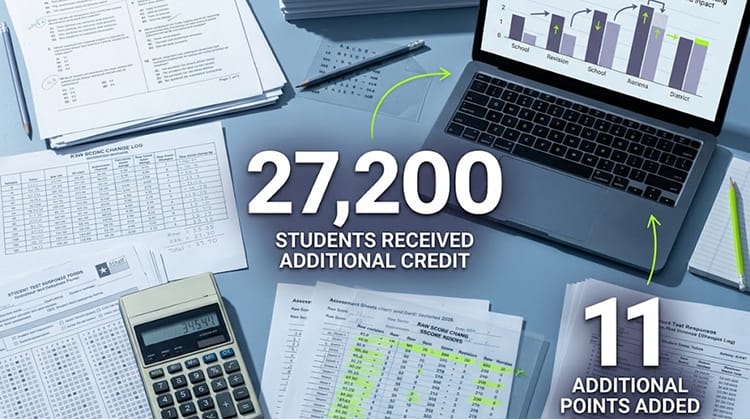
A routine review of Texas STAAR test responses has changed the academic accountability picture for several school districts and campuses across the state. About 27,200 students received additional credit after Texas Education Agency officials manually reviewed short written responses on reading assessments, and the adjustments are resulting in higher A-F accountability ratings for schools and districts affected by the changes.
The review is significant because STAAR performance plays a major role in how Texas evaluates public schools. A change involving a relatively small percentage of tested responses can therefore have consequences beyond an individual student’s score, potentially changing the letter grade attached to an entire campus or district.
For families, the episode also highlights how much weight a single assessment system carries in Texas’ public education accountability structure. The state released preliminary 2026 A-F ratings on August 14, but the ratings were still subject to review, appeals and adjustments. The Texas Education Agency accountability system provides the framework through which STAAR results and other measures contribute to those ratings.
What Changed After The STAAR Rescoring
The Texas Education Agency’s latest review focused on text-entry responses, meaning students typed brief answers such as words, numbers or short phrases instead of selecting an answer from a list. Content experts reviewed responses that may not have fit neatly into the original scoring rules.
According to state officials, about 1.6 million exams were reviewed during the process. Approximately 1.7% of those exams received score improvements. The number is relatively small when measured against the total number of tests, but the effect can become substantial when a school is close to an accountability-rating threshold.
The review affected students in grades six through eight taking relevant reading assessments as well as students taking the English I end-of-course exam.
Importantly, the rescoring did not result in lower scores. Texas Education Agency spokesperson Jake Kobersky said the purpose of the review was to make sure students received credit when their responses demonstrated the intended knowledge, even if the answer did not precisely match the original scoring expectation.
That distinction matters. A student who understands a question but enters a minor variation in spelling or wording can potentially demonstrate the correct concept without producing the exact response originally anticipated by a scoring rule.
Which Texas Districts Were Affected?
The districts identified by state officials include Chester, Crandall, Daingerfield-Lone Star, Floydada Collegiate, Forney, Fredericksburg, Galveston, Jim Hogg County, Odem-Edroy, Southwest and Walnut Bend ISDs.
The effect was not identical across every district. Officials reported that nine campuses and five districts saw their A-F ratings increase as a result of the score changes.
| District or Campus Example | Effect Of Rescoring |
|---|---|
| Galveston ISD – Central Middle School | Rating increased six points to 75, moving from a D to a C |
| Southwest ISD | Overall rating increased from 79 to 80, moving into the B range |
The Galveston example demonstrates how close accountability thresholds can make individual student scores consequential. Central Middle School’s rating increased by six points to 75, changing its classification from a D to a C.
Southwest ISD also moved from 79 to 80, pushing its district rating into the B range. The district serves approximately 14,868 students, according to the latest reporting, making the adjustment meaningful at the district level rather than simply affecting one classroom.
These changes show why families should be careful about treating an A-F letter grade as an absolute measurement of school quality. A rating can be affected by relatively narrow changes in assessment results, particularly when a campus is close to a numerical cutoff.
Why A-F Ratings Matter For Texas Schools
Texas’ A-F accountability system is more than a public scorecard.
The ratings can influence how families view schools, how educators discuss academic progress and how policymakers evaluate districts. They can also become particularly important for campuses with multiple years of unacceptable performance.
The TEA reported that 1,202 districts and 9,105 campuses received 2026 A-F ratings. About 24% of districts and campuses increased their rating compared with 2025, while 585 campuses improved from a rating below A to an A. Overall, 85% of rated campuses achieved acceptable academic performance, defined as a C or higher.
That statewide context helps explain why the STAAR rescoring matters even though the number of affected students represents a small portion of the state’s total enrollment.
The accountability system uses multiple measures, including student performance and progress on state assessments, college and career readiness indicators and performance related to underserved student populations. STAAR therefore remains a central component, but an A-F rating is not simply a single test score.
For families following Texas education news, the distinction is important because school ratings can shape perceptions long after the students who generated the underlying scores have moved to another grade.
The Difference Between A Test Score And A School Rating
One of the most important lessons from the rescoring is that student-level results and school-level accountability are connected but not identical.
A student can receive additional credit without producing a dramatic change in a school’s overall rating. Conversely, when enough scores shift around an accountability threshold, a relatively small adjustment can produce a visible change in a campus or district’s letter grade.
That is what happened in Galveston and Southwest ISD.
The difference between a 79 and an 80 may look minor on paper. But when the state’s accountability framework assigns different letter categories around that threshold, one additional point can change the way the district is publicly classified.
That creates a challenge for parents trying to interpret school ratings. A letter grade can provide a useful snapshot, but it does not necessarily tell families whether a school’s instructional quality changed overnight.
In Southwest ISD’s case, the rescoring did not suddenly create a new group of students or teachers. Instead, revised assessment results changed the data used to calculate the accountability rating.
The Rescoring Also Raises Questions About Testing Accuracy
The annual review illustrates why assessment accuracy matters.
Standardized testing systems have to process millions of responses under strict rules. Even with automated systems, human reviewers and content experts can identify answers that require more context.
The TEA says its annual review is intended to confirm the accuracy and fairness of STAAR results. That includes automated checks, educator feedback and review of open-ended responses.
For students, accuracy can be particularly important because test results can contribute to academic decisions and public evaluations of their schools.
For educators, the issue is equally significant. Teachers and administrators spend months preparing students for assessments, and accountability ratings can become part of the public conversation about whether that work produced results.
When scoring corrections subsequently change ratings, it reinforces the need for families and communities to view accountability data as something that can be reviewed and refined rather than an unchangeable verdict.
27,200 Students Received Additional Credit
The number at the center of the story is 27,200 students.
These students were not given additional points simply because their schools were close to changing an accountability grade. Their individual responses were reviewed as part of the state’s broader annual examination of STAAR scoring.

The Texas Tribune reported that content experts evaluated responses to determine whether students deserved credit. One example provided by the TEA involved a student entering a response such as “ferst” when the expected answer was “first.” Depending on the scoring circumstances, experts could determine that the response demonstrated sufficient understanding to receive credit.
That process illustrates a larger issue in standardized testing: the difference between measuring what a student knows and measuring whether the student produced an answer in precisely the form a scoring system expected.
Texas has increasingly incorporated technology into the scoring of constructed-response questions. Since December 2023, the state has used automated scoring for some open-ended STAAR responses while maintaining human review requirements. However, the responses involved in this particular rescoring were reviewed by content experts rather than receiving additional credit from the automated scoring engine.
For students, that distinction is important because the additional credit came from a human review of responses that required closer consideration.
What Happens Next For The Affected Districts?
The affected schools and districts do not have to file individual appeals to receive the changes associated with the STAAR rescoring. TEA officials said the agency will automatically update the ratings for the impacted schools and districts.
At the same time, the broader 2026 accountability process is still moving forward.
Districts have until September 11, 2026, to appeal their preliminary ratings. The state’s accountability calendar then continues through the fall, with final ratings expected later in the year.
That means the ratings currently visible to families should still be understood within the context of an ongoing accountability process.
The TEA’s 2026 accountability resources provide access to statewide information and explain how the current ratings were released.
For parents, one practical step is to look beyond the letter grade and examine the underlying performance information. A school moving from a D to a C because of revised testing data tells a different story from a school that dramatically changed its instructional outcomes over several years.
Why The Changes Matter For Students
The immediate story is about numbers, but the underlying issue is about students.
Every additional point in an accountability calculation represents individual assessment responses. When experts determine that a response deserves credit, the change recognizes the student’s demonstrated knowledge rather than simply adjusting an institutional statistic.
That is especially relevant for written responses, where students may communicate an answer correctly without using the exact wording expected by a scoring framework.
At the same time, the episode demonstrates how closely student assessments are tied to the broader accountability structure in Texas. A student’s short response can contribute to a test score, that score can influence a campus calculation, and the calculation can eventually affect a public A-F rating.
The chain from classroom to statewide accountability system is therefore much more direct than a school letter grade might suggest.
The Bigger Lesson For Texas Education
The 2026 STAAR rescoring does not mean Texas’ accountability system is unreliable. It does, however, demonstrate why accountability data requires context.
The state’s review identified additional credit for approximately 27,200 students after examining more than 1.6 million exams. Only a fraction of those changes directly affected A-F ratings, yet the impact was enough to move Central Middle School in Galveston from a D to a C and Southwest ISD from a 79 to an 80.
For families, the takeaway is straightforward: a school rating is a measurement, not the entire story of a school.
The rescoring process shows that accountability results can change when student responses receive additional review. It also shows why parents, educators and communities should examine the underlying data before drawing broad conclusions about student achievement.
As Texas continues to rely heavily on STAAR results within its accountability framework, the accuracy of every score matters. The latest review is a reminder that behind every percentage, performance level and letter grade are students whose answers are being used to describe the performance of entire schools.
For Youth Rise Texas readers, the most relevant question is therefore not simply which schools moved up after the rescoring. It is whether the state’s accountability system can continue improving its ability to measure what Texas students actually know and can demonstrate.