
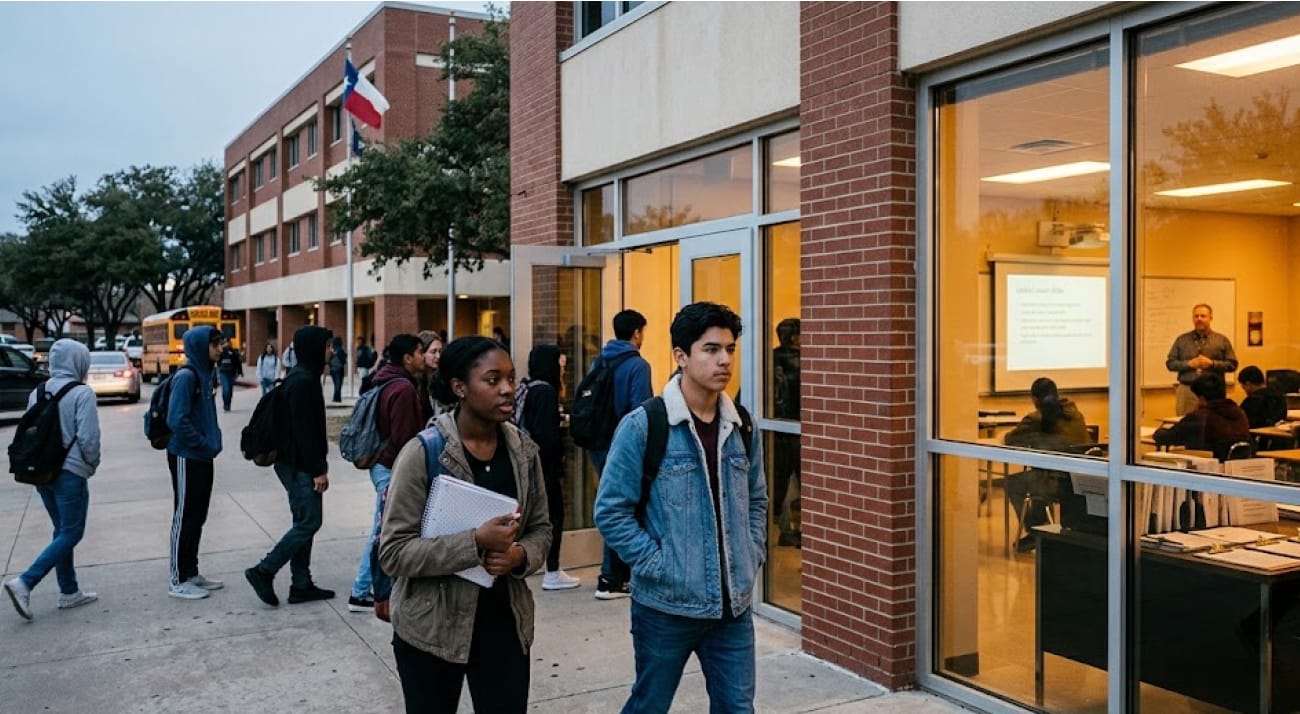
Fort Worth ISD students are challenging changes to classroom instruction introduced during the district’s state intervention, arguing that scripted lessons, mandatory slides and tighter teacher oversight are making school less engaging. The dispute has moved beyond private conversations between students and teachers: a group of students has written directly to Superintendent Dr. Peter Licata, Gov. Greg Abbott and district leaders, while a related online petition has attracted more than 1,000 signatures. The students say they want classrooms where teachers can explain ideas, encourage questions and adapt instruction to the needs of the people sitting in front of them. NBC 5 Dallas-Fort Worth reported that students including Paschal High School freshman Eve Fruge have become some of the most visible voices questioning the instructional changes.
Students Are Speaking Up About What Happens Inside Classrooms
The latest dispute is unusually direct because the criticism is coming from students themselves. A roughly 1,300-word open letter describes what students say they have experienced since Fort Worth ISD’s state-appointed leadership began implementing a more standardized approach to instruction.

The original letter was signed by 57 students ranging from third graders to high school seniors, according to reporting from Chron. CBS Texas later reported that the letter had 68 student signatures spanning second through 12th grade. The accompanying Change.org petition had collected more than 1,000 public signatures by October 6 and was approaching 1,300 signatures in subsequent reporting.
The students’ central complaint is not simply that lessons are structured. They argue that teachers have less freedom to explain subjects in their own ways and that students are spending more time following prepared materials instead of discussing ideas or exploring subjects.
Sixth grader Toby Calder told NBC 5 that students can end up writing down material without actually thinking about it. Fourth grader Clara Perkes described seeing teachers under pressure as adults with clipboards move through classrooms.
Those comments offer a student-level view of a much larger policy debate. The question is whether consistency across classrooms can be achieved without removing the professional judgment that teachers use to respond to individual students.
Fort Worth ISD Is Operating Under State-Appointed Leadership
The instructional dispute comes during one of the most significant leadership changes in Fort Worth ISD’s recent history.
The Texas Education Agency appointed a nine-member Board of Managers and named Peter Licata superintendent on March 24, 2026. The appointed board replaced the authority of the elected trustees during the intervention. TEA said the change was intended to provide leadership capable of improving academic outcomes across the district.
The district’s own TEA intervention information confirms that Fort Worth ISD is currently operating under a leadership transition directed by the Texas Education Agency. Elected trustees remain in place, but their authority is suspended while the appointed governance structure operates.
The intervention followed years of concerns surrounding low academic performance at district campuses. TEA’s enforcement action cited a Fort Worth ISD campus that had received five consecutive unacceptable academic performance ratings.
Licata arrived with more than 30 years of education experience, including leadership in Broward County Public Schools in Florida. According to TEA, he previously led Broward County to its first state A rating in more than 14 years.
His stated goal for Fort Worth ISD is straightforward: improve reading, mathematics and graduation outcomes while building a system capable of sustaining those results after state intervention ends.
That goal helps explain why the district has moved toward more consistent instructional practices. It also explains why students and teachers are questioning how those changes are being implemented.
Teachers Are Also Part Of The Debate
The student letter arrives as Fort Worth ISD deals with substantial staff turnover.
According to recent reporting, the district recorded 1,102 teacher resignations and retirements during the 2025–26 school year. That number includes departures throughout the year and is being cited by students as evidence of the pressure they believe teachers are experiencing.
More recent records show another point of concern. Fort Worth Weekly reported that 55 teachers left the district in August 2026, compared with 21 in August of each of the previous two years. The records did not establish one single reason for those departures, and former employees cited different circumstances.
That distinction matters.
It would be inaccurate to attribute every teacher departure to scripted lessons. Some employees left for family reasons, campus closures or other professional circumstances. Still, the timing has intensified questions about whether the district’s new instructional expectations are affecting teacher retention.
The student petition connects those issues directly to classroom experience. Students say they can see teachers becoming stressed and believe that pressure affects the atmosphere in their classrooms.
For a district trying to improve academic performance, retaining experienced teachers may be just as significant as creating a consistent curriculum.
ELEVATE Brings A More Standardized Instructional Model
One of the most visible changes involves ELEVATE, a network of Fort Worth ISD campuses receiving additional staffing, coaching and leadership support.
Fort Worth ISD currently identifies ELEVATE campuses as schools receiving additional resources intended to improve student outcomes. The district’s 2026–27 calendar also gives ELEVATE schools an extended schedule through the state’s Additional Days School Year program.
Recent reporting has connected the student complaints specifically to the instructional model being used at ELEVATE schools. Chron reported that the standardized model is being used in 19 schools and includes scripted lessons, mandatory slides and other tightly controlled instructional materials.
From the district’s perspective, consistency can provide a common academic foundation. A standardized lesson can make it easier for administrators to monitor whether required content is being taught and whether students across different campuses receive comparable instruction.
Students see another side of that equation.

They argue that the same structure can leave teachers with less room to respond to questions, spend additional time on difficult concepts or bring their own expertise into a lesson. For students who learn differently, the distinction can affect how engaging and understandable a classroom feels.
District Leaders Say Student Feedback Still Matters
Fort Worth ISD has not dismissed the students’ concerns.
The district told NBC 5 that it is aware of the petition and appreciates students sharing their perspectives. Officials also pointed to Licata’s regular meetings with students and said recommendations from students have already resulted in changes during the school year.
That response is significant because Licata established a Superintendent’s Student Advisory Council earlier in 2026.
According to Fort Worth ISD, approximately 40 high school students from across the district participated in the first advisory council meeting in May. Students brought concerns involving campus safety, testing and their role in district decision-making.
The existence of that council gives the current conflict an additional dimension. Students already have an official channel to communicate with district leadership, yet the new petition shows that some believe their concerns about classroom instruction require a larger public response.
Pete Geren, president of the Board of Managers, has also welcomed the students’ involvement. That could become increasingly relevant as the appointed board considers how much flexibility teachers should have under the new system.
The Board Is Now Looking At Teacher Trust
The student complaints are arriving at a moment when the Board of Managers is already examining teacher trust.
At an October workshop, board members discussed proposed goals and limits for Superintendent Licata. Community feedback had placed scripted lessons and teacher trust among the recurring concerns.
According to The Texas Tribune’s report, the proposed framework initially considered restrictions related directly to scripted lessons. The final discussion moved toward a broader requirement that teachers have opportunities to review and provide feedback on significant curriculum and instructional changes.
That approach could prove important.
The board did not ultimately impose a direct ban on scripted lessons. Instead, its proposed guardrail would require the superintendent to establish a process for teacher feedback before significant instructional changes are made and to communicate the reasoning and evidence behind those decisions.
The distinction leaves the instructional model intact while potentially changing how future decisions are made.
For teachers, that could mean a greater role in shaping curriculum. For students, it could mean that classroom changes are influenced by people who work with them every day.
The Academic Results Will Be Closely Watched
The district’s leadership has a clear argument for maintaining the instructional changes: academic results matter.
Licata has pointed to early testing indicators as evidence that his instructional overhaul may be producing improvements. During the October board discussions, he argued that the district was already seeing strong results.
But the board’s own debate highlights a problem with judging a major school transformation too quickly.
Test scores can show whether students are improving on particular measures. They do not necessarily show whether teachers feel trusted, whether students are engaged in lessons or whether experienced educators will remain in the district for years.
Those factors matter because Fort Worth ISD is trying to create sustainable improvement rather than a short-term rise in test performance.
The students’ complaints therefore create a second measurement for the district. Academic achievement can be measured through assessments, graduation rates and other data. Classroom engagement is harder to quantify, but students experience it every school day.
Students Want More Than A Different Lesson Plan
The petition’s demands extend beyond simply removing slides from classrooms.
Students are asking for accurate instructional materials, more opportunities to engage with what they are learning, changes to classroom walkthroughs and inspections, greater attention to teacher stress and more life in classrooms.
Those requests reveal a broader concern about how students define a successful school.
A student can meet an academic benchmark while still feeling disconnected from the learning process. Conversely, an engaging classroom still needs accurate content, strong instruction and measurable academic progress.
The challenge for Fort Worth ISD is finding a system that provides both.
The district has reason to seek consistency after years of academic problems. Teachers have reason to expect professional trust. Students have reason to expect instruction that makes them think rather than simply complete assignments.
Those interests do not have to be mutually exclusive.
Fort Worth Students Could Influence The Next Phase Of The Takeover
The student petition may ultimately become part of a larger conversation about what state intervention should accomplish.
The Texas Education Agency’s intervention gives the appointed board and superintendent significant authority to make changes. But the district’s long-term success will still depend on teachers, students and families accepting those changes.
Fort Worth ISD has roughly 60,000 students, meaning even a relatively small group of vocal students can highlight issues that affect a much larger population.
The response from district leaders will therefore be important. If students see their feedback translated into meaningful adjustments, the petition could become an example of youth participation during a period of major institutional change.
If they do not, the dispute over scripted lessons could become a lasting source of tension between students, teachers and state-appointed leadership.
The next major test may be whether Fort Worth ISD can demonstrate measurable academic progress while giving teachers and students a meaningful role in deciding how that progress is achieved.
For students such as Eve Fruge, Toby Calder, Clara Perkes and Charlotte Hall, the issue is already personal. They are describing what school feels like from inside the classroom. Their message to Fort Worth ISD leadership is that academic improvement should not come at the expense of curiosity, creativity and the student experience.
As the state-appointed leadership continues its work, those voices will be difficult to ignore.