
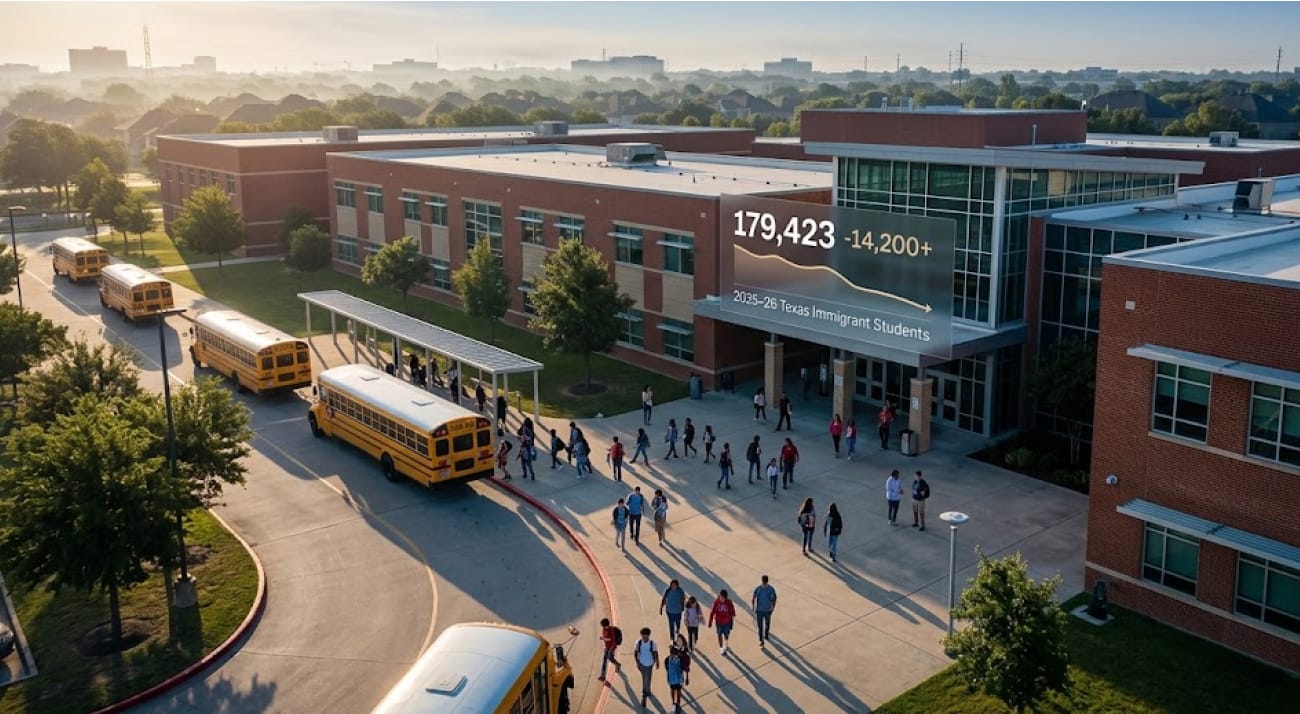
Texas public schools reported losing more than 14,200 immigrant students during the 2025–26 school year, a 7% decline from the previous year and the first statewide decrease in this student population since the pandemic.
The number fell to 179,423 immigrant students statewide in 2025–26, according to Texas education data analyzed in September 30 reporting by The Texas Tribune. The decline occurred while overall enrollment in Texas public schools also decreased, but the drop among immigrant students was considerably larger in percentage terms.
The number requires an important clarification. In Texas education data, an “immigrant student” does not mean an undocumented student. The Texas Education Agency defines an immigrant student as someone between ages 3 and 21 who was born outside the United States, Puerto Rico or the District of Columbia and has attended U.S. schools for no more than three full academic years. U.S. citizenship is not part of the definition.
That distinction matters because the statewide figure captures recently arrived students from many different backgrounds and immigration circumstances.
The decline was concentrated in several large urban districts, including Houston ISD, Austin ISD, Fort Worth ISD, Frisco ISD and Katy ISD. Houston recorded a particularly sharp change, with its immigrant-student population falling 22% in one year. At the same time, some Texas districts moved in the opposite direction. Northside ISD in San Antonio reported a 9% increase in immigrant students.
The different experiences across districts show that the statewide number is part of a more complicated enrollment story involving population movement, school choice, family decisions, demographic change and the ability of districts to attract and support newly arrived students.
What Texas Counts As An Immigrant Student
The first step in interpreting the 14,200-student decline is understanding exactly what the state is measuring.
Texas does not ask public school students to identify whether they are undocumented. Instead, the state uses the federal definition associated with Title III education programs. A student qualifies for the immigrant-student category based primarily on age, place of birth and length of time attending U.S. schools.
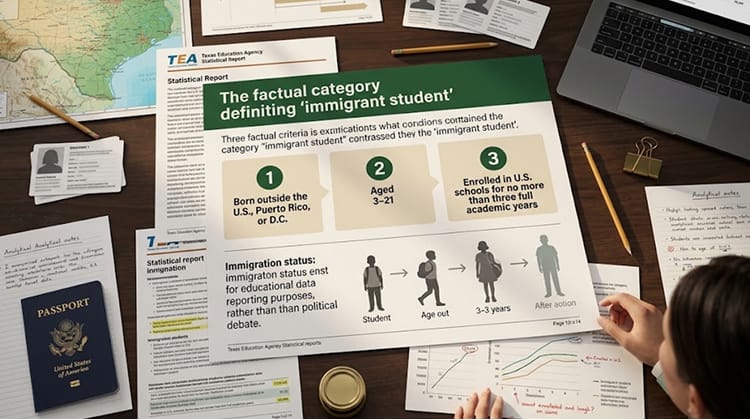
Under that definition, a student born in Mexico, Venezuela, Afghanistan, India, Nigeria or another country could be counted as an immigrant student if the student meets the three-year school-attendance requirement.
The category also changes over time.
A student who arrives in Texas at age 12 and attends U.S. schools for more than three full academic years would eventually stop being counted in the immigrant category even if the student remains in Texas and continues receiving other educational services.
That means the annual number is influenced by both new arrivals and students aging out of the definition.
The Texas Education Agency publishes enrollment information by campus, district and state, along with data on special populations and instructional programs. Its current reporting system includes student enrollment and programs such as bilingual/ESL education, special education, career and technical education and other student-support categories. (Texas Education Agency enrollment data)
For Youth Rise Texas readers, the distinction is particularly relevant because a decrease in the immigrant category does not necessarily mean the same number of students permanently left Texas.
Some students may have moved to another state, some may have left the U.S., some may have transferred to another educational setting, while others may simply have aged out of the federal reporting category.
The State Lost More Than 14,200 Students From This Category
Texas reported 179,423 immigrant students in 2025–26, compared with a higher total the previous year. The decline of more than 14,200 students represents approximately 7% of the previous population.
The decrease is occurring against a broader statewide enrollment shift.
Texas public schools lost more than 76,600 students overall during the 2025–26 school year, according to the Texas Tribune’s analysis of state data. That represented approximately a 1.4% decline in total enrollment and marked the state’s first non-pandemic statewide enrollment decrease in nearly four decades.
The comparison is significant.
If total enrollment falls by 1.4% while the immigrant-student population falls by 7%, recently arrived students are declining at a substantially faster rate than the overall student population.
That difference can affect districts that have built programs around students who are new to the U.S. education system.
| Texas Public School Enrollment Trend | 2025–26 Data |
|---|---|
| Immigrant students | 179,423 |
| Year-over-year immigrant-student decline | More than 14,200 |
| Approximate immigrant-student decline | 7% |
| Overall Texas public-school enrollment decline | More than 76,600 |
| Overall statewide enrollment change | Approximately -1.4% |
| Houston ISD immigrant-student decline | 22% |
| Northside ISD immigrant-student change | +9% |
The statewide figure also needs to be viewed within Texas’ much larger public-school population. More than 5.46 million students were enrolled in Texas public schools and charter networks during 2025–26. The state had not yet released comparable statewide enrollment data for the current 2026–27 school year at the time of the September 30 report because Texas calculates its official enrollment using an October count.
That means the 179,423 figure describes the 2025–26 school year, not a final count for the current school year.
Houston ISD Recorded A 22% Decline
Houston provides one of the clearest examples of how the statewide trend can become a local education issue.
Houston ISD reported a 22% decline in immigrant students during one year, according to the Texas Tribune’s analysis of Texas Education Agency data. The district is already experiencing a much broader enrollment decline, with nearly 10,000 fewer students reported in early September 2026 than during the comparable period in 2025.
The immigrant-student decline therefore arrives as HISD is simultaneously dealing with staffing changes, campus budget reductions and program adjustments.
The district also closed Las Americas Newcomer School, a campus specifically serving students who were new to the United States, during the 2025–26 school year. District officials cited low enrollment in connection with the closure.
For a newcomer school, enrollment trends have a direct relationship with the purpose of the campus.
These schools can provide students with specialized support as they learn English, become familiar with U.S. academic expectations and transition into a new school environment. When the number of newly arrived students decreases, districts have to reassess whether specialized campuses can continue operating at their previous scale.
The change can also have implications for teachers and bilingual education specialists.
HISD’s broader enrollment decline has already resulted in campus-level staffing changes. The district expected to lose approximately 4,000 students in its original 2026–27 budget projections, but its September enrollment figures showed a significantly larger preliminary decline. (HISD enrollment reporting)

The two enrollment stories are connected, but they are not identical. The broader HISD decline includes all students, while the 22% figure specifically concerns students meeting the federal immigrant definition.
Austin, Fort Worth, Frisco And Katy Also Saw Declines
Houston was not the only major Texas district affected.
The Texas Tribune reported that Austin ISD, Fort Worth ISD, Frisco ISD and Katy ISD also recorded declines in their immigrant-student populations during 2025–26. The percentage changes varied by district, demonstrating that the statewide decrease was not distributed evenly.
Austin is particularly significant because Superintendent Matias Segura has publicly discussed the connection between enrollment changes and immigration-related concerns in the community.
Speaking at The Texas Tribune Festival in September, Segura said the district was seeing students leave in areas where immigration enforcement activity was occurring. His statement was presented as the superintendent’s assessment of what district officials were observing rather than as a statewide determination about the cause of enrollment changes.
The distinction is important because the available enrollment data show what changed, but they do not establish one single cause for every student’s departure.
Families move for many reasons. Students can change districts, leave Texas, move to another state, enroll elsewhere or experience changes in their eligibility for the immigrant category as they spend additional years in U.S. schools.
The Texas public school enrollment data provide the underlying statewide framework for examining those changes over time.
Northside ISD Moved In The Opposite Direction
The San Antonio region provides an important counterexample.
Northside ISD reported a 9% increase in immigrant students during the 2025–26 school year. The district is one of the largest school systems in Texas and serves communities across northwest San Antonio and surrounding areas.
Ericka Dillon, Northside ISD’s director of bilingual and ESL education, attributed the increase to several factors, including Afghan resettlement and migration from Venezuela. The district has also expanded programs intended to support recently arrived students, including English as a Second Language, dual-language education and newcomer services.
Northside’s experience shows why statewide statistics should not be interpreted as evidence that every Texas community is experiencing the same demographic change.
A district receiving newly arrived families may see its immigrant-student population increase even while another district hundreds of miles away sees a substantial decline.
The reasons can include refugee resettlement patterns, employment opportunities, housing availability, family networks and local school services.
Northside officials described the district as a community that attracts families from different parts of the world, while its bilingual and ESL programs provide infrastructure for students entering the Texas education system.
That makes San Antonio an important comparison with Houston and Austin.
The contrast also illustrates why district-level planning matters. Schools need to know whether they are preparing for an influx of recently arrived students or adjusting programs because enrollment has fallen.
The Enrollment Change Has Financial Consequences
Student enrollment affects more than classroom population.
Texas public schools receive significant state funding through formulas connected to student attendance and enrollment-related measures. When districts lose students, they can also lose revenue that supports teachers, transportation, programs, facilities and student services.
The Texas Tribune reported that the decline in immigrant students contributed to tens of millions of dollars in reduced funding for Texas districts already facing broader enrollment losses and financial pressure.
The financial effect does not necessarily correspond dollar-for-dollar with the number of immigrant students who leave.
Funding formulas are complicated, and district budgets depend on factors including attendance, student characteristics, local revenue and state allocations.
Still, when thousands of students disappear from enrollment totals, school systems have fewer students around which to structure staffing and specialized programs.
That issue can be especially important for bilingual and ESL education.
Texas reported more than 1 million students enrolled in bilingual or ESL education programs during 2025–26. The immigrant category and bilingual/ESL category are not the same population, but there is significant overlap because many newly arrived students need language support when entering Texas schools.
A decline in newly arrived students can therefore change the demand for newcomer services even when a district’s broader English-learner population remains large.
Why The True Number May Be Different
The 14,200 figure should not be interpreted as a complete count of all immigrant children who left Texas schools.
The reason is built into the definition.
Texas’ immigrant-student category excludes children who were born in the United States and children who have attended U.S. schools for more than three full academic years. It also does not identify a student’s citizenship or undocumented status.
Consequently, a student who arrived in Texas several years ago may disappear from the immigrant category without leaving school.
The opposite can also happen. A newly arrived student who enters Texas and meets the criteria can be added to the immigrant population even if the family has no intention of remaining in the state permanently.
Researchers and advocates cited by the Texas Tribune therefore said the official decline likely does not capture every change involving recently arrived immigrant families.
Esmeralda Alday, senior director of programs and impact at ImmSchools, told the Tribune that some families were keeping children home because of concerns about immigration enforcement, while other families were leaving the country or experiencing parental detention. These are statements from an advocacy organization and should be distinguished from the statewide enrollment data themselves.
The federal government has offered a different account of enforcement activity.
The Department of Homeland Security said in a statement to the Tribune that ICE does not target schools and said people who are lawfully present and not violating other laws have nothing to fear. The department also disputed characterizations of its enforcement activity made by critics.
These competing claims help explain why the enrollment numbers are easier to establish than the reasons behind every individual student’s departure.
Texas Schools Still Have A Legal Duty To Educate Children
The decline in immigrant-student enrollment does not change the basic legal requirement governing public education.
The U.S. Supreme Court’s 1982 Plyler v. Doe decision established that states cannot deny children access to a free public education based on their immigration status. The Texas Tribune noted that Texas public schools therefore remain obligated to educate eligible school-age children regardless of immigration status.
For school districts, the practical challenge is maintaining attendance and enrollment while families make decisions about where and whether their children attend school.
That challenge can become more complicated when parents are concerned about government enforcement, relocation or changes in household circumstances.
Schools also have to maintain accurate enrollment records, provide language services where required and communicate with families who may have limited English proficiency.
The Texas Education Agency’s Title III resources specifically address federal programs supporting immigrant children and youth, including the definition used to identify qualifying students and the methods used to calculate related education funding. (TEA Title III resources)
Enrollment Trends Could Reshape Newcomer Programs
The sharp decline in immigrant-student enrollment creates different planning challenges across Texas.
Districts experiencing fewer newly arrived students may reconsider the size or location of newcomer programs. Districts such as Northside ISD, where immigrant enrollment increased, may need additional bilingual teachers, counselors and language-support resources.
The contrast is already visible in the types of programs districts are emphasizing.
Houston’s closure of Las Americas Newcomer School reflects one response to declining enrollment. Northside’s expansion of newcomer, ESL and dual-language services represents another response to increased demand.
Neither development by itself establishes a statewide trend for all newcomer programs.
Instead, they demonstrate how local demographics can produce very different decisions.
For Texas school communities, several measurements will be important to follow:
- 2026–27 enrollment: Texas’ official statewide enrollment data will provide a clearer picture once the current school year’s October count is available.
- Immigrant-student enrollment: This will show whether the decline continues, stabilizes or reverses.
- Bilingual and ESL enrollment: These figures can help districts measure demand for language services.
- District-level changes: Houston, Austin, San Antonio, Fort Worth, Frisco and Katy may continue to experience different demographic patterns.
- Newcomer program capacity: Changes in specialized campuses could affect how recently arrived students transition into Texas schools.
For families and educators, these figures are more than demographic statistics. They help determine where teachers are needed, how language programs are staffed and whether specialized newcomer services have enough students to operate at their existing scale.
Texas Is Entering A New Enrollment Period
The decline of more than 14,200 immigrant students is occurring at the same time Texas is confronting a broader change in public-school demographics.
Overall enrollment fell by more than 76,600 students in 2025–26, while the immigrant-student population fell approximately 7%. The state’s population of recently arrived students is therefore changing faster than its overall student population.
At the district level, the picture is less uniform.
Houston’s immigrant enrollment fell 22%. Northside ISD’s increased 9%. Other large districts, including Austin, Fort Worth, Frisco and Katy, also reported declines. Those differences demonstrate that there is no single Texas enrollment pattern for immigrant students.
The next round of state enrollment data will help determine whether the 2025–26 decline represents a temporary shift or part of a longer demographic change.
For Texas youth education, the issue reaches beyond enrollment totals. Recently arrived students often enter schools while learning a new language, adapting to a different academic system and establishing new social networks. The availability of teachers, counselors, bilingual programs and newcomer services can influence how effectively schools respond to those transitions.
Texas schools reported 179,423 students in the state’s immigrant-student category during 2025–26, more than 14,200 fewer than the year before. The number is precise within the state’s reporting definition, but its meaning requires context.
It does not represent the number of undocumented children in Texas, nor does it prove that one factor caused every student’s departure.
It does show that the population of recently arrived students being tracked by Texas public schools changed substantially in a single year. As districts prepare their 2026–27 budgets, language programs and student-support services, the differences between Houston, San Antonio and other major Texas communities will be important indicators of how the state’s schools are adapting to a changing student population.