
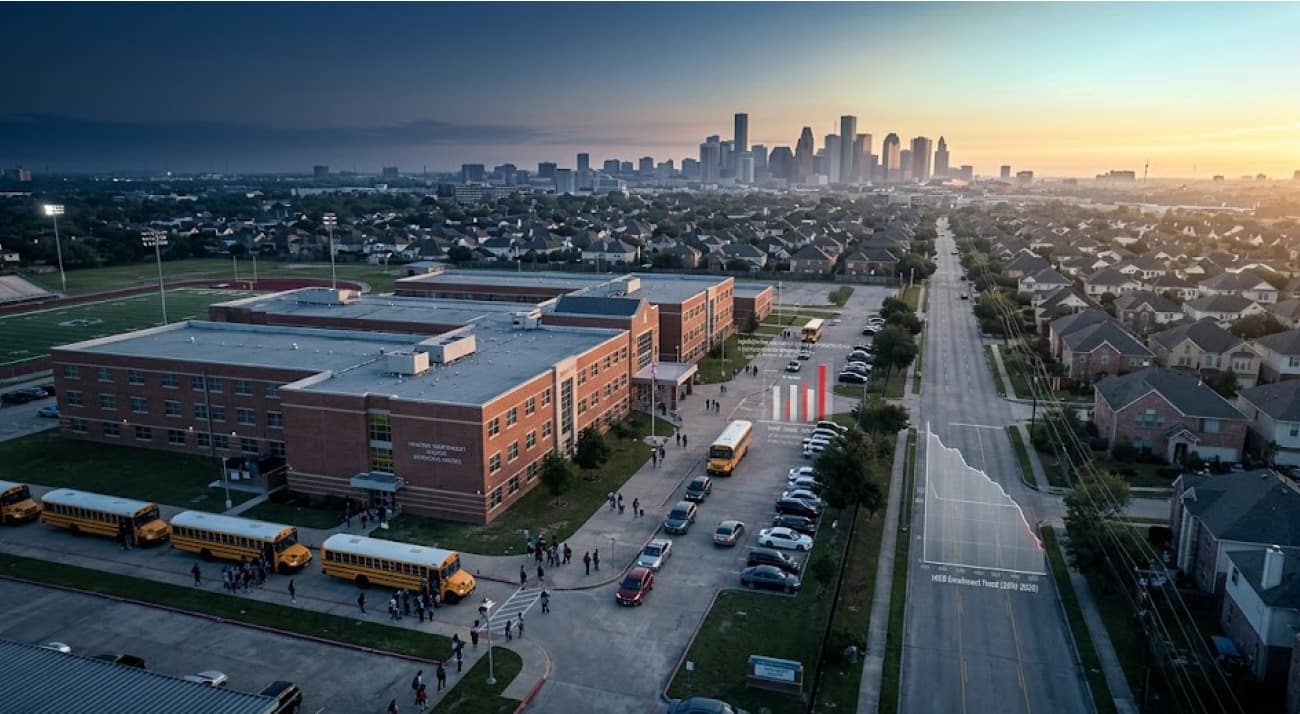
Houston Independent School District is facing another round of financial adjustments only weeks into the 2026-27 school year, after enrollment fell below the numbers used to build the district’s budget.
On September 23, The Texas Tribune reported that HISD administrators had directed some campuses to cut staff and reduce spending after the district experienced higher-than-expected enrollment losses. The district described the changes as part of its annual “campus leveling” process, but also acknowledged that declining enrollment and limited resources are contributing to the reductions.
The immediate effects are already reaching individual schools. At Lamar High School, Principal Rita Gaves told families that the campus was facing a $500,000 shortfall, with potential consequences for programs including choir and debate. At T.H. Rogers Middle School, Principal Suparna Vashisht informed parents that an assistant principal and librarian would be reassigned as part of spending reductions.
For students and families, the latest cuts are significant because they come after three years of major academic and organizational changes under the state-appointed leadership of Superintendent Mike Miles. The district now has to manage the cost of those reforms while serving a student population that has become substantially smaller.
Houston ISD Is Losing More Students Than Its Budget Expected
HISD built its 2026-27 budget around an expected enrollment decline of approximately 4,000 students. That projection was already substantial, but recent reporting indicates that the actual decline could be considerably larger.
According to The Texas Tribune, HISD lost roughly 8,000 students during the previous school year, and enrollment has declined at an accelerating rate since the state takeover began in 2023. The district’s official enrollment count for the current school year is not expected to be finalized with the state until October. The Houston Chronicle, however, has reported that the district may have lost approximately 10,000 students compared with the previous year.

The difference between a projected loss of 4,000 students and a possible decline of around 10,000 matters because Texas school funding is closely connected to student attendance. Fewer students generally mean fewer state dollars available to operate the district.
That creates a difficult financial cycle. HISD must reduce expenses because enrollment is falling, but some expenses cannot decline at the same speed. Buildings still require maintenance, classrooms still need to operate, transportation systems still need to function and schools still require administrative support even when a portion of their students leave.
Families looking for official enrollment information can also review HISD enrollment information, where the district provides its enrollment and annual student-update information.
The Enrollment Loss Has Already Reduced State Funding
The financial impact of enrollment decline is larger than the number of empty seats suggests.
A September 21 investigation by The Texas Tribune estimated that HISD had lost approximately $190 million in state funding during the first three years of the takeover because of its enrollment losses. The analysis found that the district’s enrollment decline has been faster than that of comparable large urban districts.
That funding loss comes at the same time that HISD has been spending heavily on its New Education System, commonly known as NES.
The model has been implemented across roughly 130 campuses and includes additional staff, longer instructional days, higher teacher compensation and new classroom equipment. According to district budget documents analyzed by the Tribune, adopting NES at a campus costs approximately $700,000 in its first year, while ongoing costs have been estimated at roughly $2,200 more per student.
The district has attempted to offset those expenses through reductions elsewhere. HISD eliminated roughly 1,500 central-office positions, more than 200 wraparound specialist positions and 85 bus routes during the first years of the takeover, according to the Tribune’s investigation. The district also used a significant portion of its reserves.
This creates an unusual financial equation: HISD is trying to spend more at selected campuses to implement an academic model while simultaneously reducing costs elsewhere because fewer students are generating state revenue.
Some Schools Are Already Feeling The Pressure
The latest campus-level reductions demonstrate how districtwide enrollment statistics eventually become decisions inside individual schools.
At Lamar High School, the reported $500,000 shortfall illustrates how a relatively small enrollment difference can affect discretionary programs. Choir and debate are different from core classroom instruction, but they are part of the broader educational experience for students who participate in them.
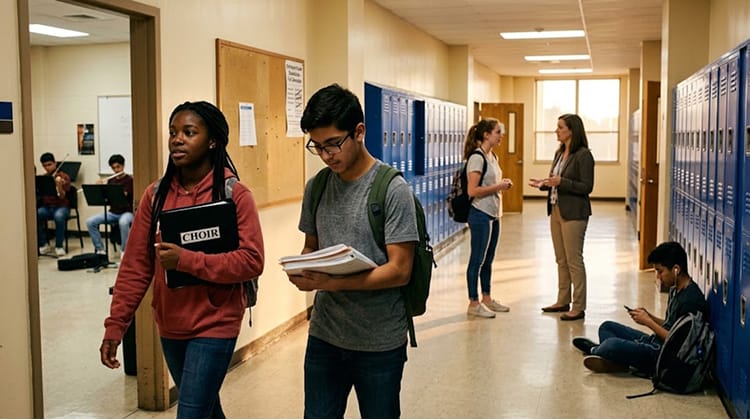
At T.H. Rogers Middle School, the reassignment of an assistant principal and librarian demonstrates another way districts can respond to lower enrollment: moving existing employees rather than immediately eliminating every position.
HISD said employees affected by the latest reductions could be reassigned to other available positions. The district has not publicly disclosed how many campuses are affected, the total amount of spending being eliminated or the number of positions at risk.
That lack of a districtwide number makes it difficult for families to measure the total scale of the latest cuts. What is clear is that the reductions are happening earlier in the academic year than some campus employees and parents expected.
A financial employee at an HISD campus told the Tribune that the mandatory nature of this year’s reductions was unusual compared with previous campus-level adjustments. The employee spoke anonymously because of concerns about retaliation.
The New Education System Is Part Of The Financial Equation
HISD’s financial situation cannot be separated from the cost of its academic transformation.
The district’s New Education System was introduced as the centerpiece of the state’s effort to change HISD after the Texas Education Agency took control of the district in 2023. The model has brought additional instructional support, different staffing structures, longer school days and technology investments to participating campuses.
Some campuses have reported significant academic improvements. Fonville Middle School, for example, moved from an F rating to an A rating under the state’s accountability system. The Tribune reported that the school added learning coaches, upgraded technology and extended its school day as part of the transformation.
The financial question is different from the academic question.
Even if a school improves academically, the district still has to determine whether it can afford the model over many years while enrollment continues to decline. That issue becomes particularly important because HISD’s costs do not disappear at the same rate as its enrollment.
A school with 22 students in a classroom does not necessarily save the full cost of that classroom when one student leaves. Major savings may require combining classes, changing staffing structures or closing facilities. Education Resource Strategies CEO Jonathan Travers told the Tribune that districts often have limited incremental savings until they make larger structural changes.
HISD Had Already Planned Major Cuts For 2026-27
The latest campus reductions come on top of cuts already incorporated into HISD’s 2026-27 financial planning.
Earlier budget documents projected approximately $50 million in lost revenue from an anticipated 4,000-student enrollment decline. HISD planned to compensate with roughly $35 million in central-office reductions and approximately $15 million in savings associated with school closures.
The district’s overall operating budget is roughly $2 billion, making the $50 million revenue loss a meaningful portion of its annual financial picture.
The challenge is that the original projection may already be outdated.
If the final enrollment count shows that HISD lost substantially more than 4,000 students, the district could have to make additional adjustments during the school year rather than waiting for the next annual budget cycle.
That is the situation now developing at campuses such as Lamar and T.H. Rogers.
The Student Experience Could Change Before Another Budget Is Approved
For students, budget reductions do not always appear as a line item on a financial document.
They can appear as fewer course options, changes to extracurricular programs, larger class sizes, reassigned administrators, reduced transportation options or fewer staff members available to support students.
The effect will not necessarily be identical across HISD.
Schools with stable enrollment, specialized programs or stronger demand may experience a different financial situation from campuses with larger enrollment declines. Magnet and specialized campuses can also have different enrollment patterns than neighborhood schools.
That means the district’s final enrollment numbers will be important, but the distribution of those students across campuses will matter just as much.
The same number of students leaving HISD could produce very different consequences depending on which schools experience the losses.
HISD’s Financial Reserves Have Become An Important Part Of The Story
HISD’s reserves have also become central to discussions about the district’s financial position.
During the first two years of the takeover, the district pulled nearly $450 million from its rainy-day reserves, according to The Texas Tribune. HISD also began selling district-owned buildings and land while reducing central-office and transportation costs.
Reserves can provide a district with flexibility during a temporary financial disruption. The challenge is different when declining enrollment creates a recurring revenue problem.
If fewer students remain enrolled year after year, reserve money can cover expenses temporarily but cannot permanently replace recurring revenue.
That distinction is particularly relevant for HISD because the district is attempting to maintain a large academic transformation while also shrinking its overall cost structure.
Houston Families Are Making Decisions That Affect The District’s Future
Enrollment numbers are ultimately connected to individual family decisions.
Some families have moved their children to other school districts, while others have chosen charter or private schools. The Tribune reported examples of families moving geographically after deciding to leave HISD campuses affected by the reforms.
That creates a longer-term challenge for the district.
If a family leaves Houston ISD for another district and establishes a new routine, returning that student becomes more difficult even if HISD’s academic performance improves. Families may move closer to another campus, change transportation arrangements or become involved in a different school community.
In that sense, enrollment decline can become self-reinforcing.
The district loses students, reduces staffing and programs, adjusts campuses and then has to convince families that its schools offer enough value to bring them back.
Superintendent Mike Miles has argued that academic improvements can eventually help restore enrollment. Parents interviewed by the Tribune have expressed different views about whether families who already left will return.
The End Of The State Takeover Adds Another Layer
HISD’s financial decisions are also unfolding as Texas prepares for the state takeover to end and control to return to the district’s elected school board.
That transition could create another period of adjustment.
The future local leadership will inherit a district with fewer students, fewer central-office employees, substantial academic reforms and less financial flexibility than it had before the takeover.
The central question will be how much of the current academic model can be maintained at its existing cost while the district adjusts to its smaller enrollment base.
The answer will affect far more than HISD’s balance sheet. It could determine which programs remain available, how campuses are staffed and whether additional schools need to be consolidated or closed.
What The October Enrollment Count Could Reveal
The next major data point will be HISD’s official enrollment count.
The district has budgeted around a projected loss of 4,000 students, while recent reporting suggests the actual decline could be considerably higher. Once official numbers are finalized, Houston families, employees and policymakers will have a clearer picture of the size of the financial gap.
Several numbers will be particularly important: total enrollment, attendance, campus-by-campus enrollment, staffing levels and the amount of state revenue connected to the final student count.
Those figures will help determine whether the September reductions are a temporary adjustment or the beginning of a larger restructuring.
For students, the significance is immediate. A district with fewer students and less recurring revenue has fewer resources to distribute, while the cost of maintaining schools and academic programs does not automatically fall at the same rate.
Houston ISD is therefore entering a period in which enrollment, academic performance and financial sustainability are becoming increasingly connected. The decisions made during the 2026-27 school year will help determine what the district can continue funding, which campuses can remain open and how much of the current reform model can survive after the state takeover ends.