

School closures are becoming an increasingly visible challenge for communities across the United States as districts respond to declining enrollment, tighter budgets and changing family needs. During the last academic year, 1,156 U.S. schools closed, the highest number since the pandemic, according to an analysis of federal education data by Big Local News at Stanford University, reported by the Associated Press on November 9, 2026.
The closures are happening while public-school enrollment continues to fall. Between fall 2019 and 2024, U.S. public schools lost more than 1.4 million students, a decline of approximately 3%. For districts already managing rising operating costs and reduced funding, fewer students can mean difficult decisions about staffing, academic programs and campus operations.
Vallejo City Unified School District in California illustrates the consequences. The district has closed five campuses since 2025 while confronting a projected $36 million deficit. Students have had to adjust to unfamiliar schools, families have raised concerns about crowded classrooms and teachers have faced uncertainty about their positions.
These developments matter beyond California. Large school systems in cities including Houston, Cleveland and Philadelphia are also confronting enrollment changes and campus closures. For students, the challenge extends beyond finding another building to attend. School transitions can affect friendships, transportation, teacher relationships, academic progress and access to specialized services.
The growing number of closures raises an important question for educators and families: how can school districts adapt to demographic and financial changes without weakening the educational opportunities available to children?
More Than 1,100 Schools Closed During the Last Academic Year
The 1,156 closures identified by Big Local News represent a significant development in the country’s public education system. The analysis, based on federal data, indicates that campus closures have accelerated even though the overall number of schools has declined only to approximately pre-pandemic levels.
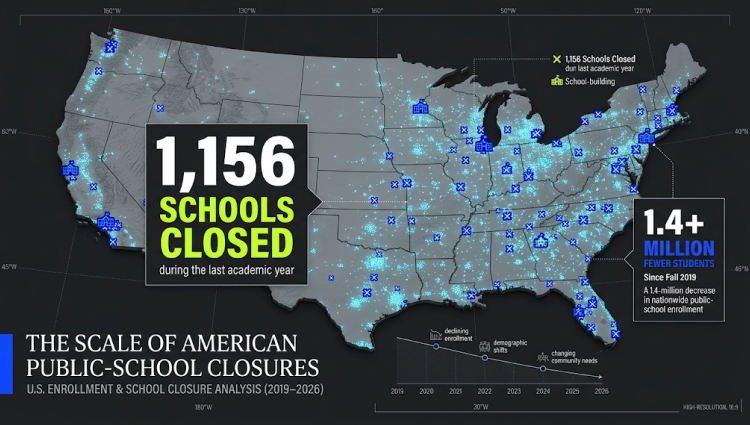
The enrollment decline has moved faster than the reduction in school buildings. That difference suggests districts may face additional consolidation decisions as they adjust facilities, staffing and academic programs to serve smaller student populations.
According to the Associated Press analysis of federal education data collected by Stanford University economist Thomas Dee and sociologist Jaymes Pyne, public-school enrollment declined by more than 1.4 million students between 2019 and 2024.
The reasons vary across communities. Lower birth rates are the primary driver, while changes in immigration, private-school voucher programs and homeschooling have also contributed to enrollment losses.
The impact is not limited to small rural districts. Large urban systems, including Houston, Cleveland and Philadelphia, have also faced campus closures or similar pressures. Their experiences show that enrollment changes can affect communities with very different economic conditions and population patterns.
For families, a school closure often changes daily life immediately. Students may need new transportation arrangements, different schedules and unfamiliar teachers. Younger children can lose access to familiar routines, while older students may have to adjust extracurricular participation, athletic opportunities and relationships with classmates.
A district’s financial calculations may focus on building capacity and operating expenses. Families, however, experience the decision through its effects on their children’s education and community connections.
Vallejo, California, Shows the Human Impact of Campus Closures
Vallejo City Unified School District offers a detailed example of how declining enrollment can reshape a school community.
According to district figures cited in the November 9 Associated Press report, enrollment fell from nearly 18,000 students in fall 2006 to approximately 9,300. That means the district now serves roughly half as many students as it did two decades ago.
The district has closed five campuses since 2025, representing approximately one-quarter of its schools. It also faces a $36 million deficit and has considered cuts affecting as much as one-third of staff positions.
Superintendent Rubén Aurelio has described the closures as an effort to adjust a school system built for a substantially larger student population. The district’s average campus occupancy was approximately 46%, according to its own figures.
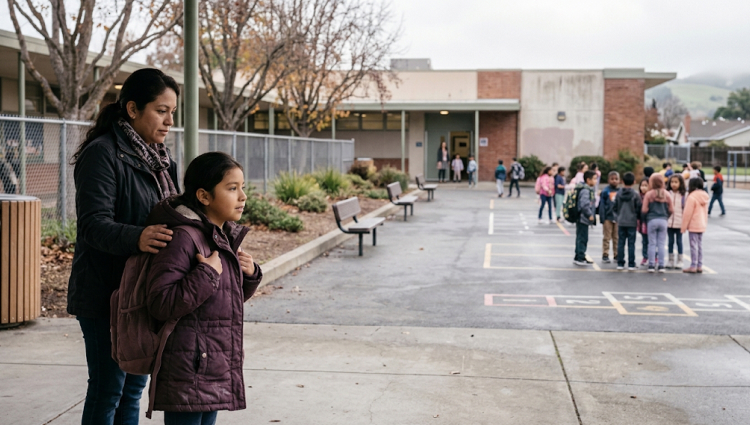
The consequences became visible during the 2026–27 school year. Fifth grader Penny Núñez-Brandão arrived at Glen Cove Elementary School on August 17, 2026, after her previous school closed. She told her mother, Kimberly Núñez-Brandão, that she could not find familiar friends outside the school.
Her experience illustrates how closures can affect students even when districts arrange new placements. A child may have a new classroom and a teacher, but still lose the social connections that made school feel familiar.
Kimberly Núñez-Brandão had already moved her older son to a competing charter school. She also raised concerns about class sizes after learning that Penny’s new teacher had 32 students in the classroom.
The district’s transition challenges were also visible at Glen Cove, where third-grade teacher Ellen Baker-Valdez had 34 children assigned to her classroom during the first week. The report described tightly arranged desks and limited space for students’ belongings.
These examples show why a campus consolidation plan needs to account for receiving-school capacity, staffing and the support students require after reassignment.
Declining Enrollment Is Creating Long-Term Financial Pressure
School closures are often presented as a way to reduce operating expenses, but declining enrollment creates a more complicated financial problem.
Public schools have costs that do not disappear immediately when student numbers fall. Buildings require maintenance, transportation systems still need to operate, and districts must continue paying for essential administrative and instructional services.
A June 2026 report from Bellwether and WestEd, Declining Enrollment in America’s Public Schools, estimated that declining enrollment could reduce state revenue for public education by $11.5 billion annually by 2030–31.
The report identified falling birth rates, slowing immigration and the expansion of private-school options and homeschooling as contributing factors. It also warned that districts may face layoffs, program reductions and school consolidations as revenue declines.
The researchers emphasized that the challenge is not simply serving fewer children. Districts may also need to support a growing share of students with additional educational needs, including English learners, students with disabilities and children from low-income households.
That creates a difficult financial balance. A district may have fewer students overall while still needing substantial resources for transportation, special education, counseling, language instruction and academic intervention.
The Bellwether and WestEd analysis recommends that states improve enrollment forecasting, provide technical assistance and reconsider funding policies so local school systems can respond to demographic changes more strategically.
These findings suggest that the financial consequences of declining enrollment require long-term planning rather than relying exclusively on emergency budget cuts.
Closing Schools Does Not Always Deliver the Expected Savings
A major concern for school leaders is whether closing campuses actually improves a district’s financial position.
Research from Stanford University offers an important caution. A September 4, 2026 study by Francis Pearman, an assistant professor at Stanford Graduate School of Education, examined California public-school districts between 2011 and 2019.
The research found that districts entering periods of school closures did not, on average, experience improved financial standing. Although spending declined, revenue also fell, leaving districts with little measurable improvement in their overall budget challenges.
Across the study’s full sample, school closures were associated with an estimated reduction of approximately $447 in per-pupil expenditures and $433 in per-pupil revenue. Neither estimate was statistically distinguishable from zero across all districts.
The financial picture was also complicated in large urban districts. There, closures were associated with lower expenditures and lower revenue per student, but the overall financial position still did not improve significantly.
Several costs can reduce expected savings. Districts may need to transport students farther, provide additional security at vacant campuses, manage unused buildings and cover staff-related expenses. If families leave the district after a closure, the loss of student-based revenue can further weaken the financial result.
Pearman’s research does not argue that schools should never close. Some districts face substantial enrollment losses, deteriorating facilities or other circumstances that make consolidation necessary. Instead, the findings show why administrators should examine the full financial consequences before treating closures as a guaranteed solution.
Districts can review the Stanford Graduate School of Education’s research on school closures to better understand the difference between reducing expenses and achieving long-term financial stability.
Students Can Experience Academic and Social Disruption After Reassignment
The educational effects of a school closure may continue long after a campus shuts its doors.
Students often depend on familiar teachers, classmates, counselors and support staff. A reassignment can interrupt those relationships, particularly when several campuses consolidate into one receiving school.
The November 9 report cited research from the University of Chicago Consortium on School Research. Marisa de la Torre, a managing director at the consortium, explained that displaced students can experience lasting declines in reading and mathematics performance, especially when they move to lower-performing schools.
The transition can also create practical problems. A student’s educational records may not arrive on time, teachers may not immediately know about accommodations or learning needs, and families may have difficulty identifying the right staff members to contact.
This can be especially important for students receiving special education services or those who rely on consistent academic intervention. Their support plans need to follow them accurately and be implemented at the new campus.
School closures can also affect students’ sense of belonging. Children who lose their classmates and familiar surroundings may need time to build new friendships and feel comfortable in a different environment.
For adolescents, the disruption may extend to extracurricular activities, sports teams, career programs and access to teachers who provide college or employment guidance.
These effects do not mean every school closure leads to poor academic outcomes. The quality of the receiving school, the preparation of staff and the support available during the transition can make a meaningful difference.
Vallejo Is Looking Beyond Budget Cuts to Keep Families Engaged
Despite its financial challenges, Vallejo City Unified has also explored ways to retain students and attract new families.
The district has been renovating older campuses and promoting academic programs and extracurricular opportunities at its remaining schools. Aurelio has also discussed plans for a Tagalog-language school intended to attract Filipino families from across the Bay Area.
The strategy recognizes that closing campuses can create a cycle that makes financial problems worse. If families lose confidence in their local schools, they may transfer children to charter or private schools, choose homeschooling or move to another district.
Those decisions can reduce enrollment further, putting additional pressure on the public-school system.
Jason Willis, a school finance expert with WestEd, credited Vallejo’s efforts to communicate with families and spread closures over multiple years. Giving parents time to understand decisions and participate in planning can help reduce uncertainty.
The district’s approach also demonstrates why school improvement needs to continue after a consolidation. Families need to see that the remaining campuses offer strong instruction, safe environments, relevant programs and opportunities for students to succeed.
The challenge is balancing necessary financial adjustments with investments that make public schools attractive places for children to learn.
What School Districts Can Do to Protect Students During Consolidation
The increase in closures makes careful planning essential for districts facing enrollment declines. While every community has different financial and demographic conditions, several priorities can help protect students during a transition.
First, administrators should evaluate receiving-school capacity before approving a closure. Class sizes, available teachers, transportation routes, special education resources and classroom facilities all influence whether students can move successfully.
Second, families need clear information well before a campus closes. Parents should understand new school assignments, transportation arrangements, academic programs, extracurricular opportunities and the staff members responsible for supporting their children.
Third, districts should establish a process for transferring student records and educational plans. Students with disabilities, English learners and those receiving specialized services should not experience interruptions because of administrative delays.
Finally, school boards should evaluate the long-term financial effects of consolidation. Transportation, vacant-building maintenance, enrollment changes and the potential loss of additional families should be included in financial projections.
The Bellwether and WestEd report recommends that state leaders provide districts with better forecasting tools, technical assistance and support for redesigning educational systems. Its recommendations are particularly relevant as more communities confront sustained demographic changes.
Families can also remain involved by attending school board meetings, reviewing proposed closure plans and asking how district leaders will protect academic programs and student support services.
Resources and stories about youth development and educational opportunities in Texas can help communities keep student needs at the center of local education discussions.
The Future of Public Schools Depends on More Than Enrollment Numbers
The closure of 1,156 U.S. schools during the last academic year highlights a major challenge for public education. Falling birth rates, changing family choices and financial pressure are forcing districts to reconsider how many campuses they operate and how they distribute resources.
Vallejo’s experience demonstrates that these decisions reach far beyond school budgets. Students must rebuild relationships, teachers face uncertainty, and families must decide whether their local district can continue meeting their children’s needs.
At the same time, research from Stanford University shows that closing schools does not automatically improve district finances. Lower expenses can be offset by reduced revenue and additional costs, making careful planning essential.
For Youth Rise Texas, the broader lesson is that successful education policy must measure more than buildings, enrollment totals and budget reductions. It must also consider whether students have access to strong teachers, consistent support, meaningful academic programs and safe environments where they can develop.
Communities cannot always prevent a school closure, but they can demand thoughtful decisions, transparent communication and a transition plan that protects students. As districts adapt to a changing population, keeping young people’s educational opportunities at the center of those decisions will remain essential.