
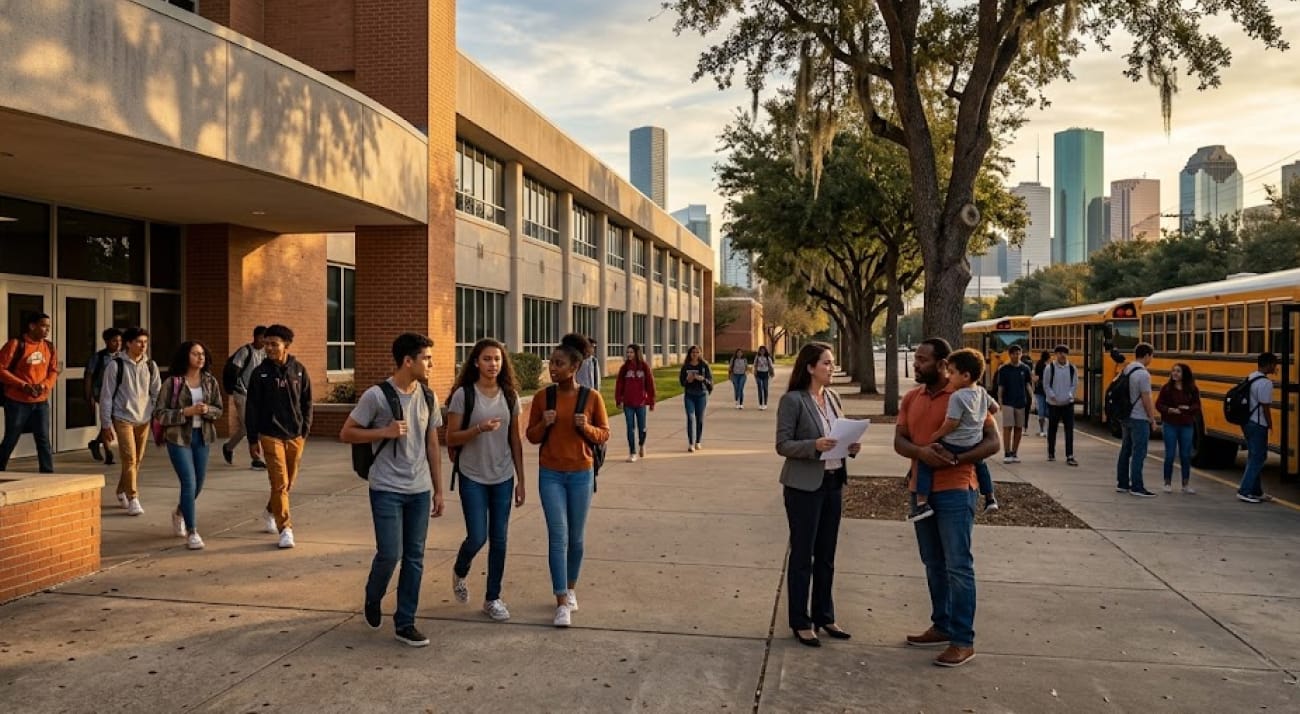
Houston Independent School District could see its state takeover come to an end after the 2026–27 school year, according to state-appointed Superintendent Mike Miles, who says the district has made substantial progress toward the conditions needed to restore local control. The possibility represents a major turning point for a district that has operated under state oversight since 2023 and serves roughly 200,000 students across Houston. For families following Houston student success, the potential transition raises important questions about academic performance, special education, governance and what happens when elected trustees eventually regain authority.
The Texas Education Agency, rather than Miles, will ultimately determine whether the intervention ends. Education Commissioner Mike Morath has previously indicated that a decision could come in June 2027, meaning the 2026–27 school year will effectively become a proving period for HISD’s reforms.
Why The 2026–27 School Year Matters
HISD entered state control in June 2023 after years of academic problems, most notably at Wheatley High School, whose repeated failing ratings helped trigger the intervention.
Since then, the district has undergone one of the most aggressive reform programs in Texas public education. Miles, appointed by the state, introduced the New Education System, changed campus leadership structures, reorganized instruction and expanded standardized approaches to curriculum and assessment.
The stated objective was straightforward: improve student outcomes and create a district capable of operating effectively without continued state intervention.
Three years later, the district has evidence that some of those changes have produced results.
According to Miles, the number of HISD campuses rated D or F has fallen from approximately 121 when the takeover began to 13 in 2026. The district has also more than doubled the number of campuses receiving A or B ratings during the same period.
Those numbers provide the strongest argument for ending the takeover.
But they are not the only measures that matter.
HISD Has Made Major Accountability Gains
Texas released its 2026 A-F accountability ratings on August 14, 2026, providing the latest statewide measurement of district and campus performance.
The TEA reported that 1,202 districts and 9,105 campuses received ratings this year. Twenty-four percent of both districts and campuses improved their rating compared with 2025, while 85% of rated campuses achieved a C or better.

HISD’s progress is particularly notable when viewed against where the district started.
At the beginning of the state takeover, dozens of campuses were rated D or F. The district’s current count of 13 D- or F-rated schools represents a substantial reduction.
| HISD Reform Indicator | Beginning of Takeover | 2026 Status |
|---|---|---|
| D/F-rated campuses | About 121 | 13 |
| State control | Began June 2023 | Ongoing |
| Local elected board | Replaced by state-appointed managers | Transition potentially after 2026–27 |
| State decision | — | Expected June 2027 |
The Texas Education Agency accountability system provides the official framework used to evaluate these results.
Yet the numbers also reveal why declaring the takeover a complete success would be premature.
Four HISD Campuses Still Received F Ratings
HISD’s progress has not been uniform.
The district reported four F-rated campuses in 2026, all elementary schools. That was an increase from zero F-rated campuses in the previous year’s results.
That development complicates the narrative surrounding the takeover.
On one hand, the overall number of D- and F-rated schools has fallen dramatically. On the other, the emergence of four F-rated campuses shows that academic performance remains uneven.
This distinction matters because the purpose of state intervention is not simply to improve the district’s average rating.
Students at individual campuses need meaningful academic improvement.
A district could dramatically reduce the number of failing schools while still leaving particular communities behind. For parents, the question is therefore more specific than whether HISD is “better” than it was in 2023.
The more useful question is whether their children’s individual schools are providing stronger instruction and better academic opportunities.
Wheatley High School Has Become A Symbol Of The Turnaround
Few campuses illustrate HISD’s transformation more clearly than Wheatley High School.
Wheatley’s chronic academic problems were central to the state intervention that began in 2023. In 2026, the school earned an A rating, marking an extraordinary change from the performance history that helped trigger state control.
The turnaround gives Miles and state officials a powerful example when defending the reform strategy.
A school that once represented the district’s deepest accountability problems is now among its highest-rated campuses.
That does not prove that every reform implemented under the takeover has worked.
But it demonstrates that significant changes in school performance are possible over a relatively short period.
For students, the importance of that improvement goes beyond the letter grade. Better academic performance can affect graduation preparation, postsecondary opportunities and the confidence families have in their neighborhood schools.
The challenge for HISD is making sure Wheatley’s progress is not an isolated example.
Student Achievement Is More Complicated Than Letter Grades
Accountability ratings provide a useful shorthand, but they cannot capture every dimension of student experience.
The A-F system combines multiple measures, including student achievement, academic growth, relative performance and closing-the-gaps indicators. TEA’s 2026 materials also identify campuses requiring additional state or federal improvement support.
That means a higher campus rating can reflect several different types of improvement.
A school may improve because students achieved higher assessment results. Another may receive a stronger rating because students made significant academic growth even if overall achievement remains below the statewide average.
For HISD, the next stage of evaluation will therefore need to look beyond the headline number of A and B schools.
The district will need to show that improvements are durable.
That is particularly important because the state takeover has been accompanied by substantial changes in staffing, curriculum, campus leadership and instructional expectations.
Special Education Remains A Major Challenge
One of the biggest obstacles to a smooth transition is special education compliance.
HISD has faced scrutiny over its handling of special education services, and TEA recently ordered the district to pause aspects of its overhaul while it reviews thousands of students’ individualized education programs.
Miles defended the changes during the district’s August 2026 teacher convocation, arguing that the reforms were intended to improve services for students with disabilities. Parents, federal officials and state administrators have continued to scrutinize the district’s implementation.
This issue could be especially important in determining whether the district is ready for local control.
Academic ratings measure student performance, but special education compliance measures whether a school system is meeting legal obligations to students with disabilities.
Those are different responsibilities.
A district can improve its test scores while still having serious compliance problems.
The Texas special education resources provide important context for understanding the obligations districts have toward students receiving special education services.
For families, this is one of the most consequential parts of the transition debate because individualized education programs directly affect services, accommodations and educational access.
The Online College-Prep Debate Complicates The Success Story
HISD’s academic gains have also faced criticism over the district’s use of supplemental college-preparatory courses.
A recent Houston Chronicle investigation questioned whether certain online college-preparatory courses used by HISD contributed to artificially higher accountability ratings. According to the newspaper’s analysis, removing those courses from the calculation would have lowered ratings at several high schools under the reform model.
The controversy does not erase the district’s other reported improvements.
STAAR performance, Advanced Placement participation and the growth in A- and B-rated campuses provide additional evidence that students are experiencing measurable academic changes.
But the debate raises an important question: Are accountability gains translating into genuine academic preparation?
That question will remain relevant even if the state takeover ends.
Students ultimately need skills that extend beyond the accountability system—reading, mathematics, critical thinking, writing and preparation for college, career or technical education.
Local Governance Is The Other Half Of The Equation
Academic performance is only one part of the potential transition.
HISD has been governed by a state-appointed board of managers since the takeover began. Returning to local control would eventually restore authority to elected trustees.
The transition would not necessarily happen overnight.
According to the Houston Chronicle, once Morath formally ends the takeover, a three-year transition period would return control to elected trustees.
That means the end of state intervention would begin another period of institutional change.
The district would have to balance the reforms introduced during state control with the priorities of an elected board accountable directly to Houston voters.
For trustees, that could mean deciding which elements of Miles’ reform program should remain, which should be modified and which should be discontinued.
For teachers, it could mean another adjustment after several years of significant operational changes.
For families, it creates an opportunity to have a stronger voice in district decision-making.
Trust Could Become As Important As Test Scores
The governance transition also raises a less measurable but equally important issue: public trust.
Some trustees have praised the academic improvements under Miles, while others have called for greater transparency and stronger community engagement.
Trustee Bridget Wade, for example, has described the potential transition as an opportunity to balance the reforms with stronger community involvement. Trustee Placido Gomez has emphasized the need to rebuild trust between district leadership and the public.
That tension is likely to remain after state control ends.
A district as large as HISD cannot operate effectively without cooperation among administrators, teachers, families, students and elected officials.
Academic reforms require teachers to implement them.
Special education changes require families to understand and trust them.
School closures and consolidations require communities to believe the decision-making process is fair.
Even strong test results can become politically fragile if families believe the system is not transparent.
HISD Faces A Financial And Enrollment Challenge Too
The potential end of the takeover comes while HISD faces another major issue: declining enrollment and underused facilities.
Recent reporting indicates that more than 100 HISD schools are operating below 60% capacity, with more than 60 operating below 50%. The district also faces a projected annual loss of $50 million to $60 million in state funding if enrollment trends continue.
That financial pressure could influence the next phase of district leadership.
HISD already closed or consolidated multiple campuses during the 2025–26 school year because of declining enrollment and aging facilities.
The issue demonstrates why the transition cannot focus solely on accountability ratings.
A financially unstable district cannot easily sustain academic reforms.
HISD’s next leaders will have to manage school performance, enrollment, facilities, staffing and finances simultaneously.
What Happens If The Takeover Ends?
If Morath determines that HISD has met the necessary conditions, the district would begin its transition back toward elected governance.
That would not mean the challenges disappear.
Instead, Houston would enter a new phase in which local leaders would be responsible for maintaining the academic gains achieved during state control.
Several priorities are likely to shape that period:
- Protecting academic gains at campuses that moved from D or F ratings into higher performance categories.
- Addressing remaining F-rated campuses, rather than allowing districtwide improvements to conceal persistent campus-level problems.
- Strengthening special education compliance and restoring confidence among families of students with disabilities.
- Managing enrollment and finances as the district adjusts to fewer students and underused facilities.
- Rebuilding community participation in decisions about schools, staffing and long-term district strategy.
The challenge will be maintaining continuity while restoring democratic governance.
The 2026–27 School Year Becomes A Test Of Sustainability
The potential end of the HISD takeover does not mean Houston schools have reached a finished product.
It means the state may soon decide that the district has made enough progress to resume greater local control.
The evidence is mixed but significant.
The number of D- and F-rated campuses has fallen from roughly 121 to 13 since 2023. Wheatley High School has moved from a symbol of chronic underperformance to an A-rated campus. HISD has more than doubled its number of A- and B-rated schools.
At the same time, four campuses received F ratings in 2026, special education compliance remains under scrutiny, and questions persist about some accountability practices.
Those competing realities will make the 2026–27 school year particularly important.
If academic improvements continue, HISD will have stronger evidence that its reforms can survive beyond state control.
If performance stalls or compliance problems deepen, state officials may have reasons to extend the intervention.
Houston Families Will Ultimately Judge The Results
The final measure of HISD’s transformation will not be the end date of the state takeover.
It will be what students experience afterward.
Families need schools where teachers have the resources to teach effectively, students receive appropriate academic support, special education services function properly and campus leaders are accountable to their communities.
The state’s intervention changed HISD dramatically.
The next phase will determine whether those changes created a sustainable system or simply produced short-term improvements under unusually strong state oversight.
For Mike Miles, the 2026–27 school year could become the final year of the takeover he has led since 2023. For Mike Morath, it will provide the evidence needed to decide whether Houston is ready to return to local control. For elected trustees, teachers and families, it could mark the beginning of a very different responsibility: preserving what worked while correcting what did not.
The possibility of ending the takeover is therefore less about declaring victory than testing whether HISD can govern itself successfully again.
That test will take place inside Houston classrooms, in student achievement data, through special education services and ultimately in the confidence families place in their neighborhood schools.