

Northside Independent School District has begun the 2026–27 school year with a new approach to secondary education: the Northside ISD Virtual Academy, a flexible online program initially serving students in grades 9 through 11. The academy launched in August after months of planning, coordination with the Texas Education Agency and the selection of Graduation Alliance as its virtual-learning provider. Early reporting put the inaugural cohort at roughly 190 students, while district officials later said enrollment was capped at 215 students as they established the program’s first-year systems.
For students and families following Texas student opportunities, the launch is significant because Northside ISD is treating virtual education as a structured academic pathway rather than simply a continuation of emergency remote learning. The program combines online instruction with access to selected extracurricular activities, academic support and courses aligned with Texas standards.
Why Northside ISD Created The Virtual Academy
The Virtual Academy is the result of a planning process that began well before the 2026–27 school year.
Northside ISD, one of the largest school districts in Texas and the largest in the San Antonio area, announced in early 2026 that it intended to launch a virtual program in August. District leaders described the initiative as another educational choice for families and emphasized flexibility while maintaining academic expectations.
The district’s official Virtual Academy materials identify several groups that could benefit from the model. Students may be particularly suited to virtual education if they are motivated to manage independent work, need a more flexible schedule or prefer completing much of their coursework outside a traditional classroom.
That distinction matters.
The academy is not designed as a universal replacement for Northside ISD’s traditional high schools. Instead, it creates another pathway within the district’s larger portfolio of educational options.
For some students, flexibility may mean managing school around athletics, travel, family responsibilities or other commitments. For others, the online format could provide an alternative to a traditional classroom environment that has not been an effective fit.
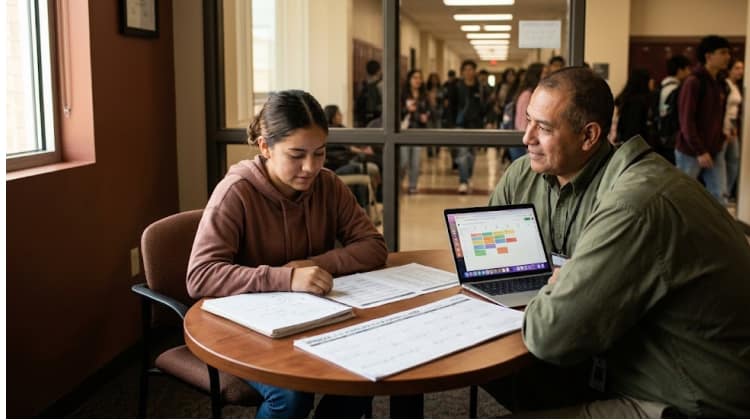
The district’s approach therefore reflects a broader question facing public education: how much flexibility can schools provide without weakening academic accountability?
A 190-Student Launch Gives The District Room To Test The Model
Northside ISD has taken a deliberately limited approach during the academy’s first year.
The initial cohort was reported at approximately 190 students across grades 9, 10 and 11, with students coming from the district’s comprehensive high schools. Later reporting from KSAT indicated that registration ultimately reached 215 students, which was the district’s enrollment cap for the inaugural year.
The difference between the early 190-student figure and the later 215-student enrollment reflects the program’s development rather than a contradiction in its basic purpose. The district initially planned for a smaller cohort and later reported that the program had reached its first-year capacity.
| Virtual Academy Detail | 2026–27 Information |
|---|---|
| District | Northside ISD |
| Location | San Antonio, Texas |
| Initial grades | 9–11 |
| Initial reported cohort | About 190 students |
| Later enrollment cap | 215 students |
| Launch | August 2026 |
| Virtual provider | Graduation Alliance |
| Format | Synchronous and asynchronous learning |
The limited enrollment is strategically important. Rather than immediately opening the program to thousands of students, Northside ISD can use the first year to evaluate attendance, academic progress, technology needs, student support and staffing.
Carrie Squyres, Northside ISD’s director of academic technology, told KSAT that the district took a conservative approach to its first year and intentionally limited participation to grades 9 through 11.
That creates an opportunity for the district to identify problems before scaling.
Graduation Alliance Becomes The Program’s First-Year Provider
Northside ISD selected Graduation Alliance to provide virtual instruction during the 2026–27 school year.
The district’s official Virtual Academy information says the provider supplies a TEKS-aligned program and course catalog, Texas-certified teachers of record, academic coaches and 24/7 tutoring. The platform also includes automated tracking designed to help satisfy the state’s daily instructional requirements.
This arrangement allows Northside ISD to establish the academy without building an entirely new virtual-school infrastructure from scratch.
But outsourcing part of the delivery does not transfer responsibility for student outcomes.
District officials told KSAT that Northside ISD remains responsible for the success of virtual students and is establishing systems to monitor student data, identify students needing intervention and coordinate with Graduation Alliance staff.
That accountability structure will be one of the most important elements to watch during the first year.
A virtual academy can provide excellent technology and curriculum, but those tools do not automatically produce better outcomes. Students still need adults who monitor engagement, intervene when progress slows and help them navigate academic difficulties.
The Texas Education Agency’s virtual learning resources provide the broader state context for districts operating online education models.
Students Still Follow Texas Academic Standards
One of the strongest features of the Northside model is that online delivery does not mean reduced academic expectations.
The district states that Virtual Academy courses are aligned with the Texas Essential Knowledge and Skills, commonly known as TEKS. Students can access standard academic courses alongside advanced offerings and electives.
The 2026–27 course catalog includes English, mathematics, science and other subjects, with advanced and AP options available.
For example, the catalog includes AP Calculus AB and AP Calculus BC, as well as AP English and advanced mathematics courses. Science offerings include Biology, Chemistry and Physics.
That course range is important because virtual education can become less attractive to high-performing students if it offers only basic coursework.
Northside ISD is attempting to avoid that problem by giving students access to multiple levels of academic rigor.
The program also includes career and technical education courses and electives, expanding the model beyond a narrow collection of online core classes.
Flexibility Comes With Greater Student Responsibility
The biggest advantage of virtual education is also one of its biggest challenges.
Students gain flexibility, but they must manage more of their own time.
Northside ISD’s program uses a combination of synchronous and asynchronous instruction, meaning students can participate in live learning while also completing self-paced coursework.
According to district information reported by the San Antonio Express-News, students can log in during the day and complete approximately 240 minutes of instruction. Some courses and activities require students to attend in person.
That creates a fundamentally different daily routine from attending a traditional high school from 8 a.m. to 3 p.m.
A successful virtual student must organize assignments, monitor deadlines, communicate with instructors and recognize when help is needed.
Northside ISD acknowledges that reality through its student self-assessment tool, which encourages families to consider whether a student is prepared for independent work and whether virtual learning matches the student’s needs.

The model therefore places more emphasis on self-management than many traditional classrooms do.
Extracurricular Activities Remain Part Of The Model
Virtual education does not necessarily mean students lose their connection to school activities.
Northside ISD says Virtual Academy students can participate in UIL-sanctioned athletics and fine arts at their home campuses, subject to district and UIL requirements. Students must attend required in-person class periods and practices, and families are responsible for transportation.
The Express-News reported that approximately 15% of virtual students participate in extracurricular activities, including athletics and fine arts.
That element is important from a youth-development perspective.
High school is not only about academic credits. Sports, music, theater and other extracurricular activities can provide students with friendships, leadership opportunities and a connection to their campus.
Northside ISD’s approach allows students to separate the location of academic instruction from participation in those broader school experiences.
A student can therefore complete much of the academic day virtually while remaining connected to the campus community.
Technology Access Could Determine Who Benefits
Any online education model depends on reliable technology.
Northside ISD operates the Virtual Academy using a bring-your-own-device model. The district says students need a laptop rather than a phone or tablet, with at least 8 GB of RAM, an integrated camera and microphone. Headphones and a mouse are also recommended.
That creates an important equity consideration.
A virtual program may provide greater flexibility for students, but flexibility is meaningful only when students have dependable access to the equipment and connectivity required to participate.
Northside ISD says families who need a computer or internet connectivity will receive information from Graduation Alliance about available procedures for obtaining those resources.
The district has therefore recognized that technology access cannot simply be assumed.
The issue will become even more important if Northside eventually expands enrollment beyond its current students.
The Federal Communications Commission’s broadband resources provide useful national context for understanding how differences in broadband availability can affect participation in online education.
An In-Person Support Hub Adds Another Layer
Northside ISD is also developing an in-person support option for students who need additional academic assistance.
The district says an in-person hub at the Northside Learning Center is being established to provide direct academic support to virtual students.
This is an important design choice.
A purely online model can create problems for students who understand material better when they can work directly with an educator. Providing a physical location gives virtual students another option without requiring them to return to a traditional full-time classroom.
It also reinforces the idea that the Virtual Academy is not simply an online portal.
The district is building an ecosystem around the student: virtual coursework, teachers, academic coaches, tutoring, extracurricular opportunities and physical support when necessary.
Why The First Year Matters For Northside ISD
Northside ISD’s decision to begin with a relatively small cohort gives the district an opportunity to study the program before deciding how quickly it should grow.
The district has already indicated that it is using a phased implementation approach. Its official materials say the initial year focuses on grades 9 through 11, while the district evaluates the evolving state requirements and its own support systems before potentially expanding the program.
That cautious approach is particularly relevant because Texas is also changing its broader virtual-learning environment.
The academy was developed in the context of Senate Bill 569, which aims to expand virtual learning opportunities across the state. Northside ISD’s first-year model gives district leaders a chance to understand how those policies work in practice at a local level.
The district’s future decisions will likely depend on measurable outcomes.
Among the most important indicators will be:
- Student attendance and engagement
- Course completion and grades
- Credit accumulation
- Graduation progress
- Student retention
- Participation in extracurricular activities
- Demand for additional grade levels
Those measurements will tell Northside ISD whether flexibility is translating into stronger student outcomes or simply creating another delivery method.
The Program Could Expand The Definition Of A School Day
The launch of Northside ISD Virtual Academy reflects a broader change in what public education can look like.
A traditional school day assumes that students learn most effectively inside a physical campus according to a relatively fixed schedule. The virtual model challenges that assumption without abandoning the academic standards associated with a public school district.
The question is no longer whether online education can exist.
It is whether districts can build virtual programs that are rigorous enough, supportive enough and connected enough to serve students effectively.
Northside ISD has chosen a measured way to test that question.
Its first cohort is relatively small. The program initially serves only grades 9 through 11. Students remain connected to their home campuses for certain activities. The district retains responsibility for monitoring student performance, even while Graduation Alliance provides much of the virtual instructional infrastructure.
That structure gives the district several ways to adjust before expanding.
For San Antonio students who need more flexibility, the new academy creates an option that did not previously exist within Northside ISD at this scale. For the district, the 2026–27 school year becomes a test of whether a carefully managed virtual environment can deliver the same academic expectations while giving students greater control over when and where they learn.
The early enrollment figure of roughly 190 students, followed by a reported cap of 215, suggests there was enough initial demand to fill a deliberately limited first-year program.
What happens next will depend less on the novelty of online schooling and more on measurable student progress.
If Northside ISD can demonstrate that students remain engaged, earn credits, complete rigorous courses and stay connected to their school communities, the Virtual Academy could become more than a one-year experiment. It could become another established pathway through which San Antonio students earn a Northside ISD education.