

Let’s be honest. The map to opportunity is often drawn in invisible ink.
You know the resources are there—the grants, the programs designed to level the field. But finding your way? That’s the first, and most demoralizing, socioeconomic access barrier. It’s like a treasure chest with a lock nobody gave you the key for.
Data proves the point. Sites like Grants.gov list thousands of opportunities. The CDFI Fund and STTR programs pour billions into communities. The resources exist in staggering volume.
The real challenge is the labyrinth between need and the help on offer. It’s a logistics puzzle, not a tragedy.
Think of this as the opening scene of a heist movie. First, we identify all the locks. We’re charting the terrain of exclusion—a system where, as research on healthcare barriers illustrates, financial and geographic hurdles create a maze. Our mission isn’t to bemoan the map. It’s to make it legible.
Sliding Scale and Scholarship Models
Let’s break down the myth of a single price for everyone. It’s not fair that a veteran in Minnesota and a woman in San Francisco pay the same. The future should be more flexible, not fixed.
The sliding scale is a smart way to help people. It’s not about giving away free stuff. It’s about matching the right price to the right person.
The Strategic Calculus of Tiered Investment
Programs in Minnesota and San Francisco are not just giving out free stuff. They’re making smart investments. They look for businesses that need help the most.
The American Association of University Women’s Career Development Grants are a great example. They don’t just look at your bank account. They see your value and what’s holding you back.
This approach is fair. It doesn’t charge everyone the same. It invests in people’s futures.
The Pure-Play Scholarship Engine
The scholarship model is direct and simple. It asks, “What if the only thing stopping you is money?”
Look at Brightspeed’s partnership with TeamSnap. They’ve given out over 330 scholarships. It’s not just good PR. It’s real help for people.
This mix of data and kindness is powerful. It shows how money can open doors. It’s personal and real.
These models are better because they respect people. They don’t just give out money. They see your situation and help you.
Sliding scales and scholarships are about precision. They open doors for more people. They make sure everyone has a chance.
Gear Libraries and Sizing Systems
The cost barrier gets a lot of attention, but the real issue is access to the tools needed. Solving the cost is just the first step. Then, there’s the $300 pair of cleats or the special tool kit that keeps kids from participating.
We move from financial aid to making sure everyone has what they need. This is about making sure everyone can join in, no matter their background. It’s about making sure everyone has a chance to participate.
The Logistics of Shared Stuff
A gear library is not just giving things away. It’s a smart way to share resources. It’s like a service that lets everyone use what they need, without having to own it all.
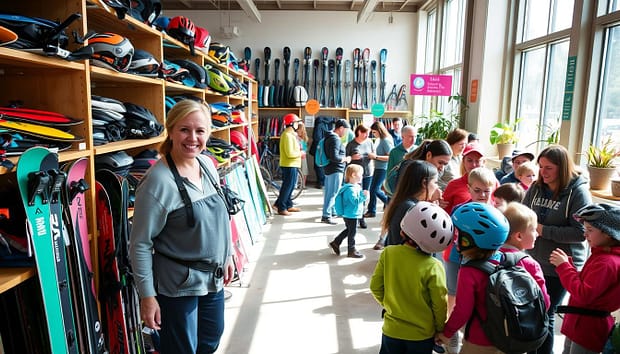
Companies are starting to see the value in this idea. They offer “equipment support” as part of their services. The real magic happens when you match the right gear with the right person.
Without a good system, donations can be a mess. It’s like a digital garage sale. But with the right system, you can make sure everyone gets what they need.
A good system has a few key parts. The table below shows how it can make a difference.
| Aspect | Chaotic Donation Pile (Traditional) | Optimized Gear Library (Modern) |
|---|---|---|
| Inventory Management | Unknown items, mixed conditions, no sizing data. | Cataloged items, condition graded, precise sizes recorded. |
| Access Model | First-come, first-served. Often benefits those who can physically browse. | Reservation-based system. Matches need via digital request forms. |
| Impact on Socioeconomic Access | Limited. Relies on luck and proximity. | Maximized. Creates predictable, equitable pathways to gear. |
| Donor Experience | One-time drop-off. Unclear impact. | Ongoing partnership. Clear reporting on how their gear donation was used. |
The sizing system is key. It answers important questions before they become problems. Does the gear fit? Is it the right version? This way, everyone knows what they’re getting.
In the end, a gear library does more than share stuff. It builds a place where everyone can join in. It makes sure that everyone has a chance to participate, no matter their background.
Transportation Partnerships and Route Planning
The biggest obstacle to socioeconomic access isn’t a policy or cost—it’s the lack of roads. Even with a scholarship and the latest gear, you can’t reach the field or library without a way to get there. This is the main barrier to opportunity.
There’s a $1.2 trillion plan in Washington, D.C. It’s called the Infrastructure Investment and Jobs Act (IIJA). This isn’t about waiting for a bus from a company. It’s about matching your community’s needs with the nation’s funds.
The IIJA Grant Menu: Your Blueprint for Mobility
The IIJA is not just one fund. It’s a set of programs to remove physical barriers. Each program targets a specific problem in the transportation system. Let’s look at the main programs.
| Grant Program | Total Funding | Primary Focus | The Access Problem It Solves |
|---|---|---|---|
| RAISE Grants | $15 Billion | Local & Regional Projects | Connects neighborhoods to essential services (schools, jobs, clinics) with new sidewalks, bike lanes, and transit hubs. |
| INFRA Grants | $10.9 Billion | Freight & National Mobility | Fixes critical routes for jobs and commerce, ensuring reliable paths for the workforce and supply chains. |
| Safe Streets & Roads for All | $5 Billion | Safety Action Plans | Makes the journey to opportunity safe. Funds pedestrian crossings, traffic calming, and vision-zero plans. |
| Rural Surface Transportation Grants | $1 Billion | Rural Connectivity | Ensures your zip code doesn’t limit your future. Targets isolation in low-density areas. |
| Low-No Emission Bus Grants | ~$5.62 Billion | Public Transit Modernization | Electrifies and expands bus fleets, reducing costs and pollution for daily commuters. |
See the plan? It’s a big strategy. RAISE solves the local “last mile” problem. INFRA works on regional economic routes. Safe Streets makes travel safer. This is a big effort to fight immobility.
Working together is different here. You’re not asking for a ride. You’re showing a local access gap that matches a national priority. That plan for a new bus line to the community college? That’s a Low-No grant application. The dangerous intersection kids cross to reach the rec center? That’s a Safe Streets plan.
This is where big economics meets small mobility. The IIJA makes the journey itself a valuable investment. Your job is to connect the need to the funding. It’s not just plotting a route on a map. It’s making it part of the nation’s budget.
Fundraising and Sponsor Decks
You’ve found the economic challenges and opened the doors to solutions. Now, it’s time to turn your ideas into real money. Fundraising is not just asking for help. It’s about showing how your project is a smart investment.

Take TeamSnap as an example. They didn’t just ask for donations. They created a way for brands to help youth sports. This approach has raised over $19 million for sports.
The Business Case for Breaking Barriers
Your sponsor deck should be a pitch, not a plea. Show how your project benefits the partner. It could be building goodwill, like the Amex Shop Small Grants Program.
You’re not asking for charity. You’re making a deal. You offer a brand a chance to make a difference. In return, you get the money to help your community.
The best proposals see socioeconomic access as a business problem. They show clear goals and how they match the brand’s mission. It’s like investing in social change.
This approach leads to many funding chances. It turns your program into a valuable asset. The question changes from “Why should we give you money?” to “How can we work together?”
Your deck must have three key slides: the problem, your solution, and the partnership chance. Anything else is just extra.
Remember, companies have budgets for marketing, community, and innovation. Show them why your project is the best choice. You’re not just building a team. You’re creating a success story.
Communicating Aid without Stigma
Financial aid often carries a heavy burden. Asking for help can feel like admitting a personal weakness. The paperwork seems to say “prove you’re poor,” while the aid whispers “you’re not enough.”
This isn’t just about red tape—it’s a psychological challenge. How do you tell someone about a program without defining them by their situation? The answer is a change in how we talk.
The Vocabulary of Value vs. The Lexicon of Lack
Look at the contrast. Government forms use words like “eligibility requirements” and “disadvantaged entities.” They’re necessary for checks and balances, but they don’t inspire people to join.
But some organizations get it right. They talk about “removing barriers” and “unlocking your future.” They focus on inclusion, not what’s lacking. This makes a huge difference.
Let’s compare two ways to tackle the same Socioeconomic Access challenge:
- The Deficit Model: “Need-based waiver for low-income participants”
- The Asset Model: “Participation fellowship for emerging leaders”
The first approach defines you by what you lack. The second sees your future achievements. One feels like a diagnosis, the other like an investment.
Framing Scholarships as Selective Investments
Here’s the magic. When you view scholarships as selective opportunities, not handouts, you change everything. It’s not charity—it’s investing in people’s futures.
Consider this:
- Bad framing: “We help poor kids play sports”
- Good framing: “We find talented young athletes and remove financial barriers to their growth”
The first statement evokes pity. The second fills you with pride. One reduces you to your economic status. The other sees your future.
This isn’t just about words. Research shows framing affects how people respond. When aid feels like an earned chance, not a handout, more people participate.
The Practical Shift: From Forms to Invitations
So, how do you make this change? Begin with your application materials. Every form, webpage, and email shapes the narrative.
Change “Financial Aid Application” to “Partnership Opportunity Form.” Swap “Income Verification Section” for “Background Context for Customized Support.” It’s about dignity, not deception.
Even the way you ask for information changes the experience. Asking for “proof of financial need” feels intrusive. Asking for “information to help customize your experience” feels collaborative.
This approach aligns with research from public health. Framing aid as community investment boosts participation across all socioeconomic groups.
Building a Stigma-Free Communication Ecosystem
To truly include everyone, you need to rebuild your communication system. Every interaction should say: “We see your future, not your current situation.”
Think about your communication strategy:
| Traditional Language | Transformative Language | Psychological Impact |
|---|---|---|
| “Financial aid available” | “Investment opportunities” | Shifts from receiving to partnering |
| “Based on need” | “Based on your future” | Shifts from deficiency to capacity |
| “Apply for assistance” | “Apply for partnership” | Shifts from supplication to collaboration |
The right words don’t just sound better—they work better. When scholarships are seen as competitive, not charitable, recipients bring a different energy. They see themselves as partners, not just recipients.
This is the delicate balance of modern access initiatives. Offer real support without the stigma. Master this, and you don’t just provide Socioeconomic Access. You create real change.
Tracking and Reporting Impact
Sentiment is important, but data shows real change. You can’t just give out gear and expect results. Did that calculator help with AP Physics? Did those cleats last three seasons?
This is where the circle closes.
From Anecdote to Evidence
Grantors’ reporting rules aren’t just red tape. They’re the blueprint for your success story. TeamSnap, for example, supported over 26,000 young athletes and reached over 38,500 kids and families. That’s not just a feel-good stat. It’s a strong, scalable story for socioeconomic access.
This approach is similar to global development frameworks. A recent analysis shows tracking co-benefits proves an initiative’s worth. Your gear donation program needs this proof too. Tracking turns a single event into a trend of increased participation.
Reporting isn’t just a task. It shows your model works, gets more funding, and keeps trust. It’s the key to moving from good intentions to a lasting, proven system. Every tracked outcome makes a gear donation a part of lasting equity.